

Businesses are increasingly motivated to track and reduce their carbon emissions to achieve net-zero emissions targets, avoid unintentional greenwashing, and gain a competitive advantage through effective carbon management. One important source of emissions that businesses need to address is Scope 3 emissions: emissions generated across their value chains, beyond their direct operations.
In this article, CGS Vietnam explores the concept of Scope 3 emissions, why they matter, and how businesses can manage them effectively.
What are Scope 3 emissions?
Scope 3 emissions include all indirect emissions that occur throughout a company’s value chain and are not covered by Scope 2 (indirect emissions from the generation of purchased energy).
These emissions, also known as value chain emissions, result from a company’s business activities but originate from sources that the company does not own or control.
Scope 3 emissions include:
- Emissions generated throughout a company’s supply chain, such as the extraction, production, and transportation of purchased materials and fuels.
- Emissions resulting from the use of sold products and services.
- Emissions associated with waste treatment and disposal, including waste generated from business operations and the production of purchased materials and fuels, as well as the end-of-life treatment of sold products.
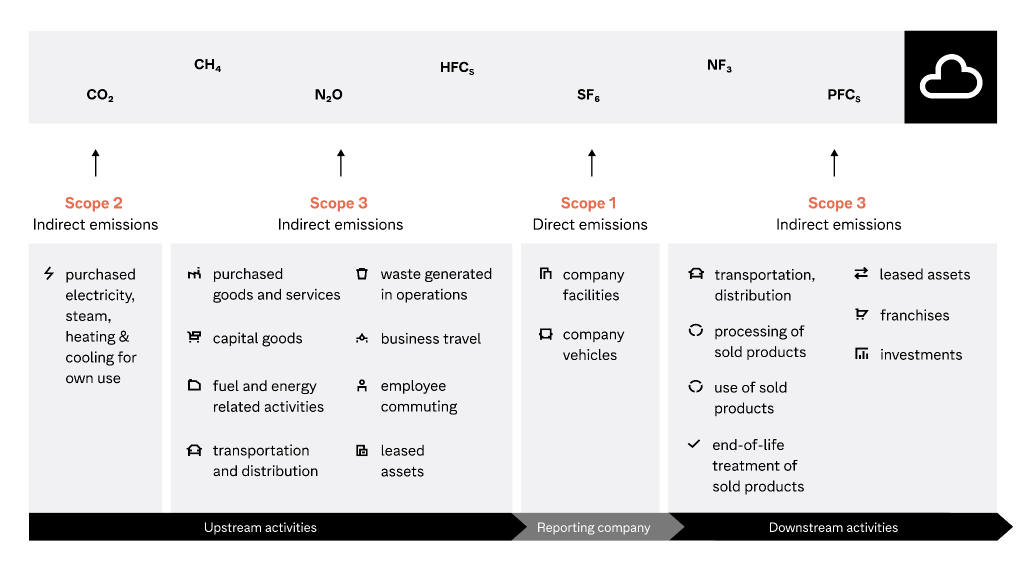
According to the Greenhouse Gas Protocol (GHG Protocol), the most widely used framework for corporate carbon accounting, Scope 3 emissions are divided into upstream and downstream emissions.
Upstream emissions arise from activities associated with the production of a company’s products or services, while downstream emissions result from the use and disposal of those products or services.
The illustration below presents a company’s upstream and downstream activities, along with the 15 categories of Scope 3 emissions defined by the GHG Protocol:
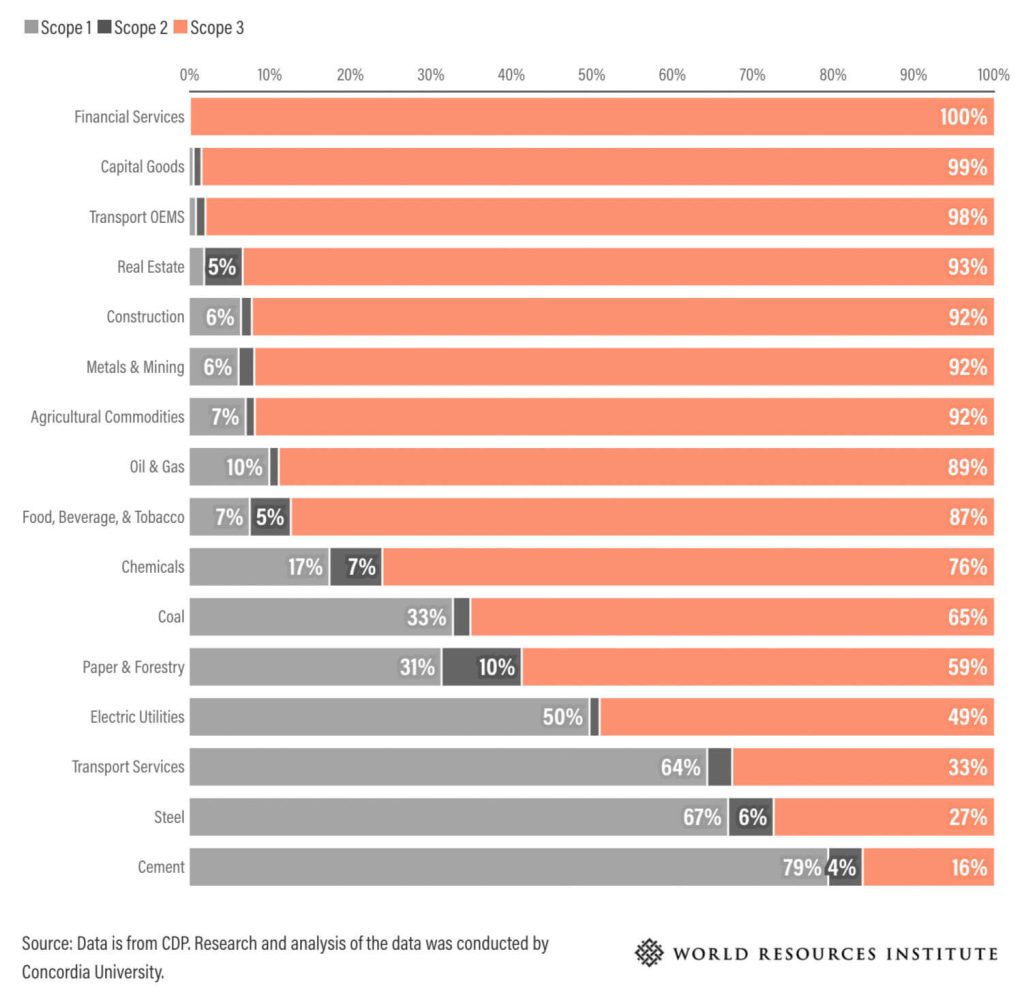
Although Scope 3 emissions typically represent the largest source of emissions for most companies, their relative contribution varies significantly across industries. In the financial services sector, Scope 3 emissions account for as much as 99.98% of total emissions, compared with just 16% in the cement industry.
The chart below, published by the World Resources Institute using data provided by CDP, analyzes average emissions across 16 industries:
Why are Scope 3 Emissions important for businesses?
Across industries, Scope 3 emissions account for approximately 88% of total greenhouse gas (GHG) emissions. This means that, in most cases, Scope 3 represents a significant proportion of a company’s carbon footprint and should therefore be included in emissions reporting. Depending on where a company operates, it may already be, or soon become, legally required to report its Scope 3 emissions.
However, businesses that effectively manage their Scope 3 emissions can realize benefits that extend well beyond regulatory compliance. A comprehensive Scope 3 strategy can help companies reduce their environmental impact, strengthen brand value, improve procurement efficiency, adopt circular economy principles, and meet the expectations of consumers, investors, and employees.
How can businesses reduce Scope 3 emissions?
Reducing Scope 3 emissions presents a significant challenge because these emissions occur beyond a company’s direct control. The first step toward reducing Scope 3 emissions is to measure them comprehensively and accurately. After all, businesses cannot manage what they do not measure.
Companies calculate their emissions through a process known as carbon accounting. Because Scope 3 emissions occur outside a company’s owned or controlled operations, collecting the data needed to calculate emissions across the value chain can be challenging. However, automated solutions can help streamline and accelerate this process.
Once a company has calculated emissions across its entire value chain, it can begin implementing measures to reduce them. For many businesses, the most effective approach to reducing Scope 3 emissions is to collaborate with suppliers to achieve emissions reductions.
While various strategies can support this effort, businesses can follow a general roadmap to initiate and strengthen supplier engagement.
A five-step plan for engaging suppliers in carbon management
- Identify suppliers with the greatest emissions impact.
- Set emissions reduction targets with these suppliers.
- Collaborate with suppliers to develop action plans for achieving these targets.
- Monitor progress and provide feedback to suppliers.
- Recognize and reward suppliers for their emissions reduction efforts.
This five-step plan is adapted from Normative’s comprehensive guide to value chain engagement. Learn more about the guide here.
Source: Normative. Read the original article here.
About CGS Vietnam
CGS Vietnam Consulting Joint Stock Company provides specialized advisory services in Corporate Governance, Sustainability (ESG), Risk Management, and Internal Audit. Backed by a team of experienced professionals with deep expertise in international best practices, CGS Vietnam partners with businesses to strengthen corporate governance, enhance management capabilities, meet investor expectations, and achieve long-term sustainable growth.
Contact CGS Vietnam:
Hotline: (+84) 363 581 520 | Email: [email protected] | Website: https://cgsvietnam.com/
LinkedIn: https://www.linkedin.com/company/cgs-vietnam | Facebook: https://www.facebook.com/CGSVietnamCompany/