

Greenhouse gas (GHG) emissions from business operations arise not only from fuel combustion at factories but also from electricity consumption, purchased raw materials, transportation activities, and product use.
To effectively manage and reduce emissions, businesses first need to understand where GHG emissions originate, how much is emitted, and which sources contribute the most. This is where carbon footprint measurement plays an important role.
What is a carbon footprint, how is it measured, and how can businesses use the results? Join CGS Vietnam as we explore these questions in this article.
What is a carbon footprint?
A carbon footprint is a measure of the greenhouse gases associated with an organization, product, or service within a defined boundary, expressed in carbon dioxide equivalent (CO₂e). Depending on the subject and applicable standards, the measurement may account for both GHG emissions and removals in accordance with relevant accounting rules.
Contrary to the common perception that a carbon footprint only concerns CO₂, it can include various greenhouse gases, such as:
- Carbon dioxide (CO₂): Primarily generated by fuel combustion and certain industrial processes.
- Methane (CH₄): Emitted from activities such as livestock farming, waste management, and fossil fuel extraction.
- Nitrous oxide (N₂O): Can be released from agricultural activities, fertilizer application, and certain industrial processes.
- Fluorinated greenhouse gases: Used or emitted by certain refrigeration equipment and industrial activities.
What is carbon dioxide equivalent (CO₂e)?
Different greenhouse gases have different global warming effects. To measure their combined impact, emissions are converted into carbon dioxide equivalent (CO₂e) using the Global Warming Potential (GWP) metric. GWP indicates how much warming a greenhouse gas causes relative to CO₂ over a specified period.
The basic conversion formula is:
CO₂e emissions = GHG emissions × Corresponding GWP factor
For example, methane (CH₄) emissions are multiplied by the appropriate GWP factor to convert them into CO₂e. This conversion enables businesses to aggregate emissions from different sources and monitor changes across reporting periods.
Why should businesses measure their carbon footprint?
Measuring their carbon footprint helps businesses identify major emission sources, prioritize reduction measures, and use resources more efficiently. The resulting data also supports businesses in meeting the expectations of customers, business partners, and investors, as well as sustainability reporting requirements.
In addition, carbon footprint measurement helps businesses develop the data management capabilities needed to comply with mandatory GHG inventory requirements where applicable.
Organizational carbon footprint vs. product carbon footprint
A carbon footprint can be measured at either the organizational or product level. While an organizational carbon footprint covers emissions associated with a company’s operations and value chain, a product carbon footprint focuses on emissions across the stages of a product’s life cycle.
Organizational carbon footprint
An organizational carbon footprint reflects the GHG emissions associated with an organization’s activities within defined organizational boundaries and a specified reporting period.
It may include direct emissions from sources owned or controlled by the company, indirect emissions from purchased energy, and other emissions throughout its value chain.
For example, a food manufacturing company’s carbon footprint may include emissions from fuel used in boilers, electricity consumed at production facilities, the production of purchased raw materials, and product transportation and distribution.
Organizational GHG accounting commonly refers to the GHG Protocol Corporate Accounting and Reporting Standard, ISO 14064-1:2018, and the GHG Protocol Corporate Value Chain (Scope 3) Standard for emissions across the value chain.
Product carbon footprint (PCF)
A product carbon footprint measures the GHG emissions and removals associated with the life cycle of a product or service.
Product carbon footprint measurement typically follows a life cycle assessment (LCA) approach. Under ISO 14067:2018, businesses may calculate a product’s full or partial life cycle carbon footprint, using boundaries such as:
- Cradle-to-gate: Covers emissions from raw material extraction and production through to the point when the finished product leaves the manufacturing facility. This represents a partial life cycle assessment, excluding the use and end-of-life stages.
- Cradle-to-grave: Covers emissions from raw material extraction through the entire product life cycle, including use and end-of-life treatment.
Where only part of the life cycle is assessed, the result should be clearly identified and reported as a partial carbon footprint, with the corresponding assessment boundaries specified.
For example, the carbon footprint of an electrical appliance may include emissions from manufacturing the appliance and the electricity it is expected to consume during its useful life.
Comparison of the two approaches
| Criteria | Organizational level | Product level |
|---|---|---|
| Subject | Company or organization | Product or service |
| Boundary | Operations and value chain | Product life cycle stages |
| Common unit | Tonnes of CO₂e/year | kg CO₂e per product unit or defined functional unit |
| Reference standards | GHG Protocol Corporate Standard, ISO 14064-1 | ISO 14067, GHG Protocol Product Standard |
| Purpose | Manage overall emissions, set targets, and disclose information | Improve product design, materials, and manufacturing processes |
The two approaches can complement each other. Organizational GHG accounting helps identify activities with significant emissions, while product life cycle assessment provides deeper insights into individual stages and potential emission reduction opportunities.
Scope 1, Scope 2 and Scope 3 emissions
Under the GHG Protocol, an organization’s GHG emissions are categorized into three scopes: Scope 1, Scope 2 and Scope 3. This classification helps businesses distinguish between direct and indirect emissions from their operations and value chains.
Scope 1 – Direct emissions
Scope 1 covers direct GHG emissions from sources owned or controlled by a company, according to its selected organizational boundary.
Common sources include fuel combustion in boilers, generators, and vehicles; emissions from industrial processes; and refrigerant leakage.
For example, CO₂ emissions from natural gas combustion in a factory boiler fall under Scope 1 if the boiler is owned or controlled by the company under its selected accounting approach.

Scope 2 – Indirect emissions from purchased energy
Scope 2 covers indirect emissions from the generation of purchased or acquired electricity, steam, heating, and cooling consumed by a company.
For example, when a factory purchases electricity from the grid to operate its production lines, the associated emissions generated at power plants are accounted for under the factory’s Scope 2 emissions.
According to the GHG Protocol Scope 2 Guidance, two calculation methods are used:
- Location-based: Calculates emissions using the average emission factor of the electricity grid in the area where the company consumes electricity.
- Market-based: Calculates emissions based on the emission attributes of purchased or acquired electricity, as reflected in supplier-specific data or contractual instruments that meet the GHG Protocol’s quality criteria.
Under the GHG Protocol Scope 2 Guidance, companies operating in markets where product- or supplier-specific electricity data or relevant contractual instruments are available must calculate and report Scope 2 emissions using both methods. Companies operating exclusively in markets without such data or instruments report using the location-based method.
Scope 3 – Indirect emissions across the value chain
Scope 3 covers all other indirect emissions occurring throughout a company’s value chain that are not included in Scope 2. Under the GHG Protocol Corporate Value Chain Standard, Scope 3 consists of 15 categories divided into two groups:
- Upstream emissions: Associated with purchased goods and services, raw material production, inbound transportation, waste generated in operations, business travel, employee commuting, and other related activities.
- Downstream emissions: Associated with transportation and distribution, processing or use of sold products, end-of-life treatment, leased assets, franchises, and investments.
For example, a food manufacturing company’s Scope 3 emissions may include emissions from suppliers producing raw materials and third-party transportation of finished products.
Scope 3 can account for a significant share of total emissions for some businesses. However, measuring these emissions is often complex because the required data comes from multiple entities throughout the value chain.
It is important to note that the same emission-generating activity may fall under different scopes when viewed from the perspectives of different companies. For instance, fuel consumption by a truck may be classified as Scope 1 for the transport operator but Scope 3 for the company purchasing the transportation service.
How businesses can measure their carbon footprint
Based on the GHG Protocol Corporate Accounting and Reporting Standard and ISO 14064-1:2018, the organizational GHG inventory process can be summarized into five steps, from defining inventory boundaries and identifying emission sources to calculating emissions and reviewing data quality.
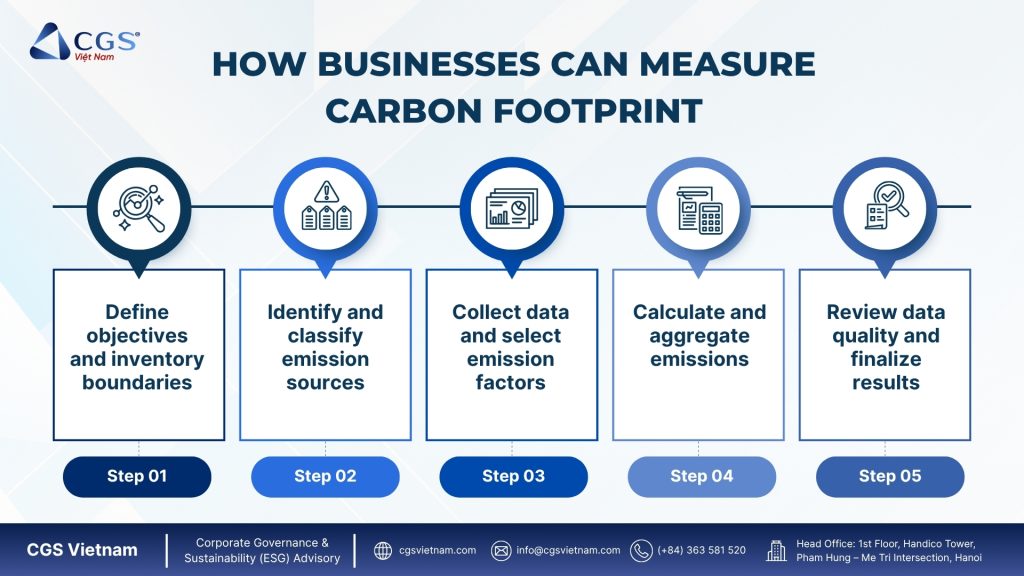
Throughout the process, businesses should follow the five GHG Protocol accounting and reporting principles: relevance, completeness, consistency, transparency, and accuracy.
Step 1. Define objectives and inventory boundaries
Businesses first determine the purpose of measurement, such as internal management, emission reduction, sustainability reporting, or meeting customer requirements, and establish:
- Organizational boundaries: Identify which companies, factories, facilities, and activities are included in the inventory based on equity share or control under the selected consolidation approach.
- Operational boundaries: Identify emission sources classified under Scope 1, Scope 2, and Scope 3.
Clearly defined boundaries help reduce omissions and double counting while ensuring comparability across reporting periods.
Step 2. Identify and classify emission sources
Businesses compile a list of emission sources by facility, department, or production process, including fuel combustion, electricity consumption, refrigerant leakage, purchased raw materials, and goods transportation.
These sources are classified under the relevant scopes. For Scope 3, businesses should also review the applicable emission categories across their value chains.
Step 3. Collect activity data and select emission factors
Businesses collect activity data, such as fuel consumption (litres, kg), electricity consumption (kWh), raw material quantities (tonnes), transportation distances (km), and waste generation.
An emission factor indicates the amount of GHG emissions associated with a unit of activity, such as 1 kWh of electricity or 1 litre of fuel. Appropriate emission factors may be obtained from national guidance, the IPCC, life cycle databases, or supplier-specific information.
For Scope 3, businesses can combine primary data from their value chains with secondary data, such as industry-average emission factors, while prioritizing improvements in data quality for significant emission sources.
Step 4. Calculate and aggregate emissions
A commonly used calculation formula is:
GHG emissions = Activity data × Emission factor
For example, a factory consumes 200,000 kWh of electricity, with an assumed emission factor of 0.70 kg CO₂e/kWh:
200,000 × 0.70 = 140,000 kg CO₂e = 140 tonnes CO₂e.
This emission factor is for illustrative purposes only and does not represent the official electricity grid emission factor for Vietnam.
Where necessary, results are converted into CO₂e and aggregated by emission source, facility, and scope to analyze the company’s overall emissions profile.
Step 5. Review data quality and finalize results
Businesses reconcile activity data with supporting documents, verify calculation formulas and emission factors, check for omissions or double counting, and document assumptions and limitations.
Data and supporting evidence should be retained to ensure traceability. Businesses should also establish a base year as a reference point for comparing emissions across reporting periods and consider recalculating base-year emissions when significant changes occur, in accordance with applicable standards.
Independent verification is conducted where required by regulations, customers, or reporting standards.
How can businesses use carbon footprint measurement results?
Carbon footprint measurement results support more than GHG inventories and reporting. They also provide a basis for prioritizing actions, setting targets, and implementing emission reduction measures:
- Prioritize emission reduction opportunities: By analyzing their emissions profile, businesses can identify the largest contributing activities and focus on the most relevant solutions. For example, where electricity consumption is a major emission source, improving energy efficiency or using renewable energy may be prioritized.
- Set emission reduction targets and action plans: Inventory data provides a basis for establishing absolute or emissions intensity reduction targets over defined periods. Solutions should be evaluated based on their emission reduction potential, investment costs, and feasibility.
- Integrate emissions management into governance and reporting: Measurement results help the board of directors, members’ council, and executive management oversee targets, allocate resources, and monitor progress. Emissions data also supports climate-related disclosures under standards such as IFRS S2 and GRI.
GHG inventory regulations in Vietnam
In Vietnam, GHG inventory activities are governed by Decree No. 06/2022/ND-CP, as amended and supplemented by Decree No. 119/2025/ND-CP and Decree No. 83/2026/ND-CP.
Notably, Decision No. 42/2026/QD-TTg, effective September 25, 2026, updates the list of 2,441 facilities required to conduct GHG inventories. Facilities included in the mandatory GHG inventory list are responsible for conducting inventories and submitting reports in accordance with applicable legal requirements.
However, mandatory GHG inventories under Vietnamese law should be distinguished from organizational or product carbon footprint measurement under international standards. Their boundaries, methodologies, and reporting requirements may differ depending on the purpose and applicable regulations.
Conclusion
Carbon footprint measurement is an essential starting point for businesses seeking to systematically manage and reduce GHG emissions. By identifying Scope 1, Scope 2, and Scope 3 emission sources, businesses can build a reliable emissions database, establish targets, and prioritize appropriate reduction measures.
More importantly, measurement results should be integrated into corporate governance and decision-making to help businesses improve resource efficiency, manage climate-related risks, and advance their sustainable development goals.
To move from measurement to systematic emissions management, businesses need to integrate GHG inventory data with strategy, organizational structure, processes, and appropriate governance mechanisms. Businesses can refer to the Greenhouse gas emissions management framework developed by CGS Vietnam and EGP Vietnam to assess their current practices and identify priority areas for improvement.
References:
- WRI & WBCSD (2004). The Greenhouse Gas Protocol: A Corporate Accounting and Reporting Standard – Revised Edition.
- WRI & WBCSD (2011). Corporate Value Chain (Scope 3) Accounting and Reporting Standard.
- WRI & WBCSD (2011). Product Life Cycle Accounting and Reporting Standard.
- GHG Protocol (2015). Scope 2 Guidance.
- ISO (2018). ISO 14064-1:2018 – Greenhouse gases – Part 1.
- ISO (2018). ISO 14067:2018 – Greenhouse gases – Carbon footprint of products.
- IPCC (2021). Sixth Assessment Report, Working Group I, Chapter 7.
- IFRS Foundation (2023). IFRS S2 Climate-related Disclosures.
- GRI (2025). GRI 102: Climate Change 2025.
- Government of Vietnam (2022). Decree No. 06/2022/ND-CP on greenhouse gas emission mitigation and ozone layer protection.
- Government of Vietnam (2025). Decree No. 119/2025/ND-CP.
- Government of Vietnam (2026). Decree No. 83/2026/ND-CP.
- Prime Minister of Vietnam (2026). Decision No. 42/2026/QD-TTg on the updated list of sectors and facilities required to conduct greenhouse gas inventories.
About CGS Vietnam
CGS Vietnam Consulting Joint Stock Company provides specialized advisory services in Corporate Governance, Sustainability (ESG), Risk Management, and Internal Audit. Backed by a team of experienced professionals with deep expertise in international best practices, CGS Vietnam partners with businesses to strengthen corporate governance, enhance management capabilities, meet investor expectations, and achieve long-term sustainable growth.
Contact CGS Vietnam:
Hotline: (+84) 363 581 520 | Email: [email protected] | Website: https://cgsvietnam.com/
LinkedIn: https://www.linkedin.com/company/cgs-vietnam | Facebook: https://www.facebook.com/CGSVietnamCompany/