

Sustainability is evolving from a broad commitment into an increasingly concrete business requirement. Investors, customers, banks, and business partners are no longer interested only in whether a company has ESG goals; they also want to understand how those goals are governed, measured, and implemented.
However, many Vietnamese enterprises still face difficulties in translating standards and frameworks such as GRI, IFRS S1, and IFRS S2 into governance structures, processes, and indicators that are appropriate to their actual operations.
Against this backdrop, the Corporate Sustainability Index (CSI) can serve as a reference framework for assessing current practices, identifying gaps, and gradually integrating sustainability into corporate governance and business operations.
What is the CSI?
The CSI is a corporate sustainability assessment framework developed and regularly updated under the leadership of the Vietnam Business Council for Sustainable Development (VBCSD), which operates under the Vietnam Chamber of Commerce and Industry (VCCI).
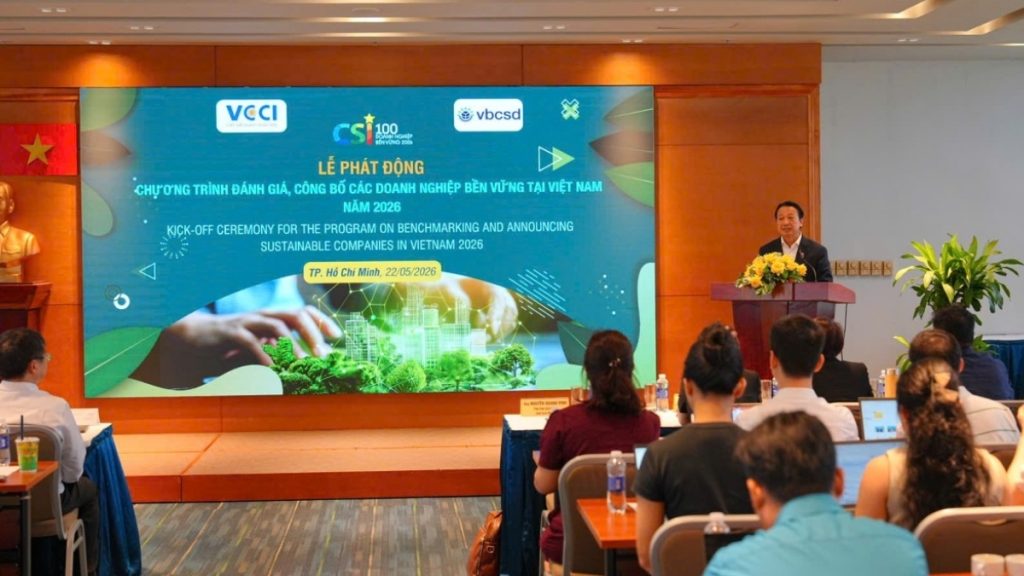
The Index is used in the Programme on Benchmarking and Announcing Sustainable Companies in Vietnam, which has been organized annually since 2016. CSI 2026 marks the 11th consecutive year that the programme has been led by VCCI, with VBCSD serving as its core implementing body.
The CSI is built around four pillars:
- Economic;
- Environmental;
- Social;
- Governance.
According to VCCI, the CSI draws on international frameworks, standards, and initiatives such as GRI, ISSB, TCFD, and the UN Guiding Principles on Business and Human Rights (UNGPs), while also being adapted to Vietnam’s legal framework and business context.
When using the CSI as a self-assessment tool, enterprises may focus on four key questions:
- Which requirements has the company already addressed?
- Have existing practices been formalized into policies and processes?
- Does the company have sufficient data and evidence to demonstrate its performance?
- Which gaps should be prioritized for improvement?
This is a suggested approach for using the CSI in internal governance and should not be interpreted as four official assessment questions issued by VCCI.
Key components of CSI 2026
The CSI is updated annually to reflect changes in regulations, business practices, and international sustainability trends.
CSI 2026 continues to provide two versions:
- Medium and large enterprises: 166 indicators, including 97 basic compliance-oriented indicators and 69 advanced indicators focusing on practical sustainability initiatives.
- Small and micro enterprises: 105 indicators, including 86 basic indicators and 19 advanced indicators.
The version for small and micro enterprises is streamlined, prioritizing the establishment of a compliance foundation before more advanced sustainability practices are introduced.
The eight-part structure of CSI 2026
The version for medium and large enterprises consists of eight sections, which can be summarized as follows:
- Corporate information;
- Organizational structure, operating model, and key personnel;
- Materiality analysis;
- Performance indicators for the past three years;
- Governance indicators;
- Environmental indicators;
- Labour and social indicators;
- Implementation of sustainability commitments.
These areas enable enterprises to review their practices comprehensively, from organizational structures and governance processes to economic, environmental, and social performance data.
From commitments to results
CSI 2026 introduces a dedicated section on “Implementation of Sustainability Commitments” for medium and large enterprises. Companies are expected to clarify:
- Commitment: What does the company aim to achieve?
- Action: What measures has the company implemented?
- Result: What outcomes have those actions produced?
This new section helps connect publicly stated goals with concrete actions and actual results, rather than allowing sustainability commitments to remain purely aspirational.
To make sustainability goals manageable, companies should define baselines, timelines, measurable indicators, and accountable business units. This is a governance recommendation and should not be interpreted as a mandatory CSI requirement unless confirmed against the relevant official indicators.
Why is the CSI important?

Providing a self-assessment framework tailored to Vietnam
Enterprises are increasingly required to respond simultaneously to regulations, investor expectations, customer requirements, banking requirements, and international standards. If these requirements are managed separately, companies may repeatedly collect the same types of data while still overlooking important information.
The CSI provides a structured starting point that enables enterprises to conduct a relatively comprehensive review of their economic, governance, environmental, and social practices within the Vietnamese context.
However, the CSI does not replace specialized standards and frameworks. Enterprises reporting under GRI, IFRS S1, IFRS S2, or specific export-market requirements still need to conduct separate gap analyses and assessments.
Turning ESG into governance accountability
The value of the CSI lies not simply in how many indicators a company can complete, but in encouraging enterprises to determine:
- The responsible business unit;
- Data sources and reporting boundaries;
- Review and approval levels;
- Supporting documentation;
- Corrective actions.
When properly applied, sustainability is no longer the sole responsibility of the ESG or communications function. The ESG team may coordinate the process, but the Board of Directors, executive management, Finance, Human Resources, Legal, Operations, Procurement, and Internal Control functions must remain accountable for matters within their respective areas.
Identifying gaps and standardizing data
A self-assessment process may help enterprises identify issues such as:
- Policies that have been issued but lack implementation mechanisms;
- Inconsistent data across different business units;
- Targets without baselines or deadlines;
- Suppliers that have not been assessed against environmental or labour criteria;
- The Board of Directors not receiving regular reports on ESG risks;
- Disclosed information that lacks sufficient supporting evidence.
Each quantitative indicator should also have a clear definition, unit of measurement, reporting boundary, calculation methodology, data source, and reviewer. These elements form an important foundation for improving the quality of sustainability reporting and progressing toward independent assurance of material sustainability information.
Enterprises should not focus solely on maximizing the number of indicators addressed. Instead, they should use the CSI materiality analysis to identify appropriate priorities, beginning with compliance requirements, material risks, and critical data gaps.
Participation in the CSI Programme in practice
After 10 editions from 2016 to 2025, the Programme on Benchmarking and Announcing Sustainable Companies in Vietnam attracted more than 4,500 enterprise participations, while more than 10,000 enterprises used or referred to the CSI for sustainability self-assessment and orientation. This indicates that the CSI is increasingly being used beyond participation in the annual benchmarking programme.
Participation has remained at several hundred enterprises per year. Approximately 500 enterprises participated in 2018, while both 2023 and 2024 recorded nearly 500 applications. Notably, the proportion of first-time participants increased from nearly 25% in 2023 to 35% in 2024. In 2025, participation remained above 500 enterprises, with small and medium-sized enterprises accounting for approximately 30%, the highest proportion since the programme was launched.
VCCI has also observed an improving trend in the quality of submissions and sustainability practices among participating enterprises. In particular, the Top 10 Sustainable Enterprises in the manufacturing and trade-services sectors during 2023–2025 generated combined revenue of nearly VND 1.5 quadrillion, contributed more than VND 100 trillion to the State budget, and provided more than VND 1 trillion for social activities.
These figures demonstrate the CSI’s value as a tool for supporting enterprises in reviewing and improving sustainability practices. However, they should not be interpreted as evidence that participation in or application of the CSI directly caused the business outcomes described above.

A practical example of CSI application
According to Mr. Nguyen Quang Vinh, Vice Chairman of VCCI, as cited by VietNamNet, in 2018, FSC (Forest Stewardship Council) forest management certification was withdrawn from certain rubber forest areas managed by the Vietnam Rubber Group, creating difficulties in meeting the requirements of certain international markets and customers.
From late 2018, the Group began referring to and applying the CSI to adjust its internal governance and production management practices. According to Mr. Vinh, this process contributed to the Group obtaining PEFC (Programme for the Endorsement of Forest Certification) certification. In addition, since 2019, approximately 10–15 member companies each year have been recognized among Vietnam’s Top 100 Sustainable Enterprises.
This case illustrates that the CSI can be used for purposes beyond participating in the annual assessment programme. When incorporated into internal governance, the Index can support enterprises in standardizing their operations and strengthening their ability to meet market requirements.
| Note: The outcomes above are based on statements made by VCCI leadership and do not constitute an independent impact assessment. FSC certification is also not a legal requirement for all export activities, although it may be required by specific customers, importers, or supply chains. |
Common mistakes when applying the CSI
Treating the CSI only as an application for the programme
If companies begin collecting information only shortly before the application deadline, they are likely to focus on completing responses rather than improving their management systems. The CSI should instead be integrated into the annual governance cycle: assessing the current state, developing action plans, monitoring performance, and addressing identified gaps.
Assigning all responsibility to the ESG function
The ESG function may coordinate the process, but it cannot independently generate all required data. Finance, Human Resources, Operations, Legal, Procurement, Internal Control, and other relevant functions should remain responsible for indicators within their respective areas.
Focusing on quantity while overlooking materiality
Not every sustainability issue is equally important to every enterprise. Attempting to improve all indicators simultaneously may disperse resources and reduce effectiveness. Companies should prioritize issues that have the greatest implications for their operations, risks, and stakeholders.
Maintaining data without an audit trail
Data that lacks a clear source, has inconsistent reporting boundaries, or has not been properly reviewed and approved can reduce the reliability of an enterprise’s submission.
The CSI is an assessment and governance support tool, not a management-system certification. Applying the CSI also does not automatically mean that an enterprise fully complies with GRI, IFRS S1, IFRS S2, or sector-specific disclosure requirements.
Conclusion
The CSI provides Vietnamese enterprises with a systematic reference framework for assessing sustainability across economic, governance, environmental, and social dimensions. Its value does not lie in how many indicators an enterprise can answer, but rather in its ability to translate those indicators into accountability, data, targets, and concrete improvement actions.
CGS Vietnam provides advisory services in Corporate Governance and Sustainability (ESG), including support for enterprises in preparing submissions for the CSI programme. The CSI can serve as one of the reference frameworks used by CGS to support enterprises in:
- Reviewing current practices and identifying gaps;
- Identifying material ESG issues;
- Developing ESG strategies and roadmaps;
- Strengthening governance structures and assigning responsibilities;
- Developing KPIs and standardizing data;
- Preparing sustainability reports;
- Providing training for Boards of Directors, executive management, and functional teams.
CGS Vietnam’s focus is not limited to helping enterprises prepare information for assessment purposes. More importantly, it aims to help companies build sustainable governance capabilities that can be maintained, measured, and continuously improved over time.
References:
- VCCI – Launch of the 2026 Programme on Benchmarking and Announcing Sustainable Companies in Vietnam
- VCCI – CSI: A “Made in Vietnam” Corporate Sustainability Governance Index
- VCCI – CSI: Ten Years of Pioneering Efforts to Strengthen Vietnamese Enterprises’ Internal Capacity
- VietNamNet – “The First Lifeline for a Business Is the Business Itself”
- Government News – Announcement of Sustainable Enterprises in Vietnam 2023
- VCCI – CSI 2024: Enterprises Transforming Green through Technology and Innovation
- VCCI – CSI: Strengthening the Internal Capacity of Vietnamese Enterprises
- Government News – Honouring Vietnam’s Top 100 Sustainable Enterprises in 2019
About CGS Vietnam
CGS Vietnam Consulting Joint Stock Company provides specialized advisory services in Corporate Governance, Sustainability (ESG), Risk Management, and Internal Audit. Backed by a team of experienced professionals with deep expertise in international best practices, CGS Vietnam partners with businesses to strengthen corporate governance, enhance management capabilities, meet investor expectations, and achieve long-term sustainable growth.
Contact CGS Vietnam:
Hotline: (+84) 363 581 520 | Email: [email protected] | Website: https://cgsvietnam.com/
LinkedIn: https://www.linkedin.com/company/cgs-vietnam | Facebook: https://www.facebook.com/CGSVietnamCompany/