
In today’s increasingly complex business environment, members of the Board of Directors (Board) and executive management are required to make decisions that can directly affect a company’s operations, financial position, and enterprise value. A transaction alleged to involve a conflict of interest, deficiencies in disclosure, or inadequate oversight may give rise to claims and potential legal liability for directors and officers.
These risks do not rest solely with the company. Where directors or officers breach their duties, they may face personal liability and exposure of their own assets. As a result, D&O liability insurance is increasingly viewed as an important component of an enterprise risk management framework.
What is D&O liability insurance?
Directors and Officers (D&O) liability insurance is designed to protect directors, officers, and other individuals falling within the policy definition of an “insured person” against losses arising from claims alleging wrongful acts committed in the course of performing their managerial duties. Depending on the policy, covered losses may include defence costs, settlements, damages awarded by a court, and certain other related expenses.

To put it simply, D&O insurance helps transfer a portion of the financial risk faced by directors, officers, and the company to the insurer, subject to the scope, terms, and conditions of the policy.
An important point is that coverage does not depend solely on job title. Board members, independent directors, the Chief Executive Officer, or other executives are protected only if they fall within the policy’s definition of an “insured person”. Companies should therefore carefully review which positions and individuals are covered.
Personal liability of directors and officers under Vietnamese law
Under Articles 165 and 166 of the Law on Enterprises 2020, company managers are required to perform their duties honestly, prudently, and loyally in the interests of the company and its shareholders. In the event of a breach, they may incur personal or joint liability and may be subject to legal action by eligible shareholders.
Management responsibilities can therefore translate into legal and financial risks for individuals. D&O insurance does not exempt directors or officers from liability; rather, it can help mitigate certain financial consequences arising from claims that fall within the scope of coverage.
Three common coverage components of D&O insurance
A typical D&O insurance programme may include three main coverage components:
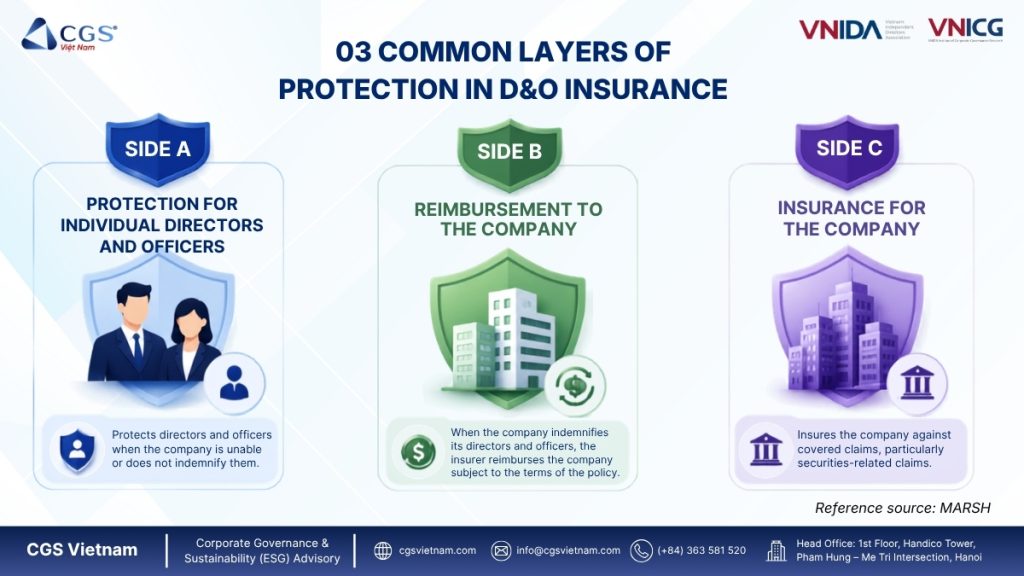
- Side A – Individual protection: Protects directors and officers when the company is unable, legally prohibited, or otherwise does not indemnify them. This provides direct protection for the personal assets of insured individuals.
- Side B – Company reimbursement: Where the company indemnifies or pays amounts on behalf of directors or officers, the insurer may reimburse the company for those amounts, subject to the policy terms.
- Side C – Insurance for the company: Protects the company itself against claims falling within the scope of coverage. For public or listed companies, Side C is commonly limited to securities claims.
D&O insurance does not cover every decision, claim, or act of a director or officer. The actual scope of protection depends on factors such as the definitions of insured persons, claims and wrongful acts, policy limits, deductibles or retentions, exclusions, and notification requirements.
Why is D&O liability insurance important for companies?
Protecting directors and officers against personal financial risks
Boards and executive management must make decisions under conditions of uncertainty. Even decisions based on reasonable information available at the time may result in claims if the outcome falls short of expectations. Subject to policy terms, D&O insurance may cover legal defence, investigation, and litigation costs relating to alleged wrongful acts, even where the claim is ultimately found to be without merit.
However, D&O insurance does not exempt directors and officers from liability and typically excludes fraud, intentional misconduct, or improper personal gain. Under some policies, such exclusions apply only after a final judgment or determination, meaning defence costs may still be advanced until that point.
Supporting the attraction and retention of qualified Board members
Legal liability and personal financial exposure can affect a company’s ability to attract qualified individuals to serve on its Board, particularly as independent directors.
In a thematic publication on independent directors, the Vietnam Independent Directors Association (VNIDA) recommended promoting D&O insurance as a mechanism to help directors perform their roles more effectively and with greater confidence. Appropriate protection can also support companies in attracting and retaining Board members with the necessary competence, experience, and reputation.
Complementing the enterprise risk management framework
D&O insurance should not be viewed simply as an insurance expense. It should form part of the broader risk management framework, alongside internal controls, conflict-of-interest management, disclosure, compliance, and Board oversight.
In other words, D&O insurance helps companies manage some of the financial consequences when liability risks materialise, while good governance helps reduce the likelihood of such risks arising in the first place.
When business decisions become liability risks
A business decision that does not deliver the expected outcome does not automatically mean that the Board has breached its governance duties. However, even where a decision was made in good faith and with due care, Board members may still face claims, disputes, and legal costs in defending that decision.
For example, suppose a major investment project approved by the Board subsequently underperforms and causes losses. A group of shareholders may allege that the Board failed to conduct adequate due diligence or properly discharge its oversight responsibilities. In such circumstances, the issue is not merely the ultimate outcome of the project, but also the process and basis on which the Board reached its decision.
This issue is also highlighted in the G20/OECD Principles of Corporate Governance 2023:
| Principle V.A.1: Board members should be protected against litigation if a decision was made in good faith with due diligence. Protecting Board members and executive management from litigation where business decisions were made diligently, with due care in the decision-making process, on an adequately informed basis, and without conflicts of interest enables them to accept the risk of decisions that are expected to benefit the company but may ultimately prove unsuccessful. (Source: Principle V – The Responsibilities of the Board, G20/OECD Principles of Corporate Governance 2023) |
In this context, D&O liability insurance is one mechanism that can help protect directors and officers against financial risks arising from covered claims. Subject to policy terms, D&O insurance may cover defence costs, settlements, or damages. Insured persons must also comply with claim notification and handling requirements; admitting liability, entering into settlements, or incurring costs without prior approval may affect insurance coverage.
From a practical perspective, the Practical Guide for Independent Directors, developed by VNIDA – VNICG – CGS Vietnam, also recommends that independent directors proactively request comprehensive information from the company regarding D&O insurance and ensure that the following matters are clearly addressed:
Source: Practical Guide for Independent Directors (VNIDA – VNICG – CGS Vietnam). |
Common mistakes companies make
Focusing only on whether D&O insurance has been purchased
Having D&O insurance does not necessarily mean that directors, officers, and the company are adequately protected. Companies need to consider who is insured, which risks are covered, the applicable limits, and the circumstances that are excluded.
Looking only at premiums and policy limits
A lower premium or higher policy limit does not necessarily mean that the programme is appropriate. Companies should also consider deductibles or retentions, defence costs, territorial scope, coverage of subsidiaries, and protection after directors or officers leave their positions.
In particular, companies should determine whether defence costs are included within or sit outside the policy limit. If defence costs erode the overall limit, the amount remaining for settlements or damages will decrease as claim-handling costs accumulate.
Failing to review policy terms and notification requirements carefully
Coverage depends on exclusions, the timing and notification of claims, retroactive dates, and extended reporting periods. Late notification, admitting liability, or settling a claim without the insurer’s approval may adversely affect coverage.
Assuming D&O insurance can replace good governance
D&O insurance only helps address certain financial consequences. It cannot replace sound decision-making processes, effective management of conflicts of interest, risk management, or effective Board oversight. Nor can insurance fully restore corporate reputation, enterprise value, or shareholder confidence after an incident.
How should companies approach D&O liability insurance?

Rather than beginning with the question, “Which D&O policy should we buy?”, companies should first assess their own governance and liability risk profile:
- Who needs protection, and does the existing coverage adequately include them?
- Is the company highly exposed to shareholder disputes, M&A transactions, securities issuance, disclosure issues, or employment-related claims?
- Does the policy limit adequately account for defence costs and the possibility of multiple claims?
- Are there potential liabilities that may arise in practice but currently fall outside the policy?
- Have Board members been provided with sufficient information about the D&O insurance programme?
More importantly, D&O insurance should be considered alongside Board effectiveness evaluation, risk management, internal controls, and compliance. This approach enables companies to move beyond simply “buying insurance” towards establishing a protection mechanism aligned with their specific risk profile.
D&O insurance at selected Vietnamese companies
Nam Long (NLG): D&O insurance disclosed at different points in time
According to its 2018 Board of Directors’ Report, Nam Long disclosed a liability insurance programme for Board members covering the period from 31 July 2018 to 31 July 2019, with a policy limit of USD 15 million and a premium of USD 14,500.
In its 2023 Annual General Meeting materials, Nam Long again presented a D&O insurance programme, this time with a USD 10 million policy limit and a premium of USD 20,900. The disclosure of D&O insurance at different points in time indicates that the company has considered liability insurance as a mechanism for protecting its Board rather than merely as a response to a specific event.
DHG Pharma: Annual renewal of D&O insurance
On 25 February 2022, the Board of DHG Pharma submitted a proposal to the 2021 Annual General Meeting seeking approval for the annual purchase of directors’ and officers’ liability insurance. The proposed insured persons included the Chair and members of the Board, the Chief Executive Officer, Deputy Chief Executive Officers, the Chief Accountant, and certain other management positions.
The proposal specified a one-year policy period with annual renewal. DHG Pharma stated that the purpose of purchasing D&O insurance was to mitigate potential economic losses where managers become legally liable to pay compensation, while also supporting transparent and professional governance practices.
The programme continued to be reflected in subsequent disclosures. In 2024, DHG Pharma disclosed insurance coverage extending to 28 June 2025; in May 2025, the company invited quotations for D&O insurance for the 2025–2026 period.
These examples illustrate how some Vietnamese companies are gradually incorporating D&O liability insurance into mechanisms for protecting directors and officers, alongside broader efforts to strengthen risk management and corporate governance.
CGS Vietnam’s perspective: D&O starts with governance quality
D&O insurance provides financial protection against liability risks arising as Board members and officers perform their duties. However, D&O liability insurance is only one layer of protection and cannot substitute for good governance. The foundation remains an effective governance system in which responsibilities between the Board and executive management are clearly defined; decisions are made on an adequately informed basis; conflicts of interest are properly managed; risks are assessed; and appropriate accountability mechanisms are in place.
Companies should therefore avoid considering D&O insurance in isolation from their risk profile and governance quality. The design of a D&O programme should begin with an assessment of Board responsibilities, group structure, capital-raising activities, M&A transactions, and potential sources of claims.
This is also the approach adopted by CGS Vietnam in supporting companies with Board effectiveness assessments, governance reviews, risk management, and internal controls, helping identify gaps and strengthen the governance foundations required to create sustainable long-term value.
This article is part of a content series on the G20/OECD Principles of Corporate Governance, developed through the professional collaboration between CGS Vietnam, the Vietnam Independent Directors Association (VNIDA) and the VNIDA Institute of Corporate Governance (VNICG). The series aims to share knowledge, assessment approaches, and practical guidance on applying corporate governance principles in business practice.
References:
- National Assembly of Vietnam (2020) – Law on Enterprises No. 59/2020/QH14, Articles 165 and 166.
- Marsh – Side A, Side B and Side C coverage.
- Allianz Commercial – D&O Insurance Explained.
- OECD (2023) – G20/OECD Principles of Corporate Governance 2023.
- VNIDA – VNICG – CGS Vietnam – Practical Guide for Independent Directors.
- VNIDA (2023) – White Paper on independent directors.
- Nam Long – 2018 Board of Directors’ Report and 2023 AGM materials.
- DHG Pharma – Proposal on the purchase of D&O insurance and invitation for quotations for the 2025–2026 period.
About CGS Vietnam
CGS Vietnam Consulting Joint Stock Company provides specialized advisory services in Corporate Governance, Sustainability (ESG), Risk Management, and Internal Audit. Backed by a team of experienced professionals with deep expertise in international best practices, CGS Vietnam partners with businesses to strengthen corporate governance, enhance management capabilities, meet investor expectations, and achieve long-term sustainable growth.
Contact CGS Vietnam:
Hotline: (+84) 363 581 520 | Email: [email protected] | Website: https://cgsvietnam.com/
LinkedIn: https://www.linkedin.com/company/cgs-vietnam | Facebook: https://www.facebook.com/CGSVietnamCompany/