

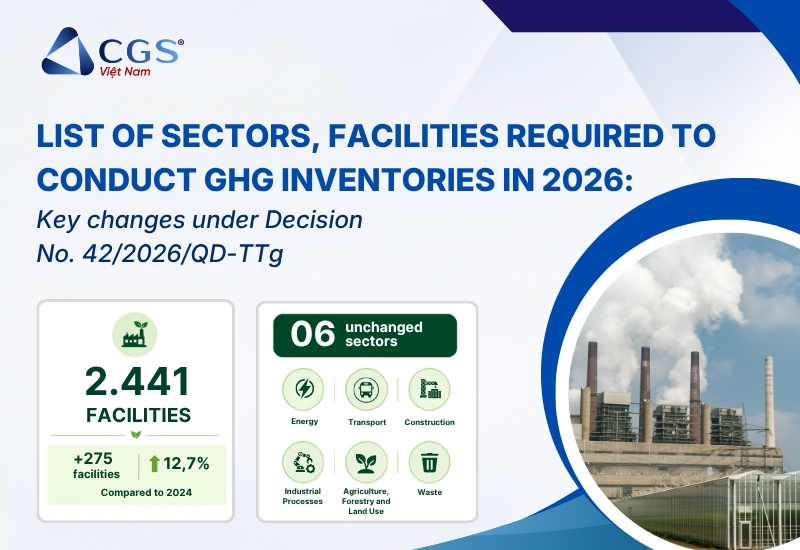
In this article, “GHG Inventory List” is used as a shortened reference to the List of sectors and facilities required to conduct greenhouse gas inventories.
On 10 August 2026, the Prime Minister issued Decision No. 42/2026/QD-TTg on the updated List of sectors and facilities required to conduct greenhouse gas inventories. The Decision takes effect on 25 September 2026 and updates the list currently applicable under Decision No. 13/2024/QD-TTg.
Under the new GHG Inventory List, 2,441 greenhouse gas-emitting facilities are required to conduct GHG inventories, an increase of 275 facilities, or approximately 12.7%, compared with the 2,166 facilities listed in 2024.
The notable changes go beyond the increase in the number of facilities. Decision No. 42 also reflects updates to facility-level emissions data and adjustments to the classification of facilities in line with the current structure of state management. However, the six sectors subject to GHG inventory requirements remain unchanged from 2024.
The six sectors subject to GHG inventory requirements remain unchanged
Appendix I of Decision No. 42/2026/QD-TTg continues to specify six sectors required to conduct GHG inventories:
- Energy, including energy production industries; energy consumption in industry, commerce, services and households; coal mining; and oil and natural gas extraction;
- Transport, including energy consumption in transport;
- Construction, including energy consumption in the construction sector and industrial processes in the production of construction materials;
- Industrial processes, including chemical production; metallurgy; the electronics industry; use of substitutes for ozone-depleting substances; and production and use of other industrial products;
- Agriculture, forestry and land use, including livestock; forestry and land-use change; crop production; energy consumption in agriculture, forestry and fisheries; and other agricultural emission sources;
- Waste, including solid waste disposal sites; biological treatment of solid waste; waste incineration and open burning; and wastewater treatment and discharge.
The structure of this list under Decision No. 42 of 2026 is identical to Appendix I of Decision No. 13/2024/QD-TTg. Therefore, the key change in the 2026 update lies in the list of specific facilities required to conduct GHG inventories, rather than the addition of a new emissions sector.
The 2026 GHG Inventory List increases to 2,441 facilities
Compared with Decision No. 13 of 2024, the number of facilities included in the 2026 GHG Inventory List has changed as follows:
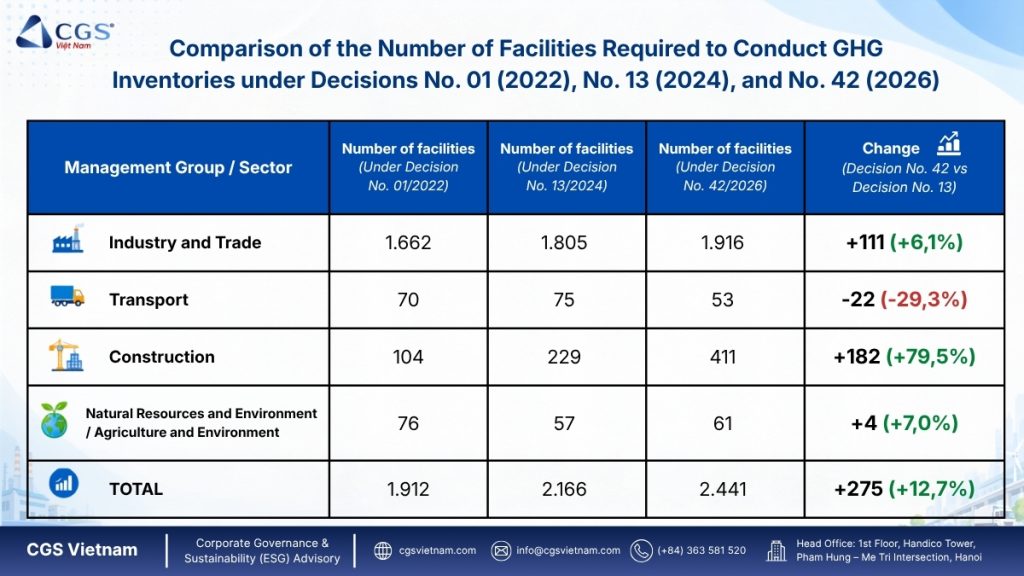
Official information from the Department of Climate Change confirms that the GHG Inventory List included 1,912 facilities in 2022, 2,166 facilities in 2024, and 2,441 facilities in 2026. The 2026 list comprises 1,916 facilities under the Industry and Trade sector, 53 facilities in the Transport sector, 411 facilities in the Construction sector, and 61 facilities under the Agriculture and Environment sector.
It is important to note that 275 represents the net increase in the GHG Inventory List; it does not mean that exactly 275 entirely new facilities were added. An update may simultaneously add new facilities, remove those that no longer meet the applicable criteria, and update information on existing facilities.
Industry and Trade continues to account for the majority of facilities
The number of facilities under the Industry and Trade sector increased from 1,805 in 2024 to 1,916 in 2026, a net increase of 111 facilities, or approximately 6.1%. With 1,916 out of 2,441 facilities, Industry and Trade accounts for approximately 78.5% of the entire 2026 list.
The list covers a wide range of production activities and facilities with significant energy consumption or emissions, including power generation, steel and metallurgy, chemicals, mining and mineral processing, textiles, paper, plastics, food processing, and various other manufacturing industries.
The first pages of Appendix II to Decision No. 42 of 2026 already include facilities involved in iron and steel production, mineral extraction, hydropower, chemicals and metallurgy.
Changes in the number of Industry and Trade facilities between review cycles are consistent with the list review mechanism: a facility’s production scale, energy consumption and operating status may change over time, while local-level data are also continuously updated.
Construction records the largest increase
The number of facilities in the Construction sector increased from 229 to 411, a net increase of 182 facilities, or approximately 79.5%. This sector accounts for the largest share of the overall increase in the 2026 list.
Notably: The Construction list includes not only cement, brick, ceramic, glass and other construction-material manufacturing facilities, but also certain large energy-consuming buildings and facilities such as shopping centers, hotels and airports.
Transport decreases from 75 to 53 facilities
In contrast to Industry and Trade and Construction, the number of facilities in the Transport sector decreased from 75 to 53, representing a net decrease of 22 facilities.
One notable structural change is that Decision No. 13/2024/QD-TTg provided a separate Appendix III for the Transport sector. Under Decision No. 42/2026/QD-TTg, the list is presented in Appendix III.A under the Construction sector – Transport field, while Appendix III.B covers the Construction field.
This arrangement is consistent with the current state management structure following the transfer of transport management functions to the Ministry of Construction. However, the change in the responsible authority should not be interpreted as the direct cause of the decrease of 22 facilities. The decrease should instead be understood as the net result of the list review process.
Agriculture and Environment records a slight increase
Decision No. 13 of 2024 listed 57 facilities under the Natural Resources and Environment sector in Appendix V. Under Decision No. 42 of 2026, this group is updated to the Agriculture and Environment sector, with 61 facilities. The change in name and responsible authority also reflects the new organizational structure of the state management authorities. In numerical terms, the list records a net increase of four facilities, equivalent to approximately 7%.
Why can the list of facilities required to conduct GHG inventories change?
Under Decree No. 06/2022/ND-CP, the identification of facilities required to conduct GHG inventories is based on criteria relating to emissions, energy consumption or operational scale for certain types of facilities. The list is also periodically reviewed and updated based on information provided by sectoral ministries and local authorities.
As a result, the list may change between review cycles for several reasons: new facilities may commence operations or expand and meet the applicable criteria; facilities not previously included may be added following data updates; facilities may cease operations or reduce their scale; or information relating to facility names, addresses, legal entities and operations may be revised.
Decision No. 42/2026/QD-TTg continues to require provincial and municipal People’s Committees to coordinate with the relevant ministries in reviewing and updating information and to take responsibility for the accuracy and completeness of facility lists within their jurisdictions.
Therefore, changes in the number of facilities between 2024 and 2026 should be understood as the result of reviewing and updating the list based on new data, rather than automatically interpreted as an increase or decrease in emissions within individual sectors.
It should also be noted that Decision No. 42 of 2026 is implemented in the context of Decree No. 06/2022/ND-CP, as amended and supplemented by Decree No. 119/2025/ND-CP and subsequently amended by Decree No. 83/2026/ND-CP. Accordingly, the obligations applicable to each facility should be determined based on the current regulatory framework, rather than solely by comparing the number of facilities between the two lists.
What should businesses consider following the issuance of Decision No. 42/2026/QD-TTg?
First, businesses should determine whether their facilities are included in the updated GHG Inventory List, rather than relying solely on whether they were previously listed under Decision No. 13/2024/QD-TTg.
Facilities included in the list are responsible for conducting facility-level GHG inventories in accordance with guidance issued by the relevant sectoral ministry and preparing and submitting reports in accordance with Decree No. 06/2022/ND-CP, as amended and supplemented by Decree No. 119/2025/ND-CP and Decree No. 83/2026/ND-CP.
For facilities newly appearing on the 2026 GHG Inventory List, early preparation of activity data, fuel and energy data, emission sources, emission factors, and data quality control mechanisms can significantly reduce pressure when entering the inventory and reporting cycle.
For facilities that have previously conducted GHG inventories, Decision No. 42 of 2026 also provides an appropriate opportunity to review inventory boundaries, emission sources, data collection processes and the traceability of supporting evidence to improve the reliability of inventory results.
From GHG inventory to emissions management
The increase from 2,166 to 2,441 facilities indicates that the scope of facilities subject to GHG emissions management in Vietnam continues to be updated and expanded. This places increasingly clear expectations on businesses to standardize their data and proactively manage emissions.
A GHG inventory should therefore not be viewed solely as a periodic reporting obligation. When developed systematically, an inventory can help businesses identify material emission sources, improve the quality of energy and environmental data, establish a baseline, and identify emissions reduction opportunities. It also provides a foundation for businesses to progressively respond to evolving carbon management requirements.
For businesses included in the GHG Inventory List under Decision No. 42/2026/QD-TTg, the first step is to accurately determine the scope of their obligations and assess the readiness of existing data. Based on this assessment, businesses can establish consistent processes for collecting, controlling and consolidating emissions data, while ensuring that these processes can be maintained across future inventory cycles.
Greenhouse Gas Emissions Management Framework
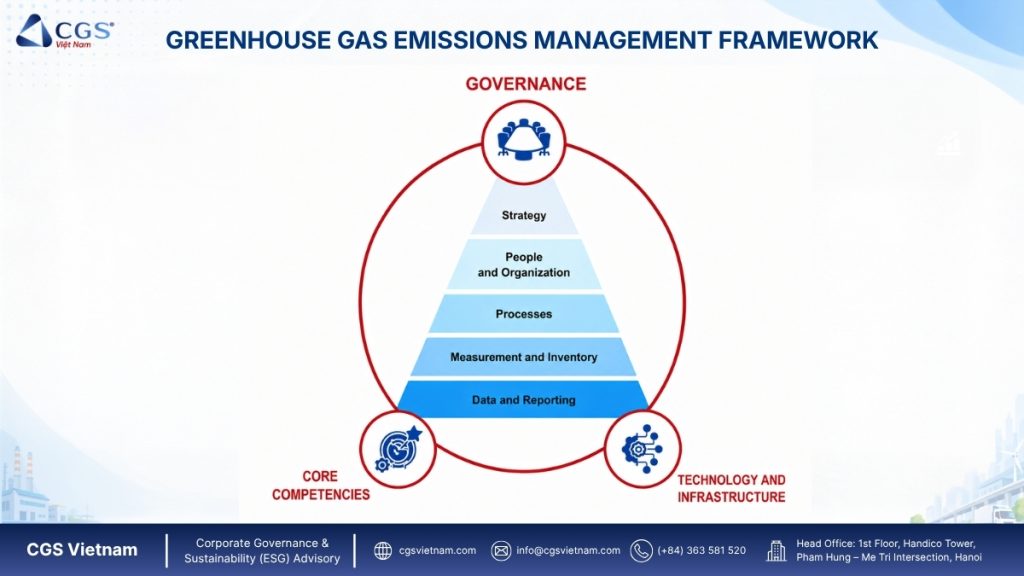
A GHG inventory is an important step, but effective emissions management requires a more comprehensive and systematic approach – covering Strategy, People and Organization, Processes, Measurement and Inventory, and Data and Reporting, supported by the foundations of Governance, Core Competencies, Technology and Infrastructure.
Based on this approach, CGS Vietnam, in collaboration with EGP Vietnam, has developed the “Greenhouse Gas Emissions Management Framework” to help businesses assess their current state and progressively build systematic emissions management capabilities.
The Framework provides a practical approach for businesses to identify the essential components of emissions management, recognize gaps and determine priority areas for improvement.
→ Learn more and access the Greenhouse Gas Emissions Management Framework
——————
References:
- Decision No. 42/2026/QD-TTg dated 10 August 2026 on the updated List of sectors and facilities emitting greenhouse gases required to conduct greenhouse gas inventories.
- Decision No. 13/2024/QD-TTg dated 13 August 2024 on the updated List of sectors and facilities emitting greenhouse gases required to conduct greenhouse gas inventories.
- Decree No. 06/2022/ND-CP dated 7 January 2022 on greenhouse gas emissions mitigation and protection of the ozone layer.
- Decree No. 119/2025/ND-CP dated 9 June 2025 amending and supplementing Decree No. 06/2022/ND-CP.
- Decree No. 83/2026/ND-CP dated 23 March 2026 further amending and supplementing Decree No. 06/2022/ND-CP.
- Department of Climate Change, Ministry of Agriculture and Environment – updated information on the list of facilities required to conduct greenhouse gas inventories in 2026.
About CGS Vietnam
CGS Vietnam Consulting Joint Stock Company provides specialized advisory services in Corporate Governance, Sustainability (ESG), Risk Management, and Internal Audit. Backed by a team of experienced professionals with deep expertise in international best practices, CGS Vietnam partners with businesses to strengthen corporate governance, enhance management capabilities, meet investor expectations, and achieve long-term sustainable growth.
Contact CGS Vietnam:
Hotline: (+84) 363 581 520 | Email: [email protected] | Website: https://cgsvietnam.com/
LinkedIn: https://www.linkedin.com/company/cgs-vietnam | Facebook: https://www.facebook.com/CGSVietnamCompany/