

The release of updated GRI Standards in Vietnamese makes it easier for Vietnamese businesses to access international sustainability reporting practices. For public and listed companies, it also presents an opportunity to review the quality of ESG disclosures, adopt updated standards, and strengthen sustainability governance capabilities.
On September 14, 2026, the Global Reporting Initiative (GRI) officially announced the release of updated Vietnamese translations of the GRI Standards.
This marks another milestone since GRI first made its standards available in Vietnamese in 2017. The updated translations cover the GRI Universal Standards, Sector Standards, and Topic Standards, including new standards addressing biodiversity, climate change, and energy.
The availability of the GRI Standards in Vietnamese not only reduces language barriers but also enables Vietnamese businesses to engage more effectively with international reporting practices, particularly as investors, financial institutions, and business partners place increasing importance on ESG information.
Why should businesses pay attention to the GRI Standards?
As investors, financial institutions, and business partners increasingly focus on ESG performance, sustainability reporting is no longer merely a communication tool. It has become an important means for businesses to demonstrate accountability and governance capabilities.
GRI is one of the world’s most widely used sustainability reporting frameworks, focusing on the disclosure of an organization’s significant impacts on the economy, environment, and people, including their human rights.
Applying the GRI Standards offers three key benefits:
- Enhancing transparency: Standardizing disclosure content and methodologies to make ESG information more structured, consistent, and comparable.
- Meeting stakeholder expectations: Providing information that addresses the needs of investors, financial institutions, customers, and value chain partners.
- Strengthening ESG governance: Helping businesses identify material impacts, assess policy effectiveness, and prioritize issues requiring management attention.
In particular, the availability of the GRI Standards in Vietnamese facilitates coordination among sustainability, finance, human resources, risk management, and information disclosure functions in collecting and managing data and preparing reports.
The value of GRI extends beyond reporting. It also lies in helping businesses better understand and manage the impacts arising from their operations.
What do the GRI Standards in Vietnamese cover?
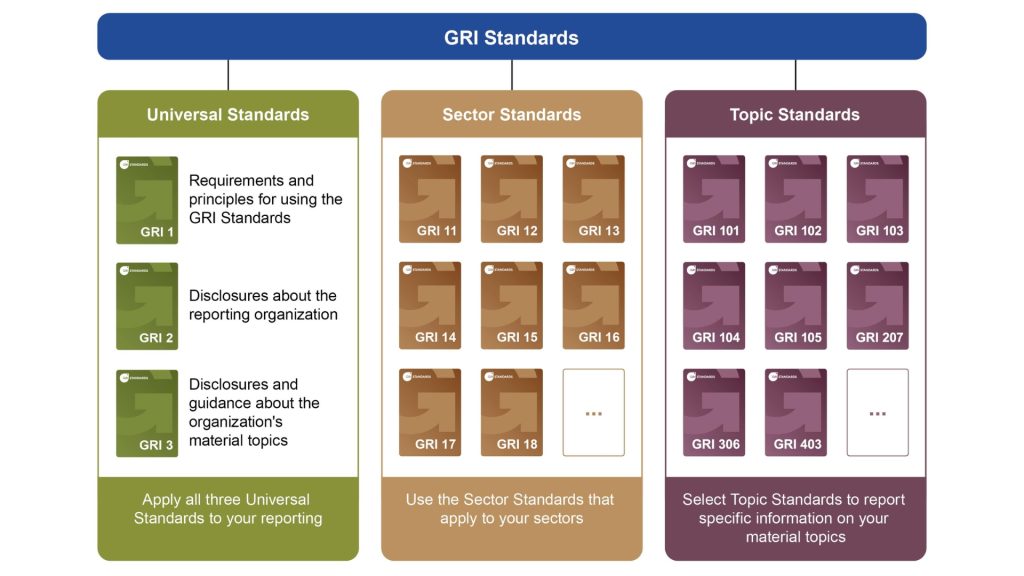
The original English-language GRI Standards are organized into three closely interconnected groups:
| Standard Category | Key Content |
|---|---|
| Universal Standards | GRI 1, GRI 2, and GRI 3: Establish the foundation for applying the standards, general disclosures, and the approach to determining and managing material topics. |
| Sector Standards | Support the identification of potentially material topics specific to different industries, such as oil and gas, coal, agriculture, and mining. |
| Topic Standards | Specify disclosure requirements relating to environmental matters, labor, human rights, anti-corruption, and other economic and social topics. |
Businesses begin with the Universal Standards, use the applicable Sector Standards where available, and then apply the Topic Standards corresponding to their identified material topics.
Key GRI updates for 2026 – 2027
During 2026–2027, businesses should pay particular attention to three important environmental standards.
GRI 101: Biodiversity 2024 – Effective January 1, 2026
- Replaces GRI 304: Biodiversity 2016.
- Expands disclosures on biodiversity impacts, affected locations, and activities across the value chain.
- Strengthens disclosure requirements relating to measures for managing, preventing, mitigating, and remediating biodiversity impacts.
GRI 102: Climate Change 2025 – Effective January 1, 2027
- Updates requirements relating to greenhouse gas (GHG) emissions, transition plans, climate change adaptation, and just transition.
- Replaces disclosures GRI 305-1 through GRI 305-5 and GRI 201-2.
- Places greater emphasis on transparency regarding climate-related targets, actions, and performance outcomes.
GRI 103: Energy 2025 – Effective January 1, 2027
- Replaces GRI 302: Energy 2016.
- Updates disclosure requirements on energy consumption, renewable and non-renewable energy sources, and measures to reduce energy consumption.
- Expands consideration of energy-related impacts across the value chain.
Important note: Effective dates are determined by when a report or other materials are published, rather than solely by the financial year being reported. Therefore, businesses preparing sustainability reports for FY2026 that will be published in 2027 should consider transitioning to the new standards, depending on their material topics and chosen approach to applying GRI.
What should public and listed companies in Vietnam consider when applying GRI?
Is GRI reporting mandatory in Vietnam?
The GRI Standards are currently not mandatory for all public and listed companies in Vietnam. However, Vietnamese securities regulations establish specific requirements for environmental and social disclosures.
Under Circular No. 96/2020/TT-BTC and its amendments and supplements, public companies are required to publish annual reports using the template provided in Appendix IV, which includes disclosures on:
- Greenhouse gas emissions and emission reduction measures;
- Materials management, energy consumption, and water use;
- Compliance with environmental protection laws;
- Labor policies, occupational health and safety, employee welfare, and training;
- Responsibilities toward local communities;
- Activities related to green capital markets, as guided by the State Securities Commission of Vietnam.
Businesses may prepare separate sustainability reports to disclose this information. Certain disclosure requirements under Appendix IV are not mandatory for businesses operating in financial services, banking, securities, and insurance.
If a company already complies with Vietnamese regulations, does it still need to apply GRI?
Compliance with Vietnam’s statutory disclosure requirements does not necessarily mean that a company’s sustainability report is prepared in accordance with the GRI Standards.
While legal regulations specify the information that must be disclosed, GRI provides a comprehensive set of standards to help businesses identify, assess, and report their material impacts.
Businesses can therefore use GRI to enhance disclosure quality while building on their existing regulatory reporting practices, rather than developing two entirely separate reporting systems.
What should businesses prepare for the 2026–2027 reporting period?
For companies already preparing annual reports or standalone sustainability reports, three priorities should be considered:
- First, review existing disclosures. Compare previously reported ESG information against Vietnamese regulatory requirements and relevant GRI Standards to identify disclosure gaps.
- Second, adopt updated standards. Review existing disclosures based on GRI 304, GRI 302, and relevant GRI 305 disclosures to prepare for the transition to GRI 101, GRI 102, and GRI 103 according to their respective effective dates.
- Third, improve ESG data quality. Identify data sources, measurement methodologies, responsible departments, and information verification processes, particularly for quantitative indicators relating to emissions, energy, and water resources.
The priority is not to disclose as many ESG indicators as possible, but to identify the right material issues and ensure that reported information is complete, consistent, and reliable.
How should businesses begin applying the GRI Standards?
GRI implementation should reflect each company’s current circumstances, size, and level of ESG maturity.
- Businesses currently disclosing ESG information primarily to meet regulatory requirements: Review existing disclosures, identify material topics, and gradually reference GRI to improve reporting quality.
- Businesses already preparing sustainability reports using GRI: Prioritize adopting updated standards, reviewing the GRI Content Index, identifying data gaps, and improving reporting processes.
- Businesses at the early stages of ESG implementation: Focus on identifying material impacts, defining reporting boundaries, and establishing appropriate data collection systems.
In practice, businesses can follow a five-step approach.
Step 1. Assess the Current Situation and Define the Scope
Review applicable disclosure requirements, existing ESG policies, and available data. Define the organizational boundaries, business activities, and value chain to be considered.
Step 2. Identify Material Topics
Identify and assess the organization’s most significant impacts on the economy, environment, and people, taking into account input from relevant stakeholders.
Step 3. Map Disclosures Against the GRI Standards
Identify applicable standards, corresponding disclosure requirements, and gaps between existing data and the information required for reporting.
Step 4. Standardize Data and Assign Responsibilities
Establish a set of ESG indicators, measurement methodologies, data sources, responsible departments, and information quality control procedures.
Step 5. Disclose Information and Drive Continuous Improvement
Select an appropriate approach to using GRI, prepare the report, and progressively use assessment findings to improve sustainability governance practices.
GRI currently provides two main approaches to using its standards:
- In accordance with the GRI Standards: Preparing a report in accordance with the GRI Standards by meeting the applicable requirements.
- With reference to the GRI Standards: Referencing selected GRI Standards or disclosures while complying with the requirements for reporting with reference to GRI.
Businesses should select the approach that best matches their reporting capabilities and scope, avoiding claims of reporting in accordance with GRI unless all applicable conditions have been met.
Where can businesses download the latest GRI Standards in Vietnamese?
Businesses can download the Vietnamese translations of the GRI Standards free of charge from the official Global Reporting Initiative website.
Access the GRI Standards in Vietnamese here
The website provides updated Vietnamese translations of the Universal Standards, Sector Standards, and Topic Standards.
When using these materials, businesses should check each standard’s version, publication year, and effective date, particularly for standards updated during 2024–2025.
Alongside the Vietnamese translations, businesses are encouraged to consult the official English versions when clarification of technical terminology or detailed disclosure requirements is necessary.
From applying GRI Standards to strengthening ESG governance
Access to the GRI Standards in Vietnamese provides a valuable starting point. However, the quality of sustainability reporting ultimately depends on a company’s governance capabilities and implementation processes.
From a corporate governance perspective, CGS Vietnam believes that effective GRI implementation should be closely linked to Board oversight, cross-functional coordination, and robust ESG data quality control mechanisms.
The disclosures under GRI 2 also address the role of the highest governance body in overseeing impacts, delegating management responsibilities, and reviewing sustainability-related information.
Businesses should therefore progressively integrate material ESG topics into corporate strategy, risk management, and oversight activities, rather than focusing solely on preparing annual reports.
Effective application of GRI not only enhances corporate transparency but also strengthens accountability and establishes a foundation for long-term sustainable development.
References:
- Global Reporting Initiative – GRI Expands Sustainability Reporting Opportunities in Vietnam (September 14, 2026)
- Global Reporting Initiative – GRI Standards in Vietnamese
- Global Reporting Initiative – GRI Standards
- GRI – Topic Standard for Climate Change and Energy
- Circular No. 96/2020/TT-BTC issued by Vietnam’s Ministry of Finance, as amended and supplemented by Circular No. 68/2024/TT-BTC, Circular No. 18/2025/TT-BTC, and Circular No. 08/2026/TT-BTC.
About CGS Vietnam
CGS Vietnam Consulting Joint Stock Company provides specialized advisory services in Corporate Governance, Sustainability (ESG), Risk Management, and Internal Audit. Backed by a team of experienced professionals with deep expertise in international best practices, CGS Vietnam partners with businesses to strengthen corporate governance, enhance management capabilities, meet investor expectations, and achieve long-term sustainable growth.
Contact CGS Vietnam:
Hotline: (+84) 363 581 520 | Email: [email protected] | Website: https://cgsvietnam.com/
LinkedIn: https://www.linkedin.com/company/cgs-vietnam | Facebook: https://www.facebook.com/CGSVietnamCompany/