

In recent years, many listed companies in Vietnam have invested significant resources in improving their performance under the ASEAN Corporate Governance Scorecard (ACGS). At the same time, the G20/OECD Principles of Corporate Governance (2023) have increasingly become an important reference for regulators, investors, and companies when developing and assessing corporate governance systems in line with international best practices.
This has led many companies to ask: How do OECD and ACGS differ? Does achieving a high ACGS score mean that a company has fully implemented the OECD Principles of Corporate Governance? The answer is not entirely.
The OECD principles and ACGS are closely related, but they were developed for different purposes. While the G20/OECD Principles of Corporate Governance (2023) provide a principles-based framework to help companies establish effective governance systems and create long-term value, the ASEAN Corporate Governance Scorecard (ACGS) is an assessment framework that measures how well companies demonstrate these governance practices through publicly disclosed information.
Understanding the distinction between these two governance frameworks enables companies to focus on the right objective: building an effective governance system in substance rather than simply improving assessment scores.
Why are OECD and ACGS often confused?
In Vietnam, the ASEAN Corporate Governance Scorecard (ACGS) is more widely recognized because it serves as a direct assessment framework for listed companies across ASEAN. A company’s ACGS results are commonly used to compare governance quality among listed companies and are an indicator that many investors closely monitor.
By contrast, the G20/OECD Principles of Corporate Governance are often regarded as a guidance document or a compilation of international best practices rather than a formal assessment system.
As a result, many companies tend to focus on activities such as:
- Preparing documentation to satisfy assessment criteria.
- Enhancing the quality of corporate disclosures.
- Issuing additional governance policies and regulations.
- Preparing supporting documentation to achieve higher assessment scores
These are all positive initiatives. However, if a company limits its efforts to meeting assessment criteria without improving the effectiveness of governance practices in reality, it will be difficult to achieve broader objectives such as enhancing operational performance, strengthening resilience, and building long-term investor confidence.
What is the relationship between OECD and ACGS?
Although they are frequently mentioned together, OECD and ACGS are not independent or competing frameworks.
The G20/OECD Principles of Corporate Governance serve as the foundational international framework for corporate governance. Based on these principles, the ASEAN Capital Markets Forum (ACMF) developed the ASEAN Corporate Governance Scorecard (ACGS) to translate governance principles into observable and measurable criteria that enable consistent assessment and comparison among listed companies across ASEAN.
In other words, the OECD Principles answer the question of how companies should be governed, while the ACGS evaluates how companies demonstrate those governance practices through publicly disclosed information.
Accordingly, the two frameworks complement rather than replace each other. The OECD Principles help companies build robust governance foundations, while the ACGS reflects how effectively those governance practices are evidenced through verifiable disclosures.
Comparing the OECD Principles and ACGS
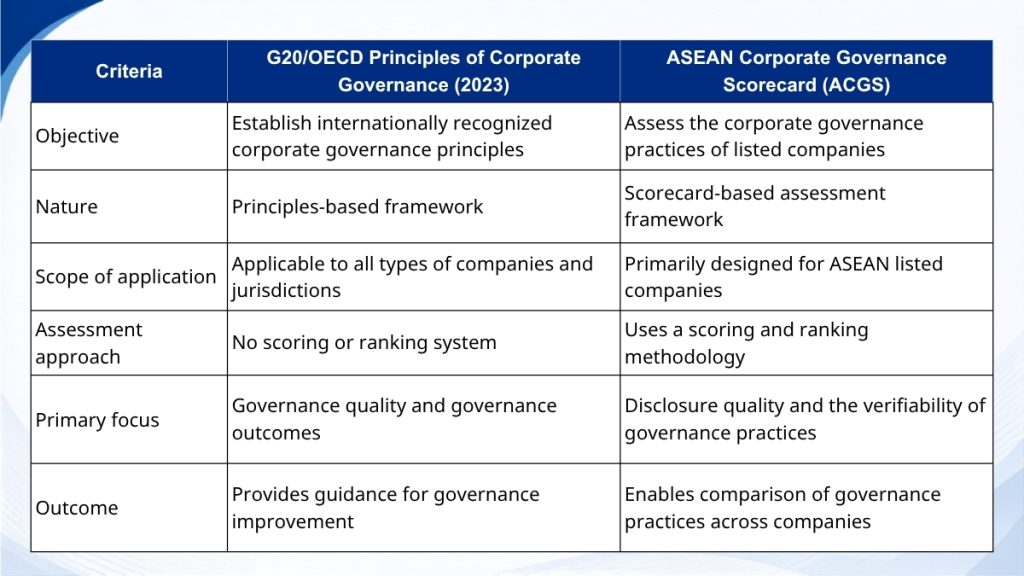
The comparison demonstrates that although both frameworks pursue the common objective of improving corporate governance quality, they approach this objective from different perspectives.
The OECD Principles focus on the substance of the governance system, defining the respective roles of the Board of Directors, management, shareholders, and stakeholders in order to promote effective oversight and long-term value creation.
By contrast, the ACGS translates these principles into specific, observable assessment criteria that can be evaluated through publicly available documents such as annual reports, corporate governance reports, sustainability reports, and company websites.
Therefore, companies should not choose between OECD and ACGS. Instead, they should understand how the two frameworks reinforce each other in improving corporate governance practices.
Risks of focusing solely on improving ACGS scores
Using the ACGS as a self-assessment and governance improvement tool is valuable. However, if companies focus primarily on increasing their scores without strengthening the effectiveness of their governance systems, several limitations may arise.
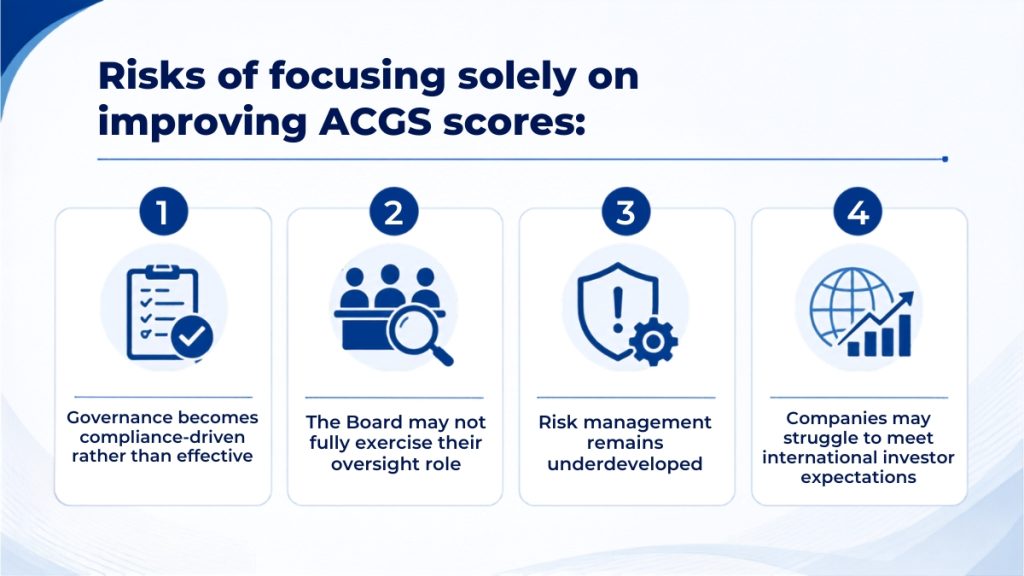
- Governance becomes compliance-driven rather than effective: Companies may introduce numerous governance policies and regulations without ensuring they operate effectively in practice.
- The Board may not fully exercise their oversight role: Meeting structural requirements does not necessarily mean the Board effectively provides strategic direction or oversees executive management.
- Risk management remains underdeveloped: The G20/OECD Principles (2023) place particular emphasis on risk management, resilience, and sustainability – areas that cannot be adequately demonstrated merely through document disclosure.
- Companies may struggle to meet international investor expectations: Investors increasingly focus on the substance of governance, particularly ESG governance, climate governance, risk management, and Board effectiveness.
A recommended approach for companies
Rather than concentrating primarily on improving ACGS scores, companies should begin by establishing a governance system aligned with the G20/OECD Principles of Corporate Governance (2023). This provides a solid foundation for improving governance quality while meeting the growing expectations of investors and capital markets.
An appropriate roadmap may begin with an assessment of the company’s existing governance system against the six pillars of the G20/OECD Principles (2023). Companies can then benchmark their governance practices against Vietnamese regulations, the Vietnam Corporate Governance Code (VNCG Code), and the ASEAN Corporate Governance Scorecard (ACGS) to identify governance gaps requiring improvement.
Based on this assessment, companies can develop a governance enhancement roadmap that aligns with their strategic objectives, business model, and stakeholder expectations.
Under this approach, the ACGS is no longer the ultimate objective but rather a tool for monitoring and reflecting governance improvements in line with international best practices.
Building an effective Governance System with CGS Vietnam
Transitioning from regulatory compliance to governance aligned with international best practices is a gradual process that should be tailored to each company’s unique circumstances.
CGS Vietnam supports companies throughout this journey by providing:
- Assessments of governance practices against the G20/OECD Principles (2023), the VNCG Code, and the ACGS.
- Gap assessments between Vietnamese legal requirements and international best practices.
- Advisory services for developing or enhancing governance models, Board structures, and Board committees.
- Consulting on disclosure quality, risk management, and sustainability governance.
- Support in developing governance improvement roadmaps to enhance operational performance, meet investor expectations, and strengthen long-term access to capital.
CGS Vietnam’s objective is not merely to help companies improve their ACGS results, but more importantly, to help them build governance systems that are effective, transparent, and capable of creating sustainable long-term value.
Conclusion
The OECD Principles and the ACGS are not competing governance frameworks but complementary ones.
The OECD Principles provide the foundation and strategic direction for building an effective governance system, while the ACGS serves as a practical assessment tool that measures how well companies demonstrate those governance practices through public disclosures.
Therefore, rather than aiming simply to “achieve a high ACGS score”, companies should begin by building a governance system that genuinely reflects the OECD Principles. When governance mechanisms operate effectively and are transparently communicated through high-quality disclosures, strong ACGS results become a natural outcome of continuous governance improvement.
As expectations for corporate governance continue to rise, this approach not only enables companies to meet the expectations of investors and regulators but also strengthens competitiveness, enhances resilience, and supports sustainable long-term value creation.
This article is part of a content series on the G20/OECD Principles of Corporate Governance, developed through the professional collaboration between CGS Vietnam, the Vietnam Independent Directors Association (VNIDA) and the VNIDA Institute of Corporate Governance (VNICG). The series aims to share knowledge, assessment approaches, and practical guidance on applying corporate governance principles in business practice.
References:
- G20/OECD Principles of Corporate Governance (2023)
- ASEAN Corporate Governance Scorecard (ACGS) – ASEAN Capital Markets Forum (ACMF)
- Vietnam Corporate Governance Code (VNCG Code) 2026
- IFC Corporate Governance Manual
- Law on Enterprises 2020
- Decree No. 155/2020/ND-CP
About CGS Vietnam
CGS Vietnam Consulting Joint Stock Company provides specialized advisory services in Corporate Governance, Sustainability (ESG), Risk Management, and Internal Audit. Backed by a team of experienced professionals with deep expertise in international best practices, CGS Vietnam partners with businesses to strengthen corporate governance, enhance management capabilities, meet investor expectations, and achieve long-term sustainable growth.
Contact CGS Vietnam:
Hotline: (+84) 363 581 520 | Email: [email protected] | Website: https://cgsvietnam.com/
LinkedIn: https://www.linkedin.com/company/cgs-vietnam | Facebook: https://www.facebook.com/CGSVietnamCompany/