


Board Evaluation is increasingly regarded as an important component of modern Corporate Governance. It not only enables companies to review the effectiveness of their Boards of Directors (the “Board”) but also provides a foundation for strengthening governance capabilities and creating long-term value.
In the spirit of the G20/OECD Principles of Corporate Governance (2023), Board Evaluation is intended to help the Board periodically review its effectiveness and ensure that its structure, capabilities, and ways of working remain appropriate for fulfilling its responsibilities in strategic direction, oversight of executive management, risk governance, and continuous improvement.
When Self-Evaluation is no longer enough to build trust
As the Board’s responsibilities continue to expand and investor expectations rise, the question companies need to ask is no longer simply “Does the Board fully perform its functions as required?” but rather “Does the Board genuinely create value for the company?” This shift has made Board Evaluation an increasingly important component of modern Corporate Governance.
However, for Board Evaluation to deliver meaningful value, what matters is not merely whether a company conducts an evaluation, but how the evaluation is designed and implemented. In practice, many companies still rely primarily on self-evaluation, typically through questionnaires or assessments conducted among Board members.
This approach can help companies meet procedural governance requirements and encourage self-reflection. However, it may not fully capture the effectiveness of the Board or clearly identify areas for improvement, while potentially lacking an independent and objective perspective.
By contrast, in developed markets, an increasing number of companies engage independent third parties to conduct Board Evaluations. The objective is not to “inspect” the Board, but to provide an objective perspective on the quality of decision-making, effectiveness of oversight, strategic capabilities, and the Board’s readiness to address future challenges. This shift reflects a clear trend in Corporate Governance: from evaluation for compliance to evaluation for stronger leadership capabilities.
Why do many companies still rely primarily on Self-Evaluation?
Although third-party Board Evaluation is increasingly recommended by corporate governance codes and international practices, self-evaluation remains widely used by many companies. There are several reasons for this, with three being particularly common:
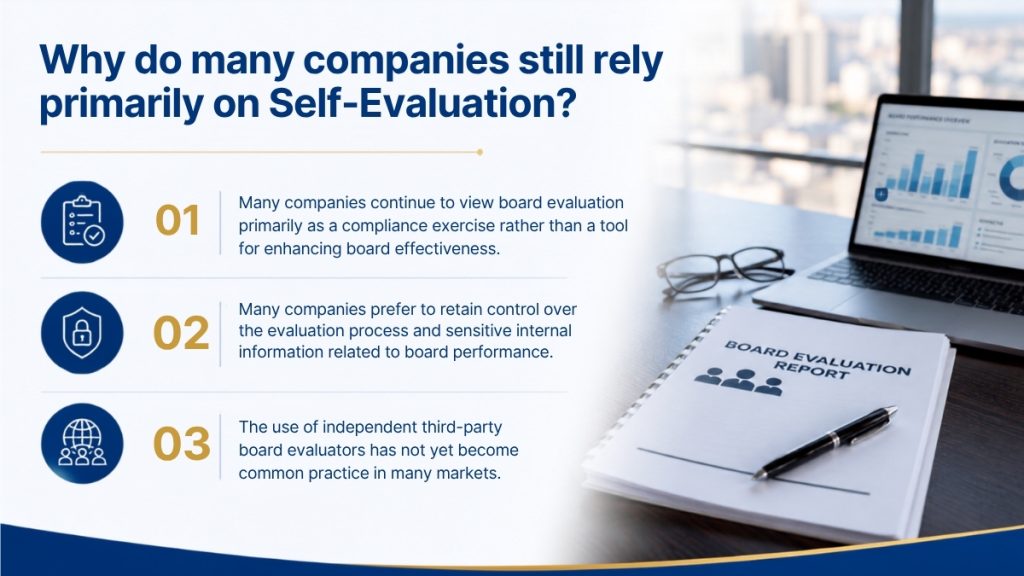
First, many companies still regard Board Evaluation primarily as a compliance exercise rather than a tool for strengthening governance capabilities. When the main objective is to complete a required process or satisfy disclosure requirements, companies tend to favor methods that are simple and convenient, while allocating limited resources to monitoring and implementing post-evaluation recommendations.
Second, many companies prefer to retain control over the evaluation process and the internal information relating to Board activities. Matters such as the Chair’s leadership effectiveness, individual directors’ contributions, collaboration between the Board and executive management, and the culture of discussion in the boardroom can be highly sensitive. As a result, many companies tend to prioritize internal evaluation before considering the engagement of an independent evaluator.
Third, the use of independent Board evaluators has yet to become common practice in many markets. Consequently, many companies do not yet view independent evaluation as a tool for strengthening governance capabilities, but instead consider it primarily in terms of cost, resources, or necessity. Yet an independent evaluation can not only provide an objective perspective but also enable companies to benchmark themselves against leading governance practices and identify gaps that self-evaluation may not fully reveal.
These factors explain why self-evaluation remains a common choice for many companies. However, without an appropriate methodology and objective feedback mechanisms, self-evaluation may be influenced by subjectivity and may not fully reflect the Board’s actual effectiveness.
For this reason, companies in many developed markets increasingly combine annual self-evaluations with periodic third-party evaluations to enhance objectivity, promote continuous improvement, and strengthen investor confidence.
Gaps in Corporate Governance practice in Vietnam
Corporate Governance in Vietnam has made considerable progress in recent years. Many listed companies have established Board committees, increased the representation of independent directors, enhanced disclosure practices, and gradually adopted international governance practices.
However, when examining the actual quality of Board performance, an important gap remains: not every company has established a substantive mechanism for evaluating Board effectiveness.
In practice, many companies continue to evaluate their Boards based on administrative indicators such as the number of meetings held, directors’ attendance rates, or the extent to which annual plans have been completed. While these indicators may reflect compliance, they are insufficient to assess the quality and effectiveness of Board performance.
More importantly, evaluation results are often not translated into concrete improvement plans, such as adjusting Board composition, addressing capability gaps, improving the effectiveness of Board committees, or developing training programs for directors. In such cases, Board Evaluation can easily become a procedural step in the governance process rather than a tool for improving Board effectiveness and the quality of decision-making.
What should a substantive Board Evaluation assess?
As noted above, in the spirit of the G20/OECD Principles of Corporate Governance (2023), Board Evaluation serves as a mechanism through which the Board can periodically review its effectiveness and assess whether its structure, capabilities, and ways of working remain appropriate, thereby supporting continuous improvement. However, the value of Board Evaluation does not lie simply in whether an evaluation is conducted, but in the scope and quality of what is assessed.
Although the OECD does not prescribe a single standardized set of Board Evaluation criteria, the Board’s core responsibilities and the objectives of Board Evaluation suggest that a substantive assessment should focus on factors that directly affect governance quality and the Board’s ability to create value, including:
- Quality of decision-making: Does the Board devote sufficient time to strategic matters and make decisions based on constructive challenge, diverse perspectives, and adequate information?
- Effectiveness of oversight: Does the Board effectively oversee strategy, risk management, internal control systems, and the activities of its committees?
- Operating effectiveness: Do the quality of information provided to the Board, boardroom culture, coordination between the Board and executive management, and decision-making processes enable the Board to perform its responsibilities effectively?
- Long-term capabilities: Do the Board’s composition, skills, and diversity remain aligned with the company’s strategy? Has the company established succession planning, director development, and capability-building mechanisms to respond to changes in technology, digital transformation, risk governance, and sustainability?
An evaluation creates meaningful value only when it goes beyond reviewing what the Board has done and helps identify what the Board needs to improve in order to strengthen governance quality and create long-term value for the company. This is the fundamental distinction between evaluation for compliance and evaluation for governance capability enhancement.
As Investors pay greater attention to Board Quality
This trend is also being driven by changing expectations in capital markets. While investors historically focused primarily on financial performance, they are increasingly paying attention to governance quality as a foundation for sustainable growth.
Major institutional investors regard Board effectiveness as a core factor in overseeing strategy, managing risk, and creating long-term shareholder value. For these investors, the question is not merely whether a company has independent directors, but how effectively the Board operates and what the company does to continuously improve that effectiveness.
This is also why many companies around the world have moved beyond relying solely on self-evaluation and have begun engaging independent evaluators as part of their strategy to strengthen governance capabilities and enhance market confidence.
Independent Third-Party Board Evaluation: From Governance practice to an emerging standard
The shift from internal Board Evaluation toward independent third-party evaluation is not a temporary trend. Rather, it reflects a broader change in how the role and effectiveness of the Board are understood. Whereas Board Evaluation was once conducted primarily to satisfy governance requirements, it is increasingly regarded as a tool for continuously strengthening the Board’s leadership capabilities and its ability to create long-term value.

This approach is reflected in the G20/OECD Principles of Corporate Governance (2023). Under Chapter VI – The Responsibilities of the Board, the OECD emphasizes that Boards should periodically assess their performance, structure, composition, and working processes to ensure that they remain capable of fulfilling their responsibilities for strategic direction, oversight of executive management, and risk governance.
Although the OECD Principles do not require companies to engage an independent third party to conduct Board Evaluations, the evaluation process should support continuous improvement rather than merely satisfy compliance requirements.
A similar approach is reflected in the ASEAN Corporate Governance Scorecard (ACGS). The ASEAN corporate governance assessment framework encourages companies to conduct periodic evaluations of the Board, the Chair, individual directors, and Board committees, while also recognizing companies that disclose their evaluation methodology and the improvements undertaken following the evaluation. This demonstrates that governance quality is measured not merely by whether a company has a Board, but also by how the Board improves its effectiveness over time.
In Vietnam, although the Law on Enterprises 2020 and Decree No. 155/2020/ND-CP do not require companies to engage independent third parties for Board Evaluation, the Vietnam Corporate Governance Code 2026 (VNCG Code 2026) recommends that Boards periodically evaluate their own performance and that of individual directors to enhance governance quality. This indicates that independent Board Evaluation is gradually evolving from a leading governance practice into an increasingly visible market expectation.
Perspectives from developed markets and practice in Vietnam
In many countries with developed capital markets, independent third-party Board Evaluation has become an established governance practice. The UK Corporate Governance Code recommends that FTSE 350 companies undertake an externally facilitated Board Evaluation at least once every three years and disclose in their annual reports the external evaluator, the scope of the evaluation, and the improvements implemented following the assessment. The purpose is not to rank the Board, but to establish an objective feedback mechanism that supports greater effectiveness.
Developed-Market Practice: Unilever and the UK Corporate Governance Code
Unilever provides a notable example. In its Annual Report, the company discloses how it evaluates Board effectiveness in accordance with the UK Corporate Governance Code. The evaluation is conducted annually, with an independent external evaluator engaged periodically to assess the effectiveness of the Board and its committees and to identify strengths, areas for improvement, and priorities for the next period.
The evaluation findings are also taken into account when reviewing Board composition and the reappointment of directors. This demonstrates that Board Evaluation is not treated merely as a governance procedure, but as a tool for supporting continuous improvement and strengthening governance quality.
Practice in Vietnam: PVCFC and Initial Steps Toward International Governance Practices
In Vietnam, several listed companies have begun adopting Board Evaluation practices aligned with advanced governance standards. Petrovietnam Ca Mau Fertilizer Joint Stock Company (PVCFC) is a notable example.
According to PVCFC’s disclosures, the company has established an annual evaluation system covering the Board, its committees, and individual directors, based on standardized criteria reviewed by the Nomination and Remuneration Committee. The evaluation process is designed around principles of objectivity, confidentiality, and methodological transparency, while the results are used as a basis for identifying improvement priorities for subsequent periods.
PVCFC also discloses its evaluation criteria and consolidated results in its Annual Report, demonstrating a commitment to improving governance quality rather than merely satisfying disclosure requirements.
Although PVCFC has not disclosed the use of an independent external evaluator, its approach illustrates how Vietnamese companies are gradually moving closer to international governance practices, with Board Evaluation increasingly viewed as a mechanism for continuous improvement rather than a procedural formality.
Where should companies start with Board Evaluation?
Board Evaluation creates meaningful value only when its findings are translated into concrete improvement actions. Rather than treating evaluation as a periodic exercise in isolation, companies should therefore incorporate it into a broader cycle of governance capability enhancement.
The first step is to clearly define the objectives of the evaluation. If the primary purpose is simply to satisfy disclosure requirements, the evaluation is unlikely to drive meaningful change. By contrast, when it is regarded as a tool for improving Board effectiveness, the process can help identify gaps in capabilities, composition, working processes, and decision-making quality.
Companies should then develop a comprehensive evaluation framework based on international practices such as the G20/OECD Principles of Corporate Governance (2023), the ASEAN Corporate Governance Scorecard (ACGS), and the Vietnam Corporate Governance Code 2026 (VNCG Code 2026).
Beyond assessing individual directors, the scope should extend to the effectiveness of the Board as a collective body, the role and effectiveness of the Chair, the performance of Board committees, the quality of information provided to the Board, oversight of executive management, and the Board’s ability to oversee strategic risks.
For companies undergoing transformation or preparing for major milestones such as an IPO, capital raising, restructuring, business expansion, or the implementation of a sustainability strategy, engaging an independent evaluator can provide an objective perspective and enable the Board to benchmark its practices against leading governance standards. This is also becoming increasingly relevant to institutional investors and capital markets when assessing the quality of Corporate Governance.
Board Evaluation is not the destination, but the starting point
An effective Board is not one without weaknesses, but one that is willing to recognize its limitations and proactively address them before they become risks to the company. In a continuously evolving business environment, the Board’s capacity for self-improvement will be one of the factors determining the company’s ability to adapt and achieve sustainable growth.
Third-party Board Evaluation should therefore not be viewed as an inspection or rating exercise. Rather, it is a tool that provides the Board with an independent perspective to strengthen governance quality, improve oversight effectiveness, and reinforce the confidence of shareholders, investors, and other stakeholders.
This article is part of a content series on the G20/OECD Principles of Corporate Governance, developed through the professional collaboration between CGS Vietnam, the Vietnam Independent Directors Association (VNIDA) and the VNIDA Institute of Corporate Governance (VNICG). The series aims to share knowledge, assessment approaches, and practical guidance on applying corporate governance principles in business practice.
—————-
References:
- G20/OECD Principles of Corporate Governance (2023)
- ASEAN Corporate Governance Scorecard – ACMF
- Vietnam Corporate Governance Code 2026
- IFC Corporate Governance Manual
- Law on Enterprises 2020
- Decree No. 155/2020/ND-CP
- UK Corporate Governance Code (Section 3, Provisions 21)
- Unilever. (2026). Annual Report and Accounts 2025 (Governance Report – Board Evaluation, pp. 57–58).
- PVCFC Annual Report (Case Study)
About CGS Vietnam
CGS Vietnam Consulting Joint Stock Company provides specialized advisory services in Corporate Governance, Sustainability (ESG), Risk Management, and Internal Audit. Backed by a team of experienced professionals with deep expertise in international best practices, CGS Vietnam partners with businesses to strengthen corporate governance, enhance management capabilities, meet investor expectations, and achieve long-term sustainable growth.
Contact CGS Vietnam:
Hotline: (+84) 363 581 520 | Email: [email protected] | Website: https://cgsvietnam.com/
LinkedIn: https://www.linkedin.com/company/cgs-vietnam | Facebook: https://www.facebook.com/CGSVietnamCompany/