

In the context of increasingly stringent sustainability requirements, businesses need not only to define ESG objectives but also to establish a system of policies to translate their commitments into practice.
ESG policies serve as a bridge between sustainability strategy and corporate governance and operations, helping businesses establish management principles, define responsibilities, control risks, and monitor performance. So, what is an ESG policy, which policies should businesses develop, and how can they be implemented effectively?
What is an ESG policy?
An ESG policy is a set of internal principles, commitments, and regulations designed to guide the management of environmental (E), social (S), and governance (G) issues in business operations.
According to the International Finance Corporation (IFC), environmental and social policies help businesses establish standards of conduct while communicating their core values and behavioral expectations to employees, suppliers, partners, and other stakeholders.
ESG policies should be distinguished from ESG strategies:
- ESG strategy: Defines a company’s sustainability priorities, objectives, and implementation roadmap.
- ESG policy: Establishes the principles, commitments, requirements, and responsibilities for implementing those strategic directions.
An example from the cement industry: Heidelberg Materials, one of the world’s largest building materials companies, has adopted specific ESG policies, including its Climate Policy and Alternative Fuels and Raw Materials (AFR) Policy.
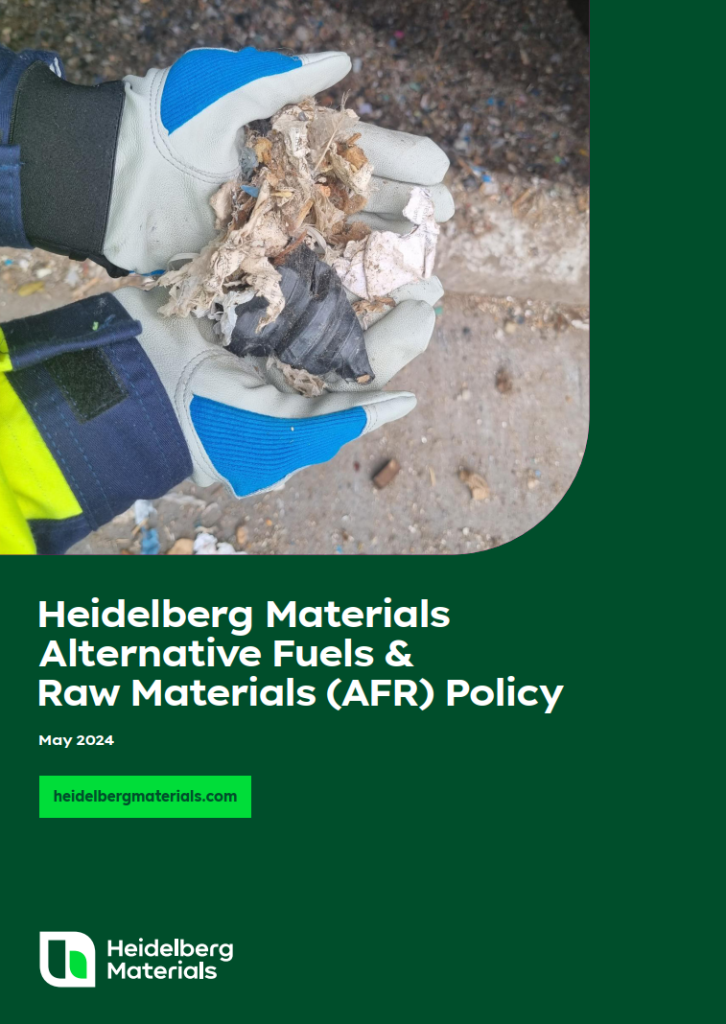
These policies aim to reduce CO₂ emissions and dependence on fossil fuels and natural raw materials by utilizing waste-derived materials and industrial by-products. The company assigns senior-level responsibility to the Chief Sustainability and New Technologies Officer and establishes auditing and reporting mechanisms to monitor implementation.
According to its Annual and Sustainability Report 2025, Heidelberg Materials achieved an alternative fuels rate of 34.1%, a clinker ratio of 68.2%, and net Scope 1 CO₂ emissions intensity of 512 kg per tonne of cementitious material. This example illustrates how a company can link ESG policies with governance responsibilities, implementation activities, and measurable outcomes.
Why should businesses develop ESG policies?
Establishing a comprehensive ESG policy framework delivers important governance and business benefits:
- Risk management: Proactively prevent and mitigate risks related to the environment, labor, supply chains, business ethics, and compliance.
- Meeting stakeholder expectations: Strengthen the confidence of investors, customers, financial institutions, and business partners through commitments supported by concrete implementation measures.
- Strengthening governance accountability: Clearly define the roles of the Board of Directors (Board), executive management, and relevant departments in ESG implementation and oversight.
- Enhancing transparency: Establish a foundation for performance measurement, evidence retention, and reliable sustainability disclosures.
Notably, Guideline 9.1.1 of the Vietnam Corporate Governance Code 2026 (VNCG Code 2026) recommends that the Board ensure the company has a policy, or a dedicated section within its Corporate Governance Policy, addressing governance arrangements and commitments related to climate change, environmental, and social matters.
This demonstrates that ESG policies are not merely operational management tools but are also directly linked to the Board’s oversight responsibilities.
Key categories of ESG policies for businesses

There is no universal list of ESG policies applicable to all businesses. The selection and development of policies should be based on a company’s size, industry, material ESG issues, regulatory requirements, and stakeholder expectations.
Overall ESG policy
An overall ESG policy, also referred to as a sustainability policy, sets out a company’s overarching commitments and approach to environmental, social, and governance matters.
This policy typically defines sustainability principles, ESG priorities, compliance commitments, management responsibilities, and oversight mechanisms. It provides the foundation for developing specific ESG policies and ensures alignment between strategy, objectives, and implementation activities.
An overall ESG policy may be issued as a standalone document or integrated into the company’s corporate governance policy and other relevant internal management documents, depending on its organizational structure and needs.
Environmental policies (E)
Environmental policies aim to manage the environmental impacts of business activities, improve resource efficiency, and address climate change.
Typical policies include:
| Policy | Key focus |
|---|---|
| Environmental management | Controlling pollution, waste, and environmental impacts arising from production and business operations |
| Climate change and emissions reduction | Managing greenhouse gas emissions, promoting emissions reductions, and addressing climate-related risks |
| Resource management | Improving the efficient use of energy, water, and raw materials; promoting reuse, recycling, and the circular economy |
| Biodiversity protection | Preventing and minimizing adverse impacts on ecosystems, natural habitats, and biodiversity |
Policy priorities may vary across industries. For example, industrial manufacturers may focus on energy, emissions, and waste management, while agricultural businesses may place greater emphasis on water, land, and biodiversity.
Social policies (S)
Social policies focus on protecting the rights and interests of employees, customers, and communities, as well as managing the social impacts of business activities.
| Policy | Key focus |
|---|---|
| Labor and human rights | Ensuring fair working conditions, respecting workers’ rights, and preventing human rights violations |
| Occupational health and safety | Preventing workplace accidents, controlling safety hazards, and protecting employee health |
| Equality, diversity, and inclusion | Promoting equal opportunities and preventing discrimination in recruitment and employee development |
| Customer and community responsibility | Ensuring product safety, protecting customer rights and information, and managing impacts on communities |
According to the OECD Guidelines for Multinational Enterprises on Responsible Business Conduct 2023, businesses are encouraged to conduct risk-based due diligence to identify, prevent, and mitigate actual and potential adverse impacts associated with their operations, while accounting for how these impacts are addressed.
Therefore, the scope of social policies should extend beyond internal human resources to consider impacts associated with suppliers, contractors, and communities.
Governance policies (G)
Governance policies provide the foundation for transparent business conduct, accountability, and effective risk management.
| Policy | Key focus |
|---|---|
| Business ethics and anti-corruption | Establishing standards of conduct and preventing corruption, fraud, and other improper practices |
| Conflict of interest management | Defining procedures for identifying, disclosing, and managing conflicts of interest |
| Risk management and internal control | Establishing principles for identifying, assessing, managing, and monitoring risks, including ESG risks |
| Whistleblowing and whistleblower protection | Establishing reporting channels, investigation procedures, and mechanisms to protect whistleblowers against retaliation |
| Information disclosure | Defining responsibilities, transparency principles, and quality control requirements for disclosed information |
For public companies, the VNCG Code 2026 also emphasizes the Board’s role in establishing and overseeing the implementation of ethical standards, disclosure policies, risk management, and internal controls, including sustainability-related matters.
In addition to these categories, businesses may establish responsible procurement and supplier management policies to integrate environmental, labor, business ethics, and risk management requirements into supplier selection, assessment, and monitoring.
In Vietnam, Article 7 of Circular No. 13/2023/TT-BKHĐT identifies environmental, social, and governance criteria for developing a tool to assess business models adopting ESG practices under the program supporting sustainable business development in the private sector for 2022–2025. These criteria may serve as references when reviewing ESG issues that need to be managed, but they do not constitute a mandatory, standardized list of policies applicable to all businesses.
What matters is not the number of policies issued, but their relevance to material ESG issues and their effectiveness in implementation and oversight.
Process for developing an ESG policy framework

Drawing on the IFC’s guidance on Environmental and Social Management Systems (ESMS) and the Handbook on ESG Framework Implementation and ESG Reporting (UK PACT/AED, 2024), businesses may develop and enhance their ESG policy framework through the following six steps.
Step 1. Assess the existing ESG policy framework
Review existing policies, regulations, and procedures related to environmental management, human resources, business ethics, risk management, and information disclosure. The objective is to identify policies that already meet relevant requirements, areas that are missing or require improvement, and opportunities to avoid creating duplicate documents.
Step 2. Identify material ESG issues
Assess ESG impacts, risks, and opportunities associated with business operations while considering stakeholder expectations. The assessment results help determine which ESG policies should be prioritized for development or improvement, ensuring resources are focused on issues that matter most to the business.
Step 3. Develop and refine policy content
Based on the identified priorities, businesses should develop new policies or revise existing ones.
A policy should generally clearly define:
- Purpose and scope of application.
- Principles, commitments, and implementation requirements.
- Responsibilities of management levels and relevant departments.
- Implementation, monitoring, and review mechanisms.
Policy content should be aligned with the ESG strategy, applicable laws and regulations, and the existing corporate governance framework.
Step 4. Review and approval
Draft ESG policies should be reviewed for appropriateness, consistency, and feasibility before being submitted to the Board or other authorized decision-making bodies for approval in accordance with internal regulations. Senior leadership involvement helps ensure that ESG commitments are aligned with governance responsibilities and the company’s strategic direction.
Step 5. Communication and implementation
Once approved, policies should be communicated to departments, employees, and relevant stakeholders. More importantly, policy commitments must be translated into operational procedures, action plans, clearly assigned responsibilities, and adequate resources.
For example, a waste management policy should be supported by procedures for waste segregation, collection, monitoring, and reporting. A whistleblowing policy should establish reporting channels, designated personnel responsible for handling reports, and confidentiality requirements.
Step 6. Monitoring, evaluation, and updates
Businesses should establish performance indicators, reporting mechanisms, and periodic reviews to assess policy compliance and implementation effectiveness. Monitoring results should provide the basis for updating policies in response to changes in legislation, corporate strategy, business operations, or emerging ESG risks.
Key considerations for effective ESG policy implementation
Issuing policies is only the first step. To ensure effective implementation, businesses should pay particular attention to the following factors:
- Board oversight: The Board should oversee the integration of ESG into corporate strategy, risk management, and internal control systems. Depending on the company’s size, it may establish a dedicated committee or assign ESG responsibilities to an existing committee or individual Board members.
- Executive management responsibilities: Executive management is responsible for organizing implementation, allocating budgets and personnel, and assigning specific responsibilities to each department. Policies should be embedded in operational processes rather than existing solely as formal documents.
- Linking policies to KPIs and internal controls: Policy commitments should be monitored through appropriate indicators, such as energy consumption intensity, occupational accident rates, or the percentage of employees trained in business ethics. Businesses should also retain supporting evidence and establish mechanisms for verifying and evaluating implementation results.
- Periodic review and improvement: Policies should be updated when legal requirements, corporate strategies, or material ESG risks change, ensuring continued relevance to business operations.
Under Guideline 9.2.7 of the VNCG Code 2026, the Board is recommended to oversee executive management to ensure that it:
- Establishes an environmental and social management system, with clearly assigned responsibilities and appropriate control measures.
- Allocates adequate resources.
- Provides budgets for managing ESG risks and opportunities and reducing greenhouse gas emissions, in line with sustainability objectives.
- Promptly addresses deficiencies related to climate, environmental, and social matters.
- Monitors and evaluates progress toward established objectives.
Common mistakes in developing ESG policies

Several common shortcomings may prevent an ESG policy framework from delivering its intended outcomes:
| Common mistake | Consequence |
|---|---|
| Issuing policies as a formality without implementation procedures | Commitments are difficult to translate into practical actions |
| Copying policies from other companies | Policy content does not reflect industry characteristics or material risks |
| Failing to assign responsibilities and allocate resources | Inconsistent implementation and unclear accountability |
| Lacking KPIs, control mechanisms, and supporting evidence | Difficulty measuring effectiveness or substantiating results |
| Failing to review and update policies periodically | Policies become outdated and no longer reflect regulatory requirements or business realities |
To address these shortcomings, businesses should treat ESG policies as an integral component of their corporate governance framework, ensuring alignment between commitments, responsibilities, resources, processes, and oversight mechanisms.
Conclusion
ESG policies provide a foundation for businesses to translate their sustainability commitments into concrete actions, strengthen risk management, and enhance accountability.
Rather than focusing on the number of policies issued, businesses should prioritize those addressing material ESG issues, with clearly defined implementation responsibilities and measurable performance indicators. This helps ensure that ESG is meaningfully integrated into corporate governance and business operations.
References:
- OECD (2023). OECD Guidelines for Multinational Enterprises on Responsible Business Conduct.
- IFC (2015). Environmental and Social Management System Implementation Handbook – General.
- UK PACT/AED (2024). Handbook on ESG Framework Implementation and ESG Reporting.
- Heidelberg Materials (2026). Annual and Sustainability Report 2025.
- Heidelberg Materials (2024). Alternative Fuels & Raw Materials (AFR) Policy.
- Heidelberg Materials (2023). Climate Policy.
- State Securities Commission of Vietnam and IFC (2026). Vietnam Corporate Governance Code 2026.
- Ministry of Planning and Investment (2023). Circular No. 13/2023/TT-BKHĐT.
About CGS Vietnam
CGS Vietnam Consulting Joint Stock Company provides specialized advisory services in Corporate Governance, Sustainability (ESG), Risk Management, and Internal Audit. Backed by a team of experienced professionals with deep expertise in international best practices, CGS Vietnam partners with businesses to strengthen corporate governance, enhance management capabilities, meet investor expectations, and achieve long-term sustainable growth.
Contact CGS Vietnam:
Hotline: (+84) 363 581 520 | Email: [email protected] | Website: https://cgsvietnam.com/
LinkedIn: https://www.linkedin.com/company/cgs-vietnam | Facebook: https://www.facebook.com/CGSVietnamCompany/