

In an increasingly complex capital market, the question “Who are the company’s shareholders?” may no longer be sufficient for investors to understand how a company is actually owned and controlled. A legal entity may be the registered holder of shares, while multiple layers of ownership may exist behind that entity. Similarly, the percentage of shares owned may not fully reflect the degree of control where a company uses different mechanisms to allocate voting rights.
This is why beneficial ownership has become an increasingly important aspect of corporate transparency and corporate governance.
What is a beneficial owner of a company?
Under the approach commonly adopted by the OECD and other international organizations, a beneficial owner is the ultimate natural person who actually owns or controls a company, even where such ownership or control is exercised indirectly through one or more intermediary legal entities.
For example, instead of Mr. A directly owning shares in Company X, the ownership structure may be: Mr. A → Company B → Company X.
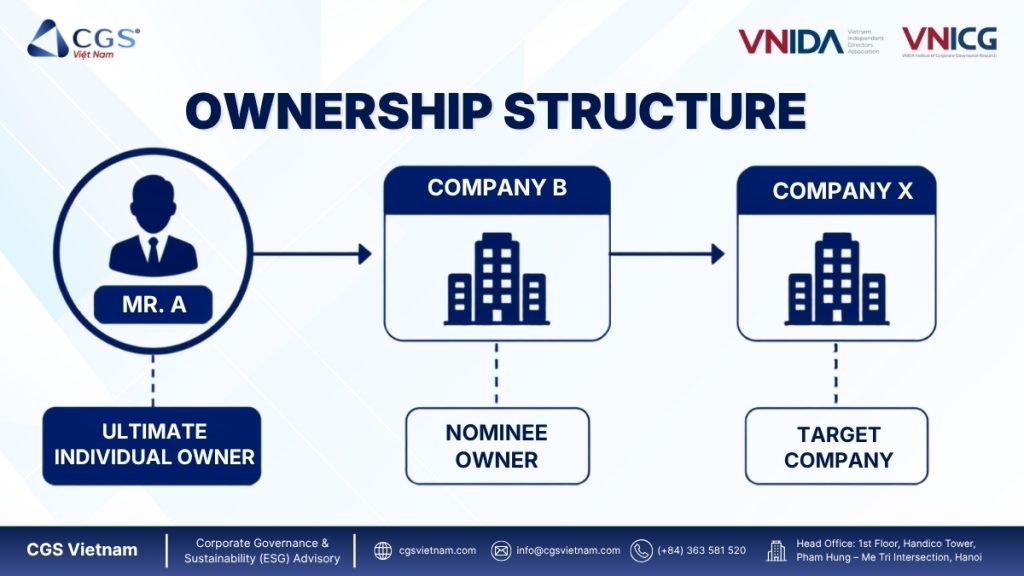
In Company X’s shareholder records, Company B is the registered shareholder. However, if Mr. A is the ultimate individual who controls Company B and, through it, Company X, disclosing only Company B would not fully reflect the actual ownership and control structure. Identifying the beneficial owner therefore helps answer a question that goes beyond the identity of the registered shareholder: Who is the ultimate natural person who actually owns or controls the company?
How is beneficial ownership regulated in Vietnam?
In Vietnam, the 2025 Law amending and supplementing a number of articles of the Law on Enterprises introduced the concept of the “beneficial owner of an enterprise with legal person status.” Accordingly, this refers to an individual who actually owns the charter capital or exercises controlling rights over the enterprise, excluding representatives of the direct owner in enterprises wholly owned by the State and representatives of State capital in joint-stock companies and limited liability companies with two or more members.
Decree No. 168/2025/ND-CP further specifies the criteria for identification and declaration. These include individuals who directly or indirectly own 25% or more of the charter capital or total voting shares, as well as individuals who have the power to control the approval of important corporate matters. Beneficial ownership is therefore determined not only by ownership percentage but may also be identified through effective control.
Why is identifying and disclosing beneficial ownership important?
Beneficial ownership transparency has direct implications for the quality of corporate governance.
In its research on beneficial ownership and control, the OECD points out that the rights of employees, creditors and other stakeholders may be difficult to enforce effectively if the parties with ultimate decision-making authority cannot be identified. The accountability of the Board of Directors may also be undermined where the decision-making structure and ultimate control are not clearly identifiable.
This does not mean that concentrated ownership or the presence of a controlling shareholder is inherently problematic. In some cases, controlling shareholders or founders with significant economic interests may have stronger incentives to oversee management and pursue the company’s long-term direction.
However, OECD research also notes that controlling owners with substantial voting power may have incentives to divert corporate assets or business opportunities for their own benefit, potentially to the detriment of minority investors.
The fundamental issue, therefore, is not simply whether a company has a controlling shareholder, but whether the market has sufficient information to determine:
- Who actually owns or controls the company?
- What is the extent of that ownership or control?
- Is control derived from equity ownership, voting rights, shareholder agreements, or other mechanisms?
- Is the level of control proportionate to the economic interest held by the controlling party?
OECD: Transparency must go beyond the shareholder register
This is also why the G20/OECD Principles of Corporate Governance 2023 addresses this issue in Chapter IV – Disclosure and Transparency.
Transparency of major shareholders, beneficial owners and voting rights
Under Principle IV.A.4, one of investors’ fundamental rights is access to information on a company’s ownership structure and their rights relative to those of other owners. This right to information also extends to the structure of corporate groups and intra-group relationships. The OECD states that disclosure should clarify the objectives, nature and structure of corporate groups.
Disclosed information may include major shareholders and other parties capable of directly or indirectly exercising significant influence or control over the company through:
- Special voting rights;
- Shareholder agreements;
- Ownership of controlling or substantial blocks of shares;
- Parent-company structures involving multiple layers of legal entities;
- Significant cross-shareholdings;
- Cross-guarantee arrangements.
Importantly, the OECD states that, for enforcement purposes and to identify potential conflicts of interest, related-party transactions, insider trading and market manipulation, information about shareholders of record should be complemented by current information about beneficial ownership. Depending on the legal framework, such information may be maintained in a central registry, held by the company, or at a minimum be accessible to regulatory, enforcement and judicial authorities.
Accordingly, the G20/OECD Principles of Corporate Governance 2023 do not necessarily require all information about every beneficial owner to be fully disclosed to the public. Rather, the OECD emphasizes two complementary requirements:
- Providing investors with the information they need;
- Ensuring that competent authorities can access current and accurate beneficial ownership information.
Transparency of capital structures and control mechanisms
In addition, Principle IV.A.3 requires transparency regarding mechanisms that may alter the degree of influence shareholders can exercise over a company. According to the OECD, certain capital structures may enable shareholders to exercise control disproportionate to their equity ownership, including:
- Pyramid ownership structures;
- Cross-shareholdings;
- Shares with limited voting rights;
- Shares with multiple voting rights.
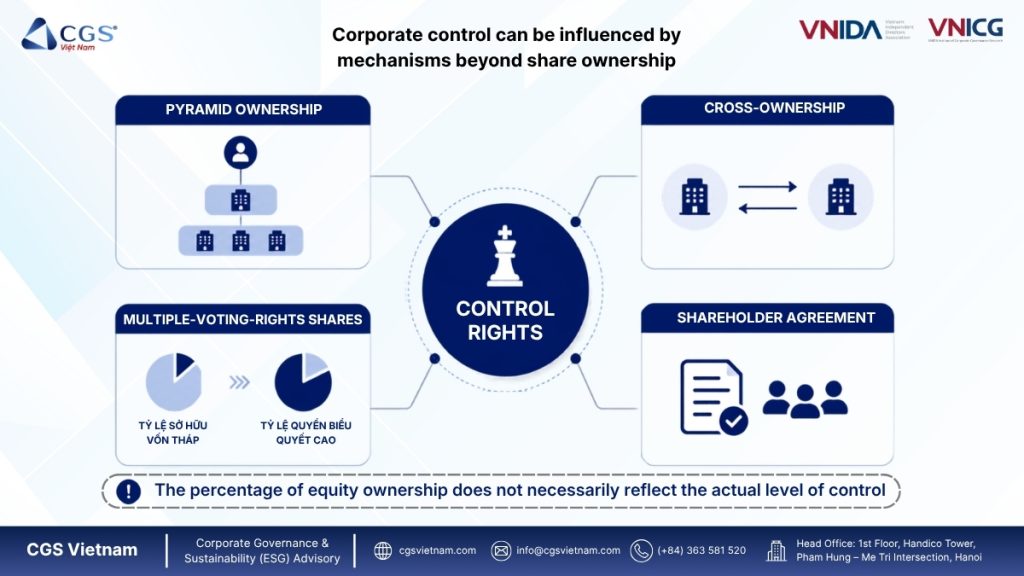
Beyond ownership relationships, control may also arise through shareholder agreements or voting caps. For example, a group of shareholders, none of whom individually holds a substantial ownership stake, may agree to act in concert and thereby form an effective majority or the largest shareholder bloc in the company.
Therefore, to understand who actually influences and controls a company, investors need to know not only who is registered as holding the shares, but also:
- Who the beneficial owners are;
- The voting rights attached to each class of shares;
- The agreements or other control mechanisms in place;
- The relationship between equity ownership and actual control.
PVCFC: Transparency of controlling shareholders and ultimate control
One example from Vietnam of how this approach can be reflected in corporate disclosure is Petrovietnam Ca Mau Fertilizer Joint Stock Company (PVCFC).
In its 2025 Annual Report, PVCFC discloses information on its shareholder structure, including shareholders holding 5% or more of its share capital and its controlling shareholder. The company also states that, apart from the disclosed controlling shareholder, no other individual or organization exercises ultimate control over PVCFC.
This information helps investors better understand the relationship between the controlling shareholder and control over PVCFC. PVCFC can therefore be regarded as a useful reference for the disclosure of ownership and control structures in Vietnam.
However, disclosure of controlling shareholders, ultimate control and related-party transactions does not necessarily constitute full disclosure of beneficial ownership in the legal sense or in accordance with good practices. Beneficial ownership transparency also seeks to:
- Identify the ultimate natural person who actually owns or controls the legal entity;
- Clarify the chain of direct and indirect ownership;
- Keep information updated when ownership or control structures change;
- Ensure that the information can be checked and verified.
In addition to information on ownership and control structures, PVCFC also publicly discloses its Regulations on the Management of Conflicts of Interest and Transactions with Related Persons, as well as information on related-party transactions in its annual report. These mechanisms contribute to greater transparency and help investors identify relationships and interests that may influence corporate decision-making.

Google: When equity ownership does not fully reflect voting power
While the PVCFC example helps answer the question “Who controls the company?”, the case of Google illustrates another dimension: equity ownership does not necessarily fully reflect voting power and the degree of control.
The OECD has used Google as an example of a company with a differentiated voting-rights structure. When Google conducted its IPO in 2004, it adopted a dual-class share structure designed to allow its founders to retain influence over the company after raising capital from public investors. Under this structure, each Class A share carried one vote, while each Class B share carried ten votes.
This distinction created a significant gap between equity ownership and control. According to Google’s 2009 disclosures, the two founders, Larry Page and Sergey Brin, together with CEO Eric Schmidt, held approximately 90% of the outstanding Class B shares and controlled approximately 68% of the company’s total voting power. Based on the disclosed number of shares, their combined holdings represented approximately 21% of the company’s total outstanding shares, illustrating that their voting power was substantially greater than their proportionate equity ownership.
Such a structure is not necessarily disadvantageous. In some circumstances, allowing founders to retain control may enable a company to pursue long-term strategies and reduce excessive pressure to deliver short-term results.
However, control that is disproportionate to equity ownership may also reduce the ability of other shareholders to influence corporate decisions. Investors therefore need sufficient information to understand:
- How many votes are attached to each class of shares;
- Who holds shares carrying enhanced voting rights;
- The actual degree of control exercised by founders or major shareholders;
- What mechanisms are in place to protect minority shareholders.
The Google case therefore demonstrates that knowing how many shares a party owns is not enough; investors must also understand the voting rights attached to those shares.
Beneficial ownership transparency as a foundation for trust
The cases of PVCFC and Google demonstrate that understanding a company’s ownership and control structure requires more than a shareholder register.
- PVCFC raises the question: Who controls the company, and is there any other party exercising ultimate control?
- Google raises a different question: Are voting power and the degree of control proportionate to equity ownership?
Together with beneficial ownership information, these disclosures provide the market with a clearer picture of the relationship between ownership, economic interests, voting rights, controlling influence and ultimate control.
This is why beneficial ownership transparency extends beyond a technical requirement relating to registration or disclosure. When investors understand who ultimately owns a company, who actually controls it, and how that control is exercised, they are better positioned to assess risks, identify potential conflicts of interest and make informed investment decisions.
Meaningful transparency should not merely answer the question “who owns how much?” It should enable the market to understand “who ultimately stands behind that ownership and control.” The ability to identify the individuals behind ownership and control is an important foundation for building trust in modern capital markets.
This article is part of a content series on the G20/OECD Principles of Corporate Governance, developed through professional collaboration among CGS Vietnam, Vietnam Independent Directors Association (VNIDA) and VNIDA Institute for Corporate Governance (VNICG), with the aim of sharing knowledge, assessment approaches and practical applications of corporate governance principles in the business context.
References:
- OECD (2023) – G20/OECD Principles of Corporate Governance 2023, Chapter IV, Principles IV.A.3 and IV.A.4.
- OECD (2013) – Beneficial Ownership and Control.
- OECD (2015) – Growth Companies, Access to Capital Markets and Corporate Governance – Google case.
- Law No. 76/2025/QH15 and Decree No. 168/2025/ND-CP – regulations on beneficial owners of enterprises.
- PVCFC – Annual Report.
- Google Inc. (2004) – IPO Final Prospectus, U.S. Securities and Exchange Commission.
- Google Inc. (2009) – Proxy Statement (DEF 14A), U.S. Securities and Exchange Commission.
About CGS Vietnam
CGS Vietnam Consulting Joint Stock Company provides specialized advisory services in Corporate Governance, Sustainability (ESG), Risk Management, and Internal Audit. Backed by a team of experienced professionals with deep expertise in international best practices, CGS Vietnam partners with businesses to strengthen corporate governance, enhance management capabilities, meet investor expectations, and achieve long-term sustainable growth.
Contact CGS Vietnam:
Hotline: (+84) 363 581 520 | Email: [email protected] | Website: https://cgsvietnam.com/
LinkedIn: https://www.linkedin.com/company/cgs-vietnam | Facebook: https://www.facebook.com/CGSVietnamCompany/