

When people think of a Sustainability Report, many companies picture a document dozens or even hundreds of pages long, filled with data on the environment, employees, communities, and social initiatives. Yet behind the report lies an entire process of identifying material topics, setting targets, managing data, and tracking performance. The quality of a report therefore depends not only on how it is presented, but also on the company’s underlying sustainability governance and data systems.
Join CGS Vietnam as we explore what a Sustainability Report is, its core components, and how companies can develop reports aligned with current standards and practices.
What is a Sustainability Report?
According to the Global Reporting Initiative (GRI), Sustainability Reporting is a process that begins with an organization identifying its material topics based on its most significant impacts and publicly reporting information about those impacts. GRI also allows sustainability information to be disclosed in various forms, including a standalone Sustainability Report, an Annual Report, a website, or other disclosure channels.
Simply put, sustainability reporting is a way for companies to provide stakeholders with information about the significant impacts that their activities and business relationships have on the economy, environment, and people, as well as how those impacts are managed.
The scope and focus of disclosure also depend on the reporting standard and purpose. GRI focuses on a company’s most significant impacts on the economy, environment, and people. In contrast, IFRS S1 and IFRS S2 issued by the ISSB focus on information about sustainability-related risks and opportunities that could affect a company’s prospects, with the aim of supporting decision-making by investors, lenders, and other creditors.
Before preparing a report, companies therefore need to clearly determine their reporting objectives, intended users, and applicable standards or disclosure requirements in order to select the appropriate content and data.
Why should companies prepare Sustainability Reports?
Sustainability Reports increasingly serve purposes beyond disclosure. They help companies systematize data, identify material ESG issues, and respond to rising expectations from investors, customers, business partners, and other stakeholders.
Enhancing transparency for investors and stakeholders
Sustainability Reports complement information that financial results alone may not fully capture, helping stakeholders better understand a company’s material issues, management approaches, performance, and targets.

Responding to market and supply chain requirements
Standardizing data on emissions, energy, labor, human rights, and other ESG matters enables companies to respond more proactively to requirements from customers, business partners, and international supply chains.
Supporting ESG risk and opportunity management
The reporting process helps companies identify ESG impacts, risks, and opportunities, which can then be progressively integrated into risk management, strategy, and decision-making.
Improving data quality and internal governance
The need for reliable data encourages companies to standardize indicators, data sources, responsibilities, and control mechanisms. A strong report therefore not only reflects ESG performance but can also contribute to improving the governance systems behind the report.
What does a Sustainability Report typically include?
There is no single Sustainability Report structure that applies to every company. Report content depends on the industry, nature of operations, impacts, material topics, and applicable standards. However, a relatively comprehensive report typically includes the following:
Company overview and development direction
This section introduces the business model, strategy, value chain, and the relationship between sustainability and the company’s operations. It helps readers understand that sustainability is not a standalone activity but is connected to how the company operates and grows.
Material topics
This is one of the core components of a Sustainability Report.
Not every environmental, social, or governance issue is equally important to every company. For example, a chemical manufacturer may place particular emphasis on chemical safety, emissions, and occupational safety, while a bank may focus more on risk management, customer data protection, responsible finance, and financial inclusion.
Under GRI, material topics represent an organization’s most significant impacts on the economy, environment, and people, including impacts on human rights. Properly identifying material topics therefore enables companies to determine which issues should be prioritized for management and which information should be the focus of disclosure.
Policies, targets, and actions
For each material topic, companies should demonstrate how the issue is managed through policies, assigned responsibilities, targets, specific action programs, and initiatives.
Data and performance results
Depending on their material topics, companies may disclose indicators such as greenhouse gas emissions, energy consumption, water use, waste, occupational safety, employee training, workforce turnover, diversity and inclusion, or governance-related metrics.
A figure becomes more meaningful when presented with context: how has performance changed compared with the previous year, what caused the change, and what is the company doing to improve?
Targets and future direction
A strong Sustainability Report should not only look back at the past year but also explain where the company is heading, its medium- and long-term targets, and the next steps it intends to take.
Sustainability reporting in Vietnamese companies
In Vietnam, several companies began sustainability reporting relatively early and have maintained the practice for many years. For example, Vinamilk began publishing a standalone report in 2012, while PAN Group introduced its standalone Sustainability Report in 2016 and has continued the practice to date.
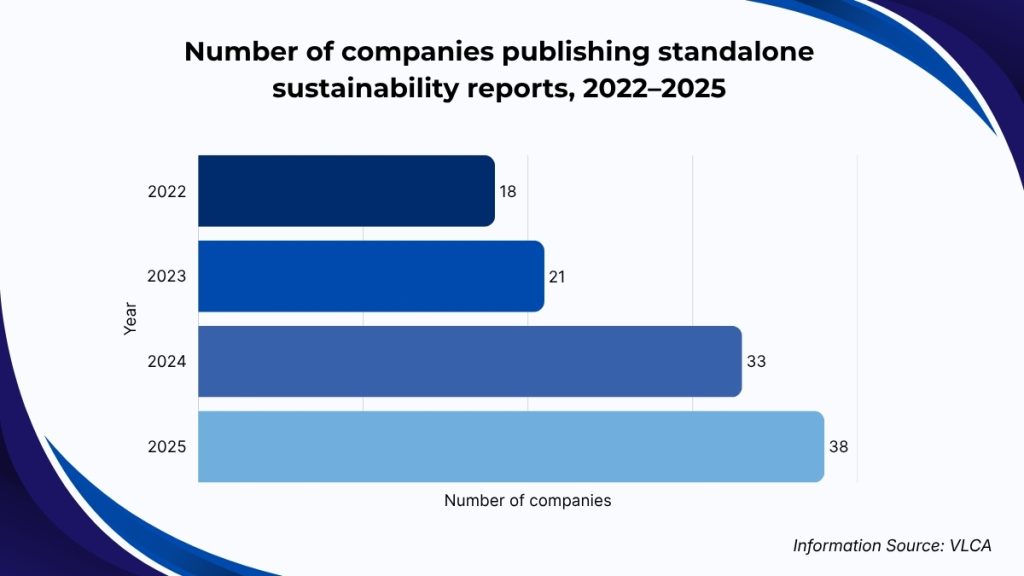
Experience from the Vietnam Listed Company Awards (VLCA) indicates that Sustainability Reports are receiving increasing attention from listed companies. The number of companies preparing standalone Sustainability Reports increased from 18 in 2022 to 21 in 2023, 33 in 2024, and 38 in 2025.
At VLCA 2025, several companies received notable recognition in the Sustainability Reporting category, including:
- Petrovietnam Ca Mau Fertilizer Joint Stock Company (PVCFC) received First Prize for Sustainability Reporting – Non-Financial Group.
- Viet Dragon Securities Corporation received the Most Improved Company Award for Sustainability Reporting – Financial Group.
- Nam Long Investment Corporation received the Most Improved Company Award for Sustainability Reporting – Non-Financial Group.
However, reporting priorities vary depending on industry and business characteristics. Manufacturing companies may place greater emphasis on energy, emissions, water, waste, and occupational safety, while banks may focus more heavily on green finance, environmental and social risks, data protection, and customer responsibility.
There is therefore no single Sustainability Report structure suitable for every company. Report content should be grounded in each company’s business model, value chain, impacts, and material topics.

Common mistakes when preparing a Sustainability Report
Equating sustainability with social initiatives
Community activities, such as scholarship programs or tree-planting initiatives, are only one part of sustainability. Companies still need to focus on other material impacts and issues relating to the environment, employees, customers, supply chains, and governance.
Providing extensive data without a clear narrative
A report containing hundreds of indicators does not necessarily provide useful information if readers cannot understand what the figures mean. Alongside quantitative data, companies should provide sufficient context to explain what the results indicate, how they have changed over time, the reasons behind significant changes, progress against targets, and how the related issues are being managed.
Following standards without considering company-specific circumstances
Standards help companies organize and disclose information systematically, but they do not replace the need to identify the issues that genuinely matter based on the company’s operations, impacts, risks, and opportunities.
Focusing only on the past year’s results
A report should communicate not only current performance but also future targets, progress, and direction, enabling stakeholders to assess how commitments are being translated into action.
Treating ESG as the responsibility of a single department
ESG data and responsibilities span multiple functions, including Human Resources, Operations, Finance, Legal, and Procurement, and require direction and oversight from the Board of Directors and executive management. Without effective coordination, reporting can become little more than a year-end data collection exercise rather than an integral part of the company’s governance system.
Good reporting starts with good governance
A strong Sustainability Report does not necessarily need to be hundreds of pages long. More importantly, it should focus on material issues, use reliable data, and demonstrate the connection between sustainability, corporate strategy, and the company’s ability to create value.
Companies should therefore view the report not simply as a communications product published once a year, but as the outcome of a continuous governance process: Identify impacts and material topics → Assign responsibilities → Collect data → Set targets → Implement and monitor → Evaluate performance → Disclose information → Continuously improve.
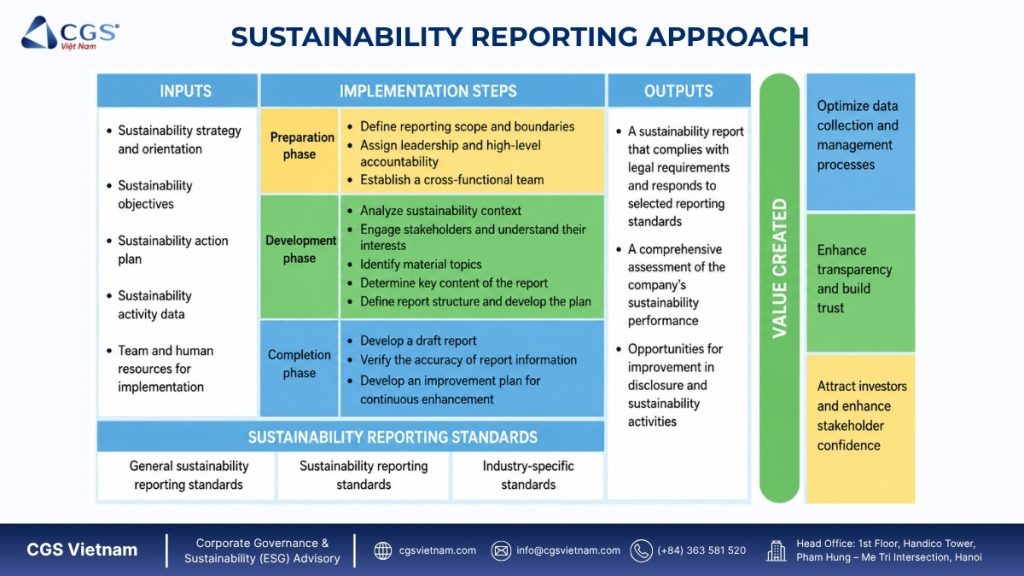
When approached in this way, a Sustainability Report becomes more than a disclosure document. It becomes a tool that helps companies better understand the risks, opportunities, and impacts associated with their operations.
CGS Vietnam supports companies on their sustainability journey
As an advisory firm specializing in Corporate Governance, Sustainability, and corporate disclosure, CGS Vietnam aims to help companies not only produce a report but also progressively strengthen the governance and data systems behind it.
CGS Vietnam can support companies across a range of areas, including:
- Assessing ESG performance and organizational readiness;
- Identifying and assessing material topics in line with industry characteristics and business strategy;
- Developing the framework and content for Sustainability Reports/Integrated Reports;
- Reviewing alignment with standards, regulations, and international practices;
- Developing ESG indicators, data systems, and information collection mechanisms;
- Advising on ESG governance mechanisms and the allocation of responsibilities among the Board of Directors, executive management, and functional units;
- Reviewing and improving the quality of corporate disclosures to enhance transparency, consistency, and verifiability.
Ultimately, the value of a Sustainability Report does not lie in the number of pages or indicators disclosed. Its value lies in helping a company understand where it stands, which impacts and risks need to be managed, which opportunities can be captured, and what needs to be done to create more sustainable value in the future.
This is when Sustainability Reporting evolves from a disclosure requirement into a tool for governance and long-term value creation.
—————-
References:
- GRI 1: Foundation 2021 – Global Reporting Initiative
- IFRS Foundation, IFRS S1 – General Requirements for Disclosure of Sustainability-related Financial Information
- IFRS Foundation, IFRS S2 – Climate-related Disclosures
- Vinamilk Sustainability Reports
- PAN Group Sustainability Reports
- Vietnam Listed Company Awards (VLCA) 2024
- Vietnam Listed Company Awards (VLCA) 2025
About CGS Vietnam
CGS Vietnam Consulting Joint Stock Company provides specialized advisory services in Corporate Governance, Sustainability (ESG), Risk Management, and Internal Audit. Backed by a team of experienced professionals with deep expertise in international best practices, CGS Vietnam partners with businesses to strengthen corporate governance, enhance management capabilities, meet investor expectations, and achieve long-term sustainable growth.
Contact CGS Vietnam:
Hotline: (+84) 363 581 520 | Email: [email protected] | Website: https://cgsvietnam.com/
LinkedIn: https://www.linkedin.com/company/cgs-vietnam | Facebook: https://www.facebook.com/CGSVietnamCompany/