

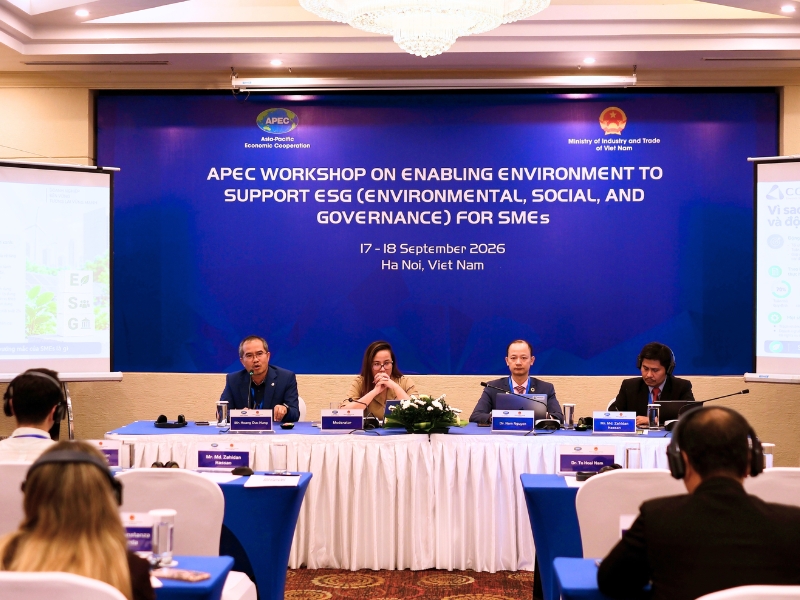
On 17–18 September 2026 in Hanoi, the APEC Workshop on “Enabling Environment to Support ESG (Environmental, Social, and Governance) SMEs” was held with the participation of experts, business support organizations and private-sector representatives from across the APEC region.
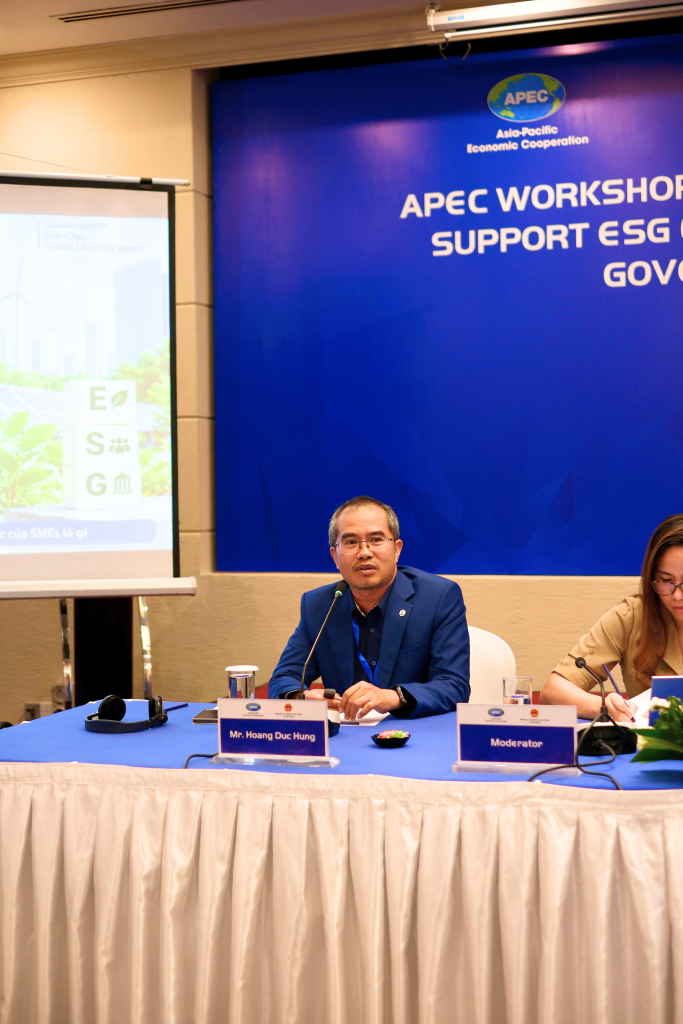
As part of the program, Mr. Hoang Duc Hung – Chairman of the Board of Directors of CGS Vietnam – participated as a speaker in Session 3: “Financing and market incentives for ESG adoption”, alongside Dr. Nam Nguyen – Founder & CEO, KLINOVA, Vietnam, and Mr. Md. Zahidan Hassan – Deputy Director, Financing Division, SME Corporation Malaysia.
Notably, the Workshop took place at the same time that Decision No. 46/2026/QD-TTg was issued on 17 September 2026, providing guidance on the identification of green projects, projects meeting circular economy criteria, and the application of environmental, social and governance standards. The Decision will take effect on 1 November 2026.
This context highlights the increasingly clear connection between ESG practices, green projects and access to financial resources.
ESG from the perspective of SMEs: Why do businesses actually want to adopt it?
Rather than starting with ESG standards or reporting requirements, Mr. Hoang Duc Hung’s presentation approached ESG from the internal priorities and business concerns of SMEs.
Drawing on his experience working with businesses in different capacities, Mr. Hung highlighted three main drivers behind SMEs’ growing interest in ESG:
- First, return on investment and operational capability – ROI: ESG can only become a sustainable part of business operations when companies see opportunities to optimise operations, use resources more efficiently or generate clear economic value.
- Second, regulatory compliance and market requirements: Requirements relating to the environment, supply chains, customers and business partners are increasingly becoming conditions of doing business that SMEs cannot afford to ignore.
- Third, access to finance: As resources for green credit and sustainable finance in Vietnam continue to expand, ESG can become one of the factors supporting businesses in accessing capital for their transition.
However, an important question remains: Are these drivers strong enough for an SME to actually allocate resources to ESG?
The barriers go beyond access to finance
One notable point in the presentation was that ESG should not be viewed simply as a matter of “businesses needing capital but being unable to obtain financing.” Before considering access to capital markets, SMEs must first address constraints within their own organizations.
According to the data presented by Mr. Hung, three major challenges stand out: 70% of businesses face difficulties in developing an ESG strategy; 60% lack implementation capabilities; and 54% face challenges in ESG measurement, monitoring and reporting. (According to PwC’s 2025 ESG Progress Survey.)
Behind these figures lies a structural issue: SMEs typically operate with limited resources. If ESG is introduced from the outset through a highly comprehensive or complex model similar to that adopted by large corporations, implementation costs may exceed their capacity.
Challenges may also come from outside the business.
For financial institutions, financing an SME is not necessarily simpler than financing a large enterprise. As highlighted in CGS’s presentation, whether a loan is provided to an SME or a large corporation, banks must still allocate resources to conduct proper due diligence and assessment.
In practice, this may make financial institutions more comfortable working with businesses that already demonstrate stronger governance, financial capacity and the ability to provide reliable supporting evidence.
At the same time, market signals also matter. Will customers genuinely prioritize a “green” product, or will purchasing decisions still be driven mainly by price and quality? How much importance do investors place on ESG, and what information are they actually looking for when making investment decisions?
If these signals remain unclear, SMEs may struggle to answer a fundamental question: How much should the business invest in ESG, and where will the actual economic benefits come from?
From ESG commitments to verifiable outcomes
Against these challenges, the central message of the presentation was that SMEs do not necessarily need to begin their ESG journey with a complex system.
Instead, businesses can adopt an approach based on four interconnected capability areas:
Governance → Technical → Finance → Monitoring
- Under Governance, businesses should define leadership commitment, assign clear accountability and identify the issues that are genuinely important to their operations.
- Under Technical, SMEs can begin with solutions appropriate to their scale, prioritising small but feasible steps rather than implementing too many initiatives at the same time.
- Under Finance, businesses should allocate funding and cash flows in line with their financial capacity, while viewing ESG as an investment that requires a clear economic rationale and potential return.
- Finally, under Monitoring, businesses should identify the necessary indicators, manage data and gradually digitalize their processes using solutions that are proportionate to actual needs rather than building an overly complex system from the outset.
The model presented by CGS reflects this transformation pathway: moving from an ESG commitment, through capabilities in governance, technical implementation, finance and monitoring, to create verifiable ESG outcomes and thereby strengthen the company’s ability to demonstrate its capacity to lenders and other providers of capital.
For SMEs, the right solution does not need to be overly complex

From this perspective, Mr. Hoang Duc Hung proposed a more practical approach for SMEs: simplify ESG without losing its substance.
What SMEs need may not be a framework containing hundreds of indicators from the outset, but rather:
- a fit-for-purpose set of ESG indicators focused on material and measurable issues;
- financing packages tailored to the characteristics, scale and financial capacity of SMEs;
- affordable governance, technical and digitalization initiatives that can be implemented step by step;
- and opportunities to learn from economies that are further along in their ESG journeys, rather than requiring SMEs to build everything from scratch.
This approach was also reflected in the practical initiatives proposed for SMEs in the presentation: ESG and governance training, assigning responsible focal points, standardizing financial and cash-flow information, starting with affordable technical solutions, establishing a simple baseline and selecting only a limited number of material KPIs for monitoring.
ESG for SMEs should start with the ability to execute
One of the key issues raised in Session 3 was that access to finance is only one part of the equation.
For green finance to genuinely reach SMEs, both sides of the equation need to be addressed. Financial institutions need tools and mechanisms that are better suited to the characteristics of SMEs, while businesses themselves need to strengthen their ability to translate ESG commitments into plans, cash flows, data and verifiable outcomes.
For SMEs, the ESG journey therefore does not necessarily need to begin with large-scale programs.
Start small – generate measurable results – demonstrate value – and then gradually scale up may be a more practical pathway for integrating ESG into business operations, rather than treating it as an external requirement disconnected from the core business.
Through its contribution to the APEC Workshop, CGS Vietnam continues to bring practical perspectives on how ESG can become more accessible to businesses, particularly SMEs – where solutions only create meaningful value when they are aligned with the company’s capabilities, resources and real business needs.
About CGS Vietnam
CGS Vietnam Consulting Joint Stock Company provides specialized advisory services in Corporate Governance, Sustainability (ESG), Risk Management, and Internal Audit. Backed by a team of experienced professionals with deep expertise in international best practices, CGS Vietnam partners with businesses to strengthen corporate governance, enhance management capabilities, meet investor expectations, and achieve long-term sustainable growth.
Contact CGS Vietnam:
Hotline: (+84) 363 581 520 | Email: [email protected] | Website: https://cgsvietnam.com/
LinkedIn: https://www.linkedin.com/company/cgs-vietnam | Facebook: https://www.facebook.com/CGSVietnamCompany/