

Financial information has always been the primary basis for assessing a company’s performance. However, financial information alone is no longer sufficient to fully reflect a company’s ability to create and sustain value over the long term.
Against the backdrop of climate change, resource scarcity, decarbonisation requirements, and accelerating technological transformation, sustainability information is becoming an increasingly important source of information that enables investors and other stakeholders to assess a company’s financial prospects and resilience.
In practice, however, financial information and sustainability information are still often managed and disclosed as two separate streams. Without meaningful connectivity, a company may be able to demonstrate that it has implemented numerous sustainability initiatives, yet struggle to explain how those initiatives will affect its business performance and long-term value creation.
For public companies and listed companies, the question today is no longer “Has the company published a Sustainability Report?” Rather, it is: “How has the company connected its financial information and sustainability information to provide a comprehensive view of its long-term risks, opportunities, and resilience?”
The relationship between financial information and sustainability information
One of the most significant developments in modern Corporate Governance is the way sustainability information is viewed. While environmental, social and governance (ESG) information was previously disclosed primarily as a separate set of metrics to satisfy transparency requirements, international best practices now pursue a broader objective: helping investors understand how sustainability-related matters affect a company’s ability to create value over the short, medium and long term.
This perspective is clearly reflected in the G20/OECD Principles of Corporate Governance (2023). The OECD recommends that companies disclose material sustainability-related information in a manner that enables investors to assess how sustainability-related risks and opportunities may affect the company’s strategy, performance, financial position and long-term prospects.
In other words, the objective of disclosure is not merely to provide transparency regarding ESG activities, but also to demonstrate the relationship between sustainability information and the company’s ability to create and preserve value.
This way of thinking also forms the foundation of today’s reporting frameworks and standards. The International Integrated Reporting Framework (IIRC) introduced the concept of integrated thinking, encouraging companies to view strategy, governance, business model, resources and performance as interrelated components of the value creation process.
Building on this approach, IFRS S1 requires companies to ensure the connectivity of information between financial information and sustainability information, enabling report users to understand not only what has happened, but also why sustainability-related matters are relevant to the company’s future financial prospects and resilience.
Why have companies not yet connected financial information and sustainability information?
Although companies are increasingly expected to disclose both financial information and sustainability information, many still manage these two categories of information through separate systems.
The Finance and Accounting function is responsible for preparing the financial statements; the ESG function monitors environmental and social performance indicators; while the risk management and internal audit functions perform their own oversight responsibilities. Although each function may perform its role effectively, companies often lack a governance mechanism that integrates these information streams into a unified management and decision-making system.
Three common gaps can typically be observed:
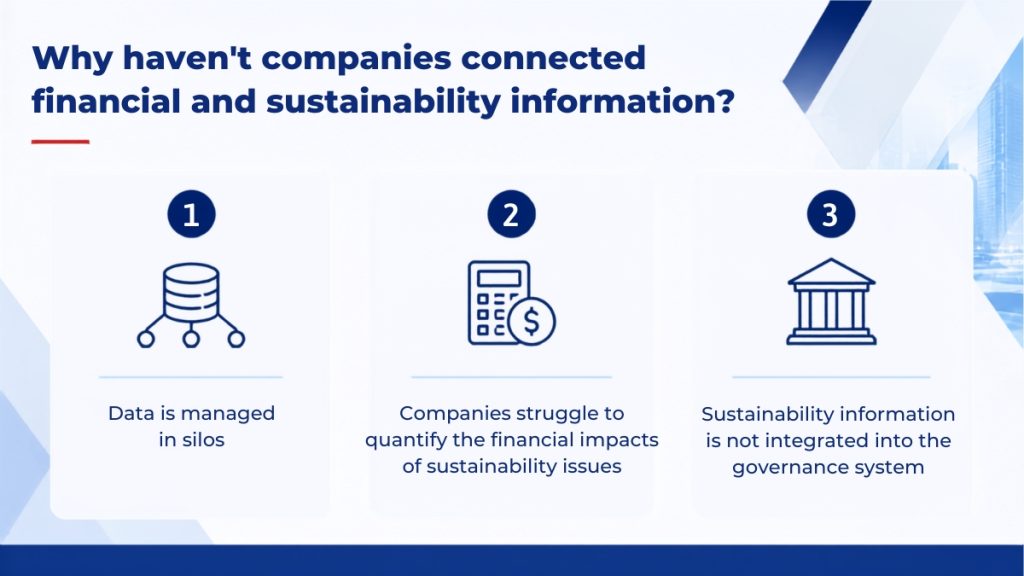
Data is managed in silos
Financial information and ESG information are often collected through different systems, using inconsistent methodologies, reporting scopes and reporting cycles. As a result, companies face significant challenges in analysing the relationship between financial and non-financial indicators.
Companies struggle to quantify the financial impacts of sustainability-related issues
Many companies have identified sustainability-related risks such as climate change, water scarcity and supply chain disruption, but have yet to assess how these risks could affect revenue, costs, cash flows or investment requirements.
Without translating sustainability-related risks into measurable financial impacts, ESG information remains largely descriptive rather than serving as a meaningful basis for planning, resource allocation and strategic decision-making.
Sustainability information is not integrated into the governance system
In many organisations, ESG is still regarded as the responsibility of a dedicated department or merely a disclosure requirement.
However, resilience can only be built when sustainability considerations are embedded into strategy development, risk management, budgeting and investment decision-making. This requires the active involvement of the Board of Directors, Executive Management, and other key governance functions, rather than relying solely on the ESG team.
More broadly, the gap between financial information and sustainability information is not simply a reporting issue, it is a decision-making gap.
A resilient company is one that not only monitors its current financial performance but also understands which environmental, social and governance factors may influence its future ability to create value. When the two information streams are connected, the Board of Directors and Executive Management are better equipped to assess risks, allocate resources and formulate long-term development strategies.
Financial information and sustainability information: Disclosure trends in Vietnam
According to PwC Vietnam’s ESG Progress Survey 2025, ESG practices in Vietnam are evolving from a commitment-based stage towards practical implementation in business operations. As more companies integrate ESG into their strategies and day-to-day operations, sustainability information is no longer viewed as a standalone category of disclosure but is increasingly linked to financial information to better serve investors and capital markets.
Market practice also shows that several listed companies, including Bao Viet Group and Petrovietnam Ca Mau Fertilizer Joint Stock Company (PVCFC), have gradually strengthened the connectivity between financial information and sustainability information within their reporting systems.
In addition to disclosing ESG metrics, these companies have increasingly linked their discussions of strategy, corporate governance, risk management and sustainable development with business performance and long-term direction, enabling investors to gain a more comprehensive understanding of the companies’ ability to create and sustain value.
Nevertheless, connectivity of information remains an area that requires further improvement. In many cases, reports describe sustainability-related risks, opportunities and initiatives without clearly explaining how these factors may affect revenue, costs, cash flows, investment requirements or financial prospects over the short, medium and long term.
This is precisely the direction emphasised by the G20/OECD Principles of Corporate Governance (2023), the International Integrated Reporting Framework (IIRC) and IFRS S1, all of which stress the importance of ensuring connectivity between financial information and sustainability information.
These developments not only reflect evolving disclosure practices but also demonstrate that sustainability information is increasingly influencing the decisions of investors and capital providers.
A study of the 100 largest listed companies by market capitalisation on the Ho Chi Minh Stock Exchange (HOSE) and the Hanoi Stock Exchange (HNX), using data from 2021–2023, found that higher levels of sustainability disclosure were associated with lower costs of debt, lower costs of equity and a lower weighted average cost of capital (WACC), with environmental disclosures showing the most significant impact.
Where should companies start in connecting financial information and sustainability information?
For the Board of Directors and Executive Management, the starting point for connecting financial information and sustainability information should not be the question: “How can we prepare a better Sustainability Report?”
Instead, it should begin with a more fundamental question: “Which sustainability-related issues have the potential to affect the company’s value?”
When viewed from this perspective, disclosure becomes the outcome of an effective governance system rather than merely a reporting exercise. To progressively build an information system with meaningful connectivity, companies may focus on the following four priorities:
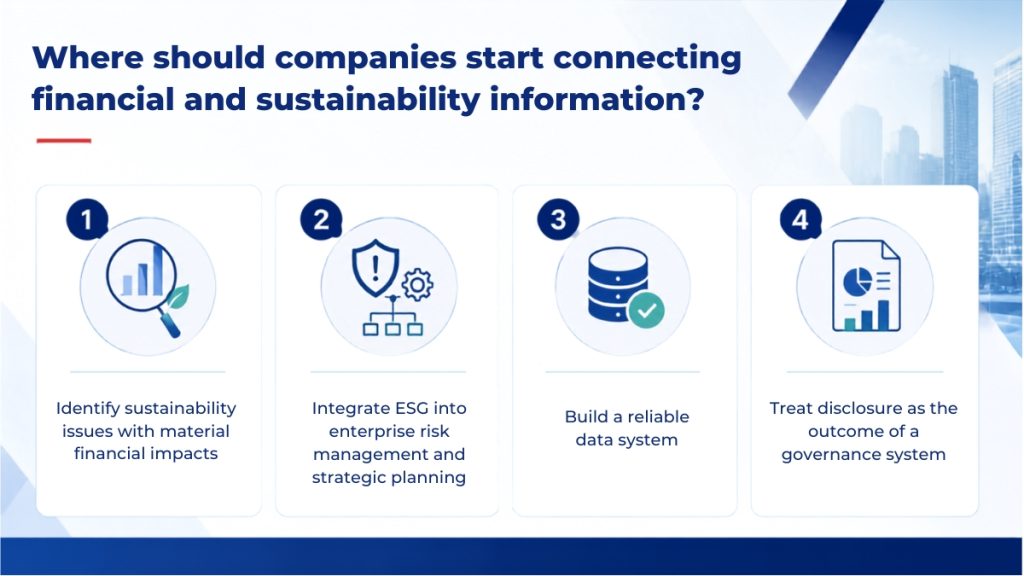
Identify sustainability-related issues with material financial impacts
Not every ESG indicator needs to be linked directly to financial metrics. Companies should focus on sustainability-related issues that could have a significant impact on their business model, strategy, revenue, costs, assets, cash flows or access to capital.
This is the first step in identifying the sustainability information that is genuinely relevant to investors’ and capital providers’ decision-making.
Integrate ESG into risk management and strategic planning
Risks related to climate change, natural resources, supply chains and regulatory requirements should be assessed alongside financial and operational risks.
Doing so enables the Board of Directors and Executive Management to make more informed decisions regarding investment planning, resource allocation and strategic scenario analysis. It also creates the conditions for financial information and sustainability information to be used together as part of the company’s governance and decision-making processes.
Build a reliable data management system
The quality of disclosure depends on the quality of the underlying data. Companies should clearly define:
- data sources;
- responsible functions;
- calculation methodologies;
- internal control procedures; and
- approval mechanisms
for both financial information and sustainability information.
This also provides the foundation for internal audit and independent assurance activities to assess the completeness and reliability of reported information.
Treat disclosure as the outcome of an effective governance system
A high-quality Sustainability Report is not produced during the few months leading up to publication. Rather, it is the result of an ongoing governance process in which sustainability considerations are embedded into strategy, operations, risk management and decision-making.
When this happens, financial information and sustainability information no longer exist as two separate data streams. Instead, they become part of a unified information system that supports effective corporate governance.
Roadmap for building a connected information system
Connecting financial information and sustainability information is not merely a disclosure requirement; it is a process of strengthening corporate governance capabilities.
Drawing on its professional expertise, CGS Vietnam supports companies in progressively building governance and disclosure systems aligned with international best practices, including:
- Assessing existing governance, risk management and disclosure systems to identify gaps against international frameworks and standards such as IFRS S1, IFRS S2, GRI and the G20/OECD Principles of Corporate Governance.
- Identifying material sustainability-related issues and evaluating how these issues may affect the company’s strategy, business model and financial prospects.
- Designing mechanisms to connect ESG data, risk management, strategy and financial information, thereby strengthening both governance and disclosure quality.
- Developing ESG data governance systems, including data collection processes, internal controls, allocation of responsibilities and quality assurance mechanisms to support both reporting and decision-making.
- Advising on the preparation of Sustainability Reports and Integrated Reports, helping companies enhance transparency and meet the growing expectations of investors and capital markets.
The ultimate objective is not simply to help companies produce better sustainability reports. More importantly, it is to build a governance system in which financial information and sustainability information are connected, enabling the Board of Directors and Executive Management to make data-driven decisions, strengthen organisational resilience and create sustainable long-term value.
This article is part of a content series on the G20/OECD Principles of Corporate Governance, developed through the professional collaboration between CGS Vietnam, the Vietnam Independent Directors Association (VNIDA) and the VNIDA Institute of Corporate Governance (VNICG). The series aims to share knowledge, assessment approaches, and practical guidance on applying corporate governance principles in business practice.
Reference:
- G20/OECD Principles of Corporate Governance (2023)
- IFRS (2023) IFRS S1 General Requirements for Disclosure of Sustainability-related Financial Information
- IFRS (2023) Connectivity―what is it and what does it deliver?
- PwC Vietnam (2025). Vietnam ESG Progress Tracker Survey Report 2025
- Huu Cuong, N. & Hien Khanh, D. (2023), The impact of sustainability reporting on the cost of capital: evidence from Vietnam’s listed companies, Journal of Financial Reporting and Accounting, 24(3), pp. 1256-1280.
About CGS Vietnam
CGS Vietnam Consulting Joint Stock Company provides specialized advisory services in Corporate Governance, Sustainability (ESG), Risk Management, and Internal Audit. Backed by a team of experienced professionals with deep expertise in international best practices, CGS Vietnam partners with businesses to strengthen corporate governance, enhance management capabilities, meet investor expectations, and achieve long-term sustainable growth.
Contact CGS Vietnam:
Hotline: (+84) 363 581 520 | Email: [email protected] | Website: https://cgsvietnam.com/
LinkedIn: https://www.linkedin.com/company/cgs-vietnam | Facebook: https://www.facebook.com/CGSVietnamCompany/