

The issue is not simply how much information a company discloses, but whether that information is sufficiently connected for readers to understand how the company creates value. The Integrated Reporting Framework was developed to address this gap.
Mục lục
ToggleWhat is the Integrated Reporting Framework?
According to the IFRS Foundation, Integrated Reporting (IR) is a concise form of communication about how an organisation’s strategy, governance, performance, and prospects, in the context of its external environment, lead to the creation, preservation, or erosion of value over the short, medium, and long term. The Integrated Reporting Framework adopts a multi-capital approach, considering the resources and relationships that an organisation uses or affects in the process of creating value.
The Framework was first published in 2013, revised in 2021, and is now part of the IFRS Foundation’s corporate reporting ecosystem. It plays an important role in promoting integrated thinking and greater connectivity across corporate information.
The Integrated Reporting Framework is not simply about combining financial statements, annual reports, and sustainability reports into a single document. A report truly reflects the spirit of integrated reporting when it demonstrates the connections between:
- The operating context, strategy, and business model;
- Governance, risks, opportunities, and resource allocation;
- Financial and non-financial performance;
- Past performance and future prospects;
- Value created, preserved, or eroded.
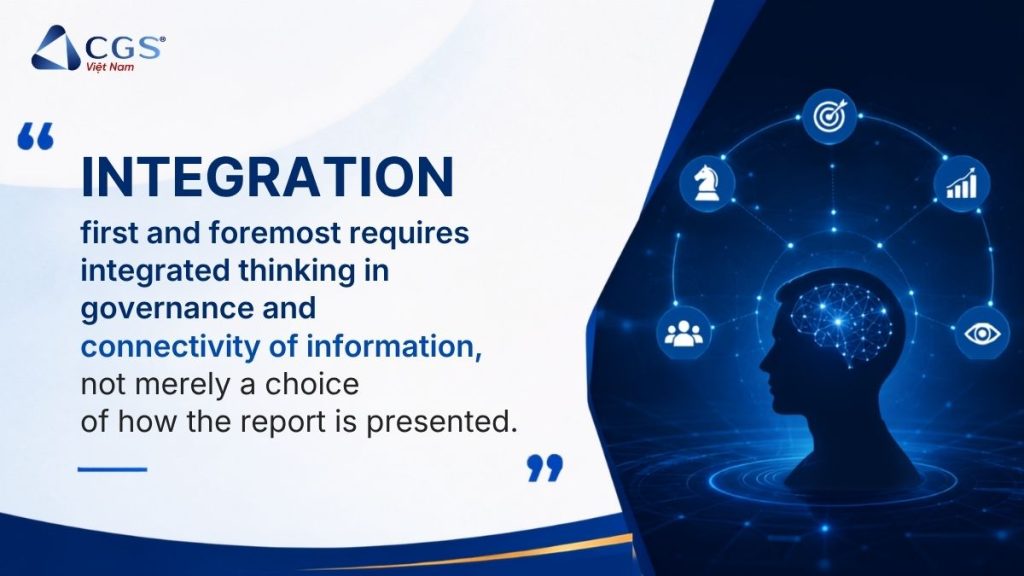
In this sense, “integration” first and foremost requires integrated thinking in governance and connectivity of information, not merely a choice of reporting format.
How is the Integrated Reporting Framework being applied?
According to the KPMG Survey of Sustainability Reporting 2024, Integrated Reporting continues to be applied by companies across a range of markets, although adoption varies by region and company group. Notably, the proportion of N100 companies using the Integrated Reporting Framework increased from 19% in 2022 to 24% in 2024, indicating growing adoption among this group.
Some notable findings from the KPMG survey include:
- 45% of N100 companies in the Middle East and Africa use the Integrated Reporting Framework;
- 16% of N100 companies in Europe use the Integrated Reporting Framework;
- 24% of N100 companies across the overall survey sample use the Integrated Reporting Framework;
- 17% of G250 companies use the Integrated Reporting Framework.
In KPMG’s research, N100 refers to the 100 largest companies by revenue in each country, territory, or jurisdiction surveyed, while G250 refers to the world’s 250 largest companies by revenue, based on the 2023 Fortune 500 ranking.
These figures suggest that Integrated Reporting continues to expand its presence in corporate reporting practice, particularly in certain regions and among N100 companies, although adoption remains uneven globally. As businesses increasingly need to connect information on strategy, governance, performance, prospects, and sustainability, the Integrated Reporting Framework is becoming an important reporting approach that can help companies communicate a more connected story of how they create, preserve, and sustain value over time.
Why does corporate reporting still lack connectivity?
In practice, the reporting process often involves multiple departments and functions.
Finance and Accounting provide financial data; sustainability, environmental, human resources, and other relevant functions compile ESG data; Corporate Governance or the Corporate Secretary provides information on the Board of Directors and governance mechanisms; while Investor Relations or Communications and Marketing may be involved in consolidating, editing, and presenting the report.
Cross-functional participation is essential to Integrated Reporting.
However, without effective coordination and integrated thinking, the report can easily become a collection of disconnected sections that fail to demonstrate the relationships between strategy, governance, the business model, risks and opportunities, performance, and the organisation’s ability to create value. Common limitations include:
- Strategy is not clearly linked to objectives and resource allocation;
- The business model remains primarily descriptive;
- Risks are listed but not connected to strategy and prospects;
- ESG information is separated from financial performance and investment decisions;
- Metrics are inconsistent in terms of scope, reporting period, or methodology;
- The Board is involved only at the final approval stage.
The underlying issue lies in the degree of integration within the governance system itself. When strategy, risk, performance, finance, and sustainability continue to be managed separately, the Board may struggle to obtain a holistic view, investors are left to connect fragmented information themselves, and management decisions can remain siloed.
In such cases, a report may contain a large volume of information without necessarily being useful.
6 capitals – 7 guiding principles – 8 content elements of the Integrated Reporting Framework
The Integrated Reporting Framework is built around three foundational components: 6 capitals, 7 guiding principles, and 8 content elements.
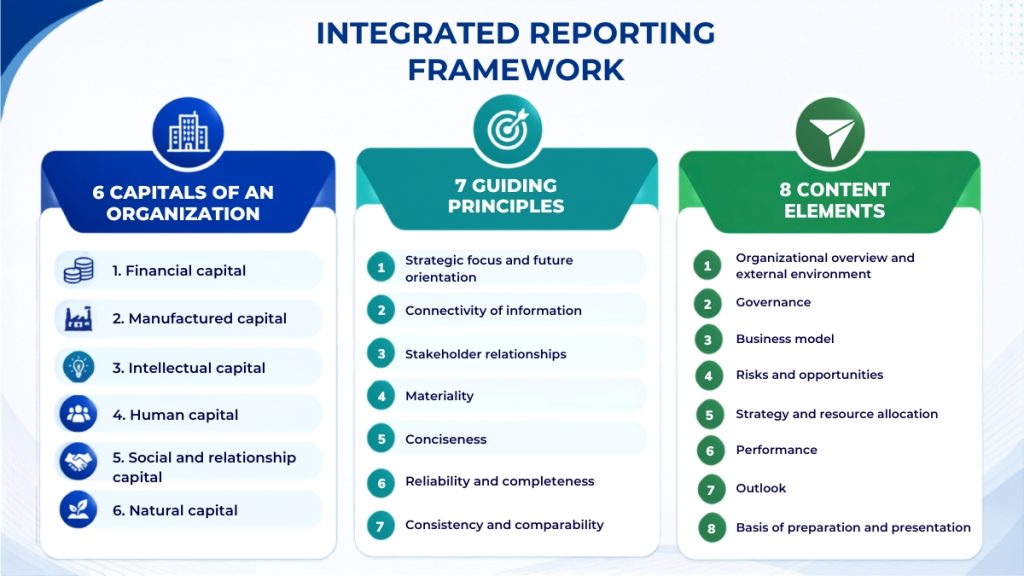
Together, these components help companies address three fundamental questions:
- What resources does the company depend on and affect?
- What key information should the report present?
- What principles should guide the selection and connectivity of information?
Companies are not required to use the exact terminology of the six capitals, report on all six capitals, or structure their reports according to the eight content elements. Instead, these components primarily serve as a reference framework to help companies consider the factors that affect their ability to create, preserve, or erode value over time.
More importantly, the information should be connected. For example, a material risk should be linked to the response strategy, resources allocated, performance indicators, actual results, and future prospects.
A business decision can affect multiple capitals
The multi-capital approach helps companies identify dependencies and trade-offs between different resources when making business decisions. For example, investing in a new production line may improve operational capacity while requiring additional financial capital and potentially increasing energy and water consumption or emissions.
Similarly, investing in employee training creates costs in the short term but may improve skills, productivity, and workforce capabilities over the longer term. Companies should therefore consider not only:
“How much profit does this decision generate?”
but also:
“Which capitals are being used, enhanced, or diminished in generating that outcome?”
This is one of the key distinctions of integrated thinking.
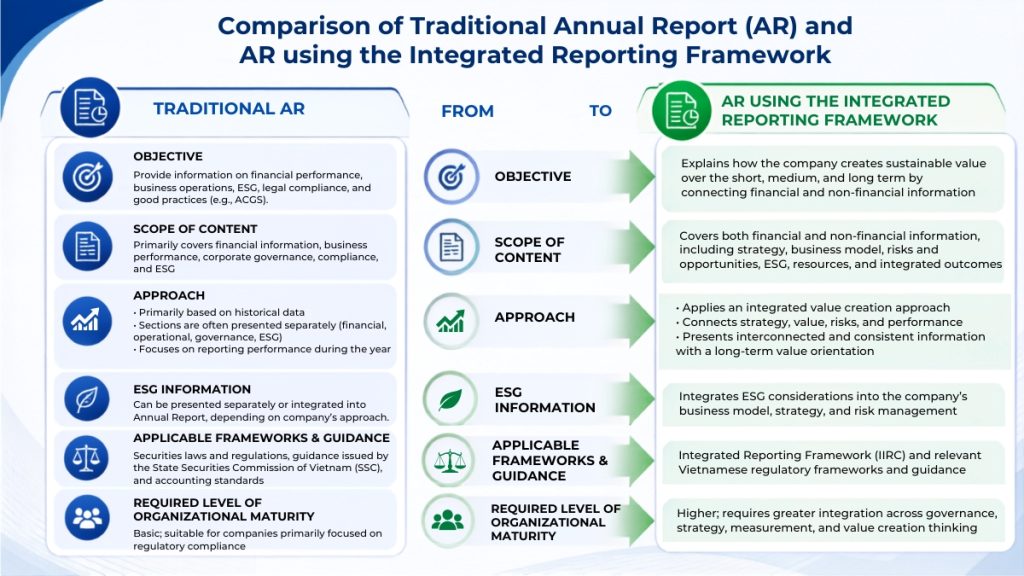
How does a conventional annual report differ from one applying the Integrated Reporting Framework?
An integrated report does not necessarily have to be a completely separate report from the annual report. Companies can apply the principles of the Integrated Reporting Framework within their annual reports to improve the connectivity of information.
How does the Integrated Reporting Framework relate to IFRS S1, IFRS S2, and GRI?
The Integrated Reporting Framework is a principles-based framework focused on how companies connect information to explain their ability to create value over time. It does not prescribe a standardised set of ESG metrics to be applied uniformly across all companies. In practice, the Framework can therefore be used alongside other disclosure standards:
- IFRS S1 requires disclosure of sustainability-related risks and opportunities that could affect an entity’s cash flows, access to finance, or cost of capital;
- IFRS S2 focuses on climate-related risks and opportunities;
- SASB Standards help identify industry-specific sustainability-related topics and metrics;
- GRI Standards support disclosure of an organisation’s significant impacts on the economy, environment, and people;
- The Integrated Reporting Framework provides an overarching structure for connecting material information with a company’s strategy, governance, business model, risks and opportunities, performance, and prospects.
Put simply, Integrated Reporting provides an overarching framework for connecting and communicating the value-creation story, while IFRS S1, IFRS S2, SASB Standards, and GRI Standards provide specific disclosure requirements or guidance for different information objectives. These frameworks and standards do not necessarily replace one another; rather, they can complement each other in creating a more connected corporate reporting system.
Integrated Reporting in the Vietnamese context
In Vietnam, public companies are required to prepare and disclose annual reports in accordance with Circular No. 96/2020/TT-BTC and its amendments and supplements. Annual reports include information on business operations, corporate governance, Board assessments, and environmental and social impacts.
However, an annual report prepared in accordance with the prescribed format under Circular 96 is not necessarily an integrated report aligned with the Integrated Reporting Framework. Companies should therefore distinguish between three levels:
- Legal compliance: Meeting applicable requirements on the content, format, and timing of disclosures;
- Application of reporting standards: Using IFRS S1, IFRS S2, GRI Standards, SASB Standards, or other relevant standards to identify and disclose information for specific reporting objectives;
- Application of the Integrated Reporting Framework: Connecting material information into a coherent narrative that explains how the company creates value over time.
This approach is also consistent with the spirit of Principle VI.A.3 of the G20/OECD Principles of Corporate Governance 2023, which emphasises connectivity between sustainability-related disclosures, financial reporting, and other corporate information.
For Vietnamese companies, the Integrated Reporting Framework can therefore serve as a reference framework for improving the quality of annual reports, enhancing the connectivity of information provided to investors, and progressively strengthening readiness for increasing sustainability disclosure requirements in the market.
Recommendations for businesses
Companies should not begin with report design. The process should start with strategy, the business model, risk management, and the way the company creates value. Integrated Reporting should be treated as a cross-functional governance project, with early Board involvement in identifying material matters, overseeing strategic trade-offs, and ensuring balanced reporting.
Reports should be concise and focused on material information, while detailed data can be provided through specialised reports, appendices, or the corporate website. Most importantly, disclosed information should be consistent with the information that the Board and management actually use in decision-making.
A high-quality Integrated Report is therefore not created only during the final editing stage. It should originate from integrated thinking embedded in the company’s governance and management processes.
How can CGS Vietnam support businesses?
CGS Vietnam provides advisory services to develop and enhance the quality of annual reports, integrated reports, and sustainability reports, tailored to each company’s business characteristics, regulatory requirements, and capital-market objectives.
Our scope of support includes assessing readiness and gaps against GRI and IFRS S1/S2; developing transition roadmaps and value-creation models; identifying capitals and material matters; connecting strategy, risks, performance indicators, and ESG; establishing governance structures, processes, and data controls; advising on report content; training internal teams; and preparing for independent assurance.
The objective is not simply to publish a better report, but to embed integrated thinking into governance and decision-making. When strategy, resources, risks, performance, and sustainability are considered within the same system, Integrated Reporting can become a tool for strengthening accountability, investor dialogue, and long-term value creation.
Further reading:
————–
References:
- IFRS Foundation (2021), Integrated Reporting Framework
- KPMG (2024), The Move to Mandatory Reporting – Survey of Sustainability Reporting 2024
- IFRS Foundation (2023), IFRS S1 – General Requirements for Disclosure of Sustainability-related Financial Information
- IFRS Foundation (2023), IFRS S2 – Climate-related Disclosures
- IFRS Foundation, SASB Standards
- Global Reporting Initiative, GRI Standards
- Ministry of Finance (2020), Circular No. 96/2020/TT-BTC
- OECD (2023), G20/OECD Principles of Corporate Governance 2023
About CGS Vietnam
CGS Vietnam Consulting Joint Stock Company provides specialized advisory services in Corporate Governance, Sustainability (ESG), Risk Management, and Internal Audit. Backed by a team of experienced professionals with deep expertise in international best practices, CGS Vietnam partners with businesses to strengthen corporate governance, enhance management capabilities, meet investor expectations, and achieve long-term sustainable growth.
Contact CGS Vietnam:
Hotline: (+84) 363 581 520 | Email: [email protected] | Website: https://cgsvietnam.com/
LinkedIn: https://www.linkedin.com/company/cgs-vietnam | Facebook: https://www.facebook.com/CGSVietnamCompany/