


OECD Corporate Governance, as embodied in the G20/OECD Principles of Corporate Governance 2023, is increasingly recognized as the international benchmark for helping companies build transparent governance systems, improve organizational performance, and strengthen investor confidence. In this article, CGS Vietnam explains what OECD Corporate Governance is, why the G20/OECD Principles are important, and how they relate to corporate governance frameworks currently applied in Vietnam.
What is OECD Corporate Governance?
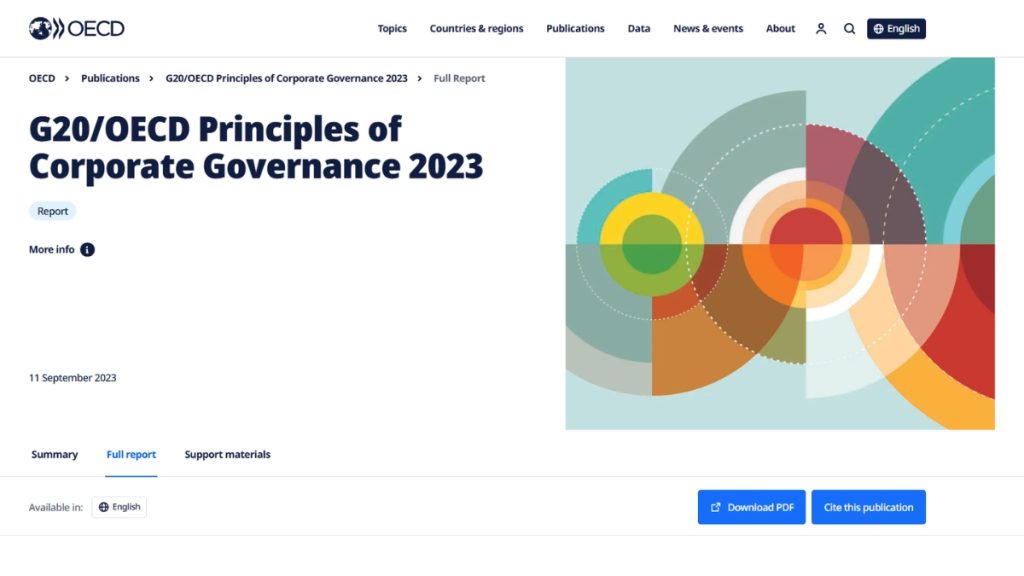
OECD Corporate Governance refers to a governance approach based on the G20/OECD Principles of Corporate Governance 2023 – the internationally recognized corporate governance standard adopted by the OECD Council at Ministerial level and endorsed by G20 Leaders.
The Principles provide a comprehensive reference framework to help companies enhance transparency, protect shareholder rights and ensure equitable treatment, strengthen board accountability, reinforce investor and market confidence, and ultimately support long-term value creation and sustainable development.
Why should companies pay attention to OECD Corporate Governance?
Corporate governance is increasingly viewed not merely as a compliance requirement for listed and public companies, but as a strategic foundation for improving decision-making, safeguarding shareholder interests, managing risks, and creating sustainable long-term value.
In Vietnam, widely adopted governance frameworks – including the Vietnam Corporate Governance Code of Best Practices (VNCG Code), the ASEAN Corporate Governance Scorecard (ACGS), the International Finance Corporation (IFC)’s corporate governance guidance, and the country’s legal framework – are all closely aligned with the principles set out in the G20/OECD Principles. Understanding these relationships enables companies to avoid approaching each framework in isolation and provides a clearer roadmap from legal compliance to the adoption of internationally recognized governance best practices.
Corporate Governance is more than compliance
Under the G20/OECD approach, corporate governance is defined as the system of relationships among the Board of Directors, executive management, shareholders, and other stakeholders that provides the structure through which a company sets its objectives, determines how those objectives are achieved, and monitors performance.
Accordingly, the quality of corporate governance is measured not only by the existence of governance policies and regulations, but also by how effectively these mechanisms operate in practice. This distinction reflects the difference between formal compliance and effective governance.
Why are the G20/OECD Principles important?
Rather than prescribing a single governance model for all countries, the G20/OECD Principles of Corporate Governance 2023 establish fundamental principles that aim to:
- Promote transparent and fair markets;
- Protect the rights and legitimate interests of shareholders;
- Strengthen the accountability of the Board of Directors and executive management;
- Improve the quality of corporate disclosure and transparency;
- Enhance investor confidence;
- Support companies’ access to long-term capital; and
- Foster sustainable development and corporate resilience in the face of evolving risks and uncertainties.
The 2023 edition places particular emphasis on two strategic objectives: facilitating companies’ access to market-based financing and promoting governance policies that strengthen sustainability and resilience.
6 pillars of the G20/OECD Principles of Corporate Governance 2023
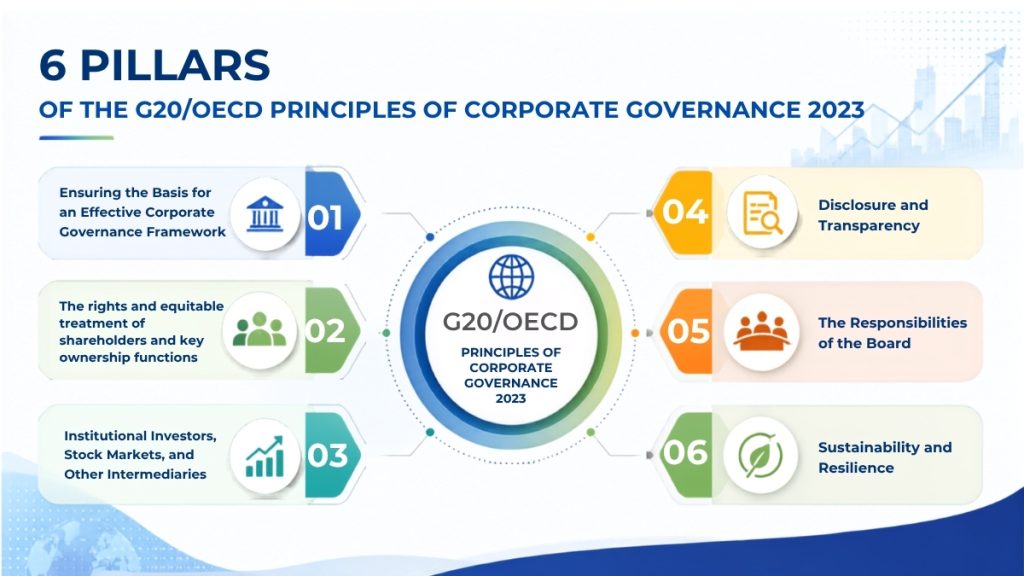
The G20/OECD Principles of Corporate Governance 2023 are structured around six core pillars:
- Ensuring the Basis for an Effective Corporate Governance Framework
- The Rights and Equitable Treatment of Shareholders and Key Ownership Functions
- Institutional Investors, Stock Markets, and Other Intermediaries
- Disclosure and Transparency
- The Responsibilities of the Board
- Sustainability and Resilience
The relationship between the G20/OECD Principles and Corporate Governance Frameworks in Vietnam
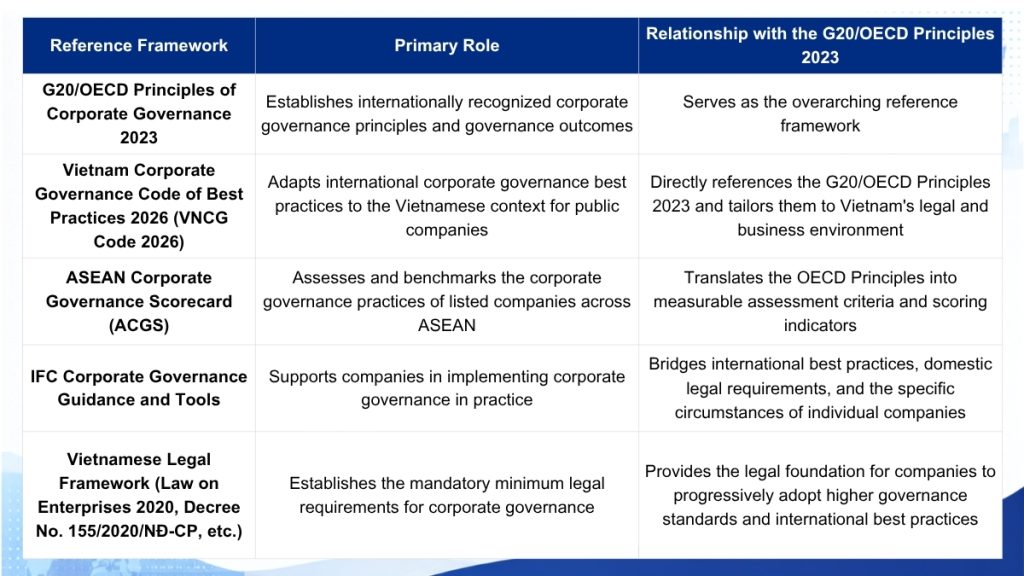
Vietnamese companies may be more familiar with the Vietnam Corporate Governance Code of Best Practices (VNCG Code), the ASEAN Corporate Governance Scorecard (ACGS), or the corporate governance guidance published by the International Finance Corporation (IFC) than with the G20/OECD Principles of Corporate Governance themselves. However, these frameworks should not be viewed in isolation.
Vietnam Corporate Governance Code 2026 (VNCG Code 2026)
The VNCG Code 2026 directly references the G20/OECD Principles of Corporate Governance 2023 while adapting them to Vietnam’s legal framework and business environment. Whereas the G20/OECD Principles establish internationally recognized governance principles, the VNCG Code localizes these principles and encourages companies to adopt them under the “Comply or Explain” approach.
ASEAN Corporate Governance Scorecard (ACGS)
The ASEAN Corporate Governance Scorecard (ACGS) is an assessment framework used to evaluate and benchmark the corporate governance practices of listed companies across ASEAN.
While the G20/OECD Principles define the underlying governance principles, the ACGS translates these principles into observable, measurable, and comparable assessment criteria based on publicly disclosed information. Consequently, companies that strengthen their governance in line with the OECD Principles are generally better positioned to improve their ACGS performance.
IFC Corporate Governance Guidance
The IFC’s corporate governance guidance focuses on helping companies implement effective governance practices through practical manuals, assessment tools, and case studies. Put simply, if the G20/OECD Principles answer the question, “What should a sound corporate governance framework achieve?”, the IFC guidance helps companies answer “How can it be implemented in practice?”
Vietnamese Legal Framework
The Law on Enterprises 2020, Decree No. 155/2020/ND-CP, and other relevant regulations establish the mandatory legal foundation for corporate governance in Vietnam. However, compliance with these legal requirements alone does not necessarily mean that a company has adopted internationally recognized corporate governance best practices. The G20/OECD Principles serve as a reference framework that enables companies to strengthen governance beyond minimum legal compliance.
Common misconceptions about OECD Corporate Governance
First, some believe that OECD Corporate Governance is a certification awarded to companies. In fact, this is not the case. There is currently no OECD certification that formally recognizes a company as being “OECD-compliant” in corporate governance.
Second, some assume that the G20/OECD Principles apply only to OECD and G20 member countries. This is also incorrect. The Principles are widely used as an international reference framework across many jurisdictions, including countries that are not members of the OECD.
Third, there is a misconception that OECD Corporate Governance replaces Vietnamese law. This is inaccurate. Vietnamese legislation establishes mandatory legal requirements for all companies operating in Vietnam, whereas the OECD Corporate Governance Principles are voluntary and serve as guidance for adopting international best practices.
Finally, applying the G20/OECD Principles does not mean copying a single governance model. Their implementation should be tailored to each company’s size, ownership structure, industry characteristics, and stage of development.
OECD Corporate Governance: A foundation for advancing governance excellence
For Vietnamese companies, the greatest value of the G20/OECD Principles of Corporate Governance 2023 lies in providing a comprehensive perspective on corporate governance. Companies do not need to implement every principle simultaneously. Instead, they should first assess their current governance maturity, identify gaps, and establish a roadmap for progressing from minimum legal compliance to internationally recognized governance best practices.
This article marks the beginning of CGS Vietnam’s in-depth series exploring each pillar of the G20/OECD Principles of Corporate Governance. Developed through a professional collaboration between CGS Vietnam, the Vietnam Independent Directors Association (VNIDA) and the VNIDA Institute of Corporate Governance (VNICG), the series aims to provide practical insights, assessment methodologies, and guidance on translating governance principles into observable, measurable, and sustainable practices within organizations.
Frequently Asked Questions (FAQs) about OECD Corporate Governance
1. Is the application of the OECD corporate governance principles mandatory?
- No. The G20/OECD Principles of Corporate Governance are not legally binding; rather, they serve as a leading international reference framework for corporate governance.
- The Principles are used by many countries as a reference for assessing and improving their corporate governance frameworks, while also providing guidance to companies and market participants on enhancing the quality of corporate governance.
2. Which companies should apply the OECD corporate governance principles?
- The G20/OECD Principles 2023 focus primarily on publicly traded companies, including both financial and non-financial companies. However, where appropriate, the Principles may also be used to improve corporate governance in unlisted companies, particularly those of significant size and complexity.
- For state-owned enterprises (SOEs), the OECD has issued a separate set of guidelines – the OECD Guidelines on Corporate Governance of State-Owned Enterprises – to address the specific governance considerations and the exercise of state ownership.
- Applying the OECD Principles and Guidelines can help companies improve governance effectiveness, strengthen transparency and accountability, and build trust among investors and other stakeholders.
3. Where should companies start when implementing corporate governance based on the OECD Principles?
- Companies should begin by assessing their current corporate governance practices against the G20/OECD Principles to identify gaps and areas for improvement.
- The assessment results can then provide a basis for developing an implementation roadmap, setting priorities, and progressively improving the quality of corporate governance.
References:
- G20/OECD Principles of Corporate Governance 2023
- Vietnam Corporate Governance Code of Best Practices 2026
- ASEAN Corporate Governance Scorecard – ACMF
- IFC Corporate Governance Manual
About CGS Vietnam
CGS Vietnam Consulting Joint Stock Company provides specialized advisory services in Corporate Governance, Sustainability (ESG), Risk Management, and Internal Audit. Backed by a team of experienced professionals with deep expertise in international best practices, CGS Vietnam partners with businesses to strengthen corporate governance, enhance management capabilities, meet investor expectations, and achieve long-term sustainable growth.
Contact CGS Vietnam:
Hotline: (+84) 363 581 520 | Email: [email protected] | Website: https://cgsvietnam.com/
LinkedIn: https://www.linkedin.com/company/cgs-vietnam | Facebook: https://www.facebook.com/CGSVietnamCompany/