

As companies grow, the question is no longer simply who manages day-to-day operations, but also who sets direction, who provides oversight, how shareholders’ interests are protected, and how the company remains accountable to the market. These questions lie at the heart of Corporate Governance (CG).
According to the G20/OECD Principles of Corporate Governance 2023, corporate governance involves a set of relationships between a company’s management, its Board of Directors (Board), its shareholders and other stakeholders. It also provides the structure and systems through which the company is directed, its objectives are set, the means of attaining those objectives are determined, and performance is monitored.
Corporate Governance is more than Business Management
Business management focuses on the day-to-day operation of a company. Corporate governance, by contrast, addresses higher-level questions: What are the responsibilities of the Board? How much authority is delegated to management? How do shareholders exercise their rights? How are conflicts of interest managed? What information should be disclosed?
Therefore, the quality of corporate governance is not determined merely by whether a company has the required structures and policies in place, but also by how its governance mechanisms operate in practice. Corporate governance is particularly evident in the allocation of authority and the handling of material decisions.
For example, when a major transaction or related-party transaction is considered, key questions include: who provides and verifies the information, who challenges the proposal, which members should abstain due to conflicts of interest, and how implementation of the decision is monitored.

Corporate Governance under international good practices
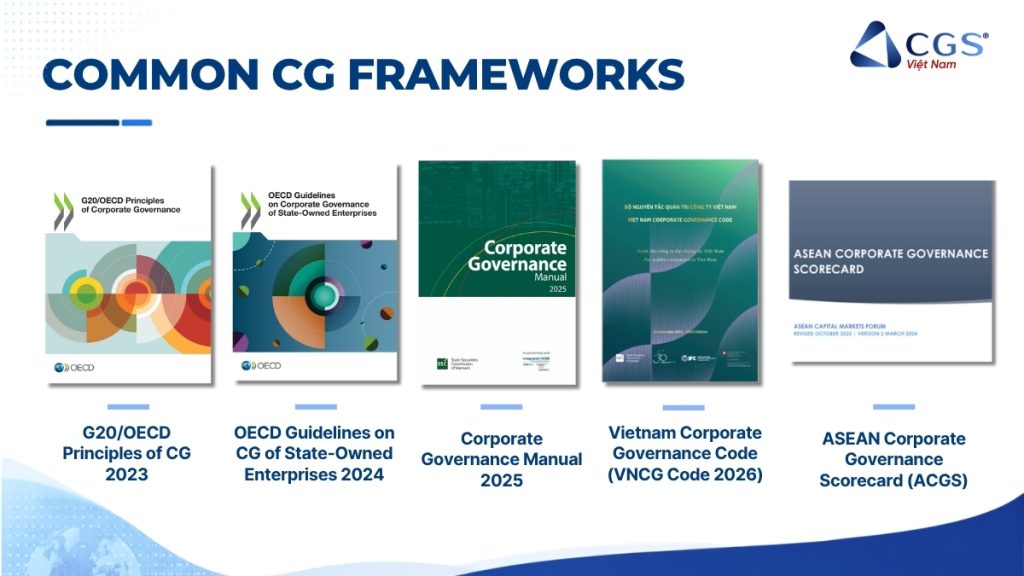
Corporate governance requirements and practices are shaped not only by national laws but also by international frameworks and good practices. For Vietnamese companies, three notable references are the G20/OECD Principles 2023, OECD SOEs Guidelines 2024 and ASEAN Corporate Governance Scorecard (ACGS).
G20/OECD Principles 2023: An international foundation for Corporate Governance
The G20/OECD Principles of Corporate Governance 2023 are among the most important international corporate governance frameworks and are structured around six chapters:
- Ensuring the basis for an effective corporate governance framework;
- The rights and equitable treatment of shareholders and key ownership functions;
- Institutional investors, stock markets and other intermediaries;
- Disclosure and transparency;
- The responsibilities of the Board;
- Sustainability and resilience.
Rather than prescribing a single governance model, OECD Corporate Governance focuses on the governance outcomes that should be achieved, allowing individual jurisdictions and companies to adopt approaches suited to their legal, ownership and market characteristics.
OECD SOE Guidelines 2024: Guidance for State-Owned Enterprises
For enterprises owned or controlled by the State, the OECD Guidelines on Corporate Governance of State-Owned Enterprises 2024 provide specific guidance on the State’s role as an owner, the professionalization of the ownership function, competitive neutrality, shareholder rights, Boards, transparency, accountability and sustainability.
ACGS: Assessing and benchmarking Corporate Governance practices across ASEAN
The ASEAN Corporate Governance Scorecard (ACGS) is a tool for assessing and benchmarking the corporate governance practices of listed companies across ASEAN. ACGS enables companies to assess their practices not only against domestic legal requirements, but also in comparison with listed companies across the region.
ACGS is not a mandatory legal instrument; rather, it serves as a reference framework for assessing the quality of corporate governance practices.
Corporate Governance in Vietnam: From regulation to good practice
In Vietnam, corporate governance can be viewed through three layers: mandatory legal requirements, good practices, and market-based assessment and recognition mechanisms.
Legal framework for Corporate Governance
The legal foundation for corporate governance is established through the Law on Enterprises, the Law on Securities and implementing regulations applicable to public and listed companies. At the company level, these requirements are further specified through the Charter, Internal Corporate Governance Regulations, Board Operating Regulations and, where applicable, the operating regulations of Board committees. This constitutes the mandatory layer of requirements that companies must comply with.
VNCG Code 2026: Moving beyond compliance
While legislation establishes minimum requirements, the Vietnam Corporate Governance Code 2026 (VNCG Code 2026) encourages companies to adopt corporate governance practices that go beyond legal compliance. Developed based on the G20/OECD Principles 2023 and international good practices, the VNCG Code 2026 focuses on areas such as Board effectiveness and accountability, shareholder rights, transparency and accountability, risk governance and sustainability.
Through its principles-based approach and “Comply or Explain” mechanism, the VNCG Code 2026 helps companies move from a compliance-oriented mindset towards improving the substantive quality of corporate governance.
Selected mechanisms for assessing and recognizing Corporate Governance practices in Vietnam
Alongside laws and governance codes, Vietnam also has mechanisms that help companies assess, benchmark and progressively improve their governance practices.
One example is the Vietnam Listed Company Awards (VLCA). The Corporate Governance category of the VLCA assesses the governance practices of eligible companies based on publicly disclosed information such as annual reports, corporate governance reports, charters, governance regulations and General Meeting of Shareholders documents. Through this process, the VLCA encourages companies to improve transparency and move closer to good corporate governance practices.
From a broader perspective, the Corporate Sustainability Index (CSI) is a tool that supports companies in reviewing and assessing governance practices from a sustainable development perspective. The CSI is not a dedicated corporate governance code; rather, it covers governance, environmental and social aspects, helping companies identify gaps and progressively improve their sustainability practices.
Accordingly, Vietnamese companies can draw on international standards and benchmarks to identify good practices, while also using domestic frameworks and tools to assess their current practices, identify gaps and determine priorities for corporate governance improvement.
Does good Corporate Governance really create value?
Good corporate governance does not guarantee better business performance. However, research in Vietnam indicates that governance quality can be associated with firm value and how companies are perceived by the market.
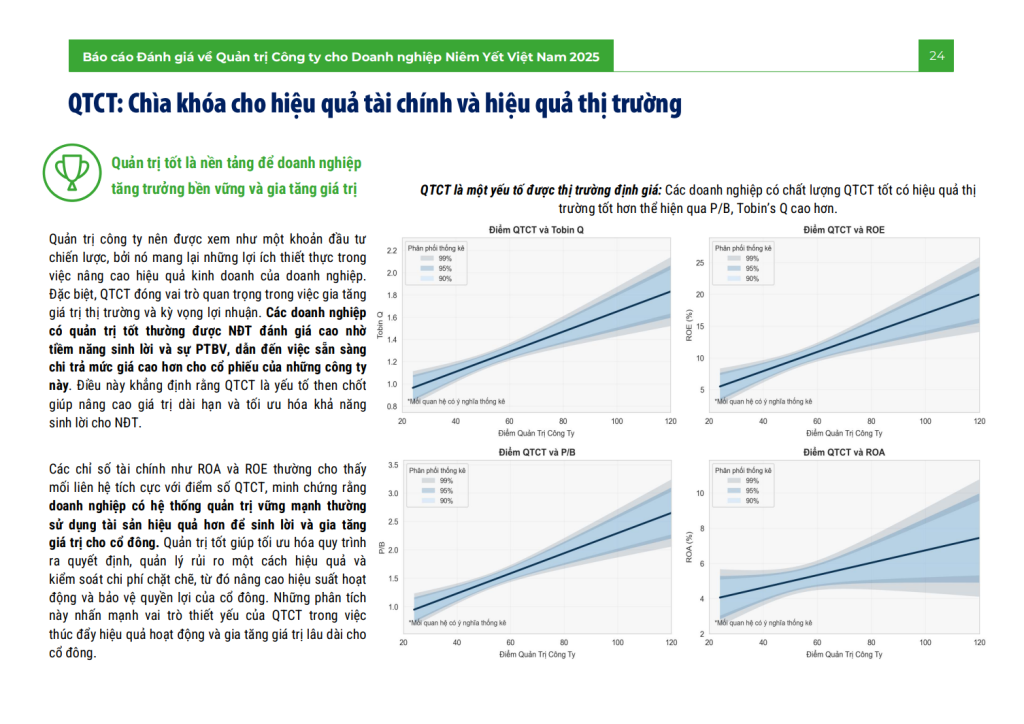
The 2025 Corporate Governance Assessment Report for Vietnamese Listed Companies by the Vietnam Listed Company Awards (VLCA) identified a positive and statistically significant relationship between corporate governance scores and indicators such as Tobin’s Q, P/B, ROE and ROA. Within the sample assessed, companies with higher corporate governance scores tended to receive higher market valuations and demonstrate stronger financial performance indicators.
These findings are also consistent with several empirical studies in Vietnam. A study by Thai, Nguyen and Kabir (2026), published in the International Review of Finance, analyzed Vietnamese listed companies over the 2016–2023 period and found improvements in Tobin’s Q among companies that increased the representation of independent and female Board members (Tobin’s Q is a commonly used indicator reflecting the market’s valuation of a company relative to the value of its assets).
Meanwhile, a study by Bui Anh Thanh, Nguyen Minh Sang and Nguyen Vinh Khuong (2024), published in Cogent Business & Management, examined 510 non-financial listed companies in Vietnam during 2015–2022 and also identified a positive relationship between a composite corporate governance index and firm value.
These findings suggest that the value of corporate governance does not arise from meeting a few individual criteria, but from the quality and effectiveness of the governance system as a whole. This perspective is also consistent with the G20/OECD Principles of Corporate Governance 2023, which recognize good corporate governance as an important foundation for facilitating access to capital, protecting investors, and strengthening sustainability and resilience.
Corporate Governance in Vietnam: Improving, but significant room remains
The 2025 corporate governance assessment by the Vietnam Listed Company Awards (VLCA) showed that the average corporate governance score of assessed companies reached 53.14 points, up from 50.83 points in 2024. However, as the 2025 scorecard had a higher maximum score and adjusted the weighting of individual questions, the average score as a percentage of the maximum declined from 36.31% to 35.43%. The report also showed that the increase in 2025 was driven mainly by compliance-related criteria, while scores for good-practice criteria and bonus/penalty items remained broadly stable.
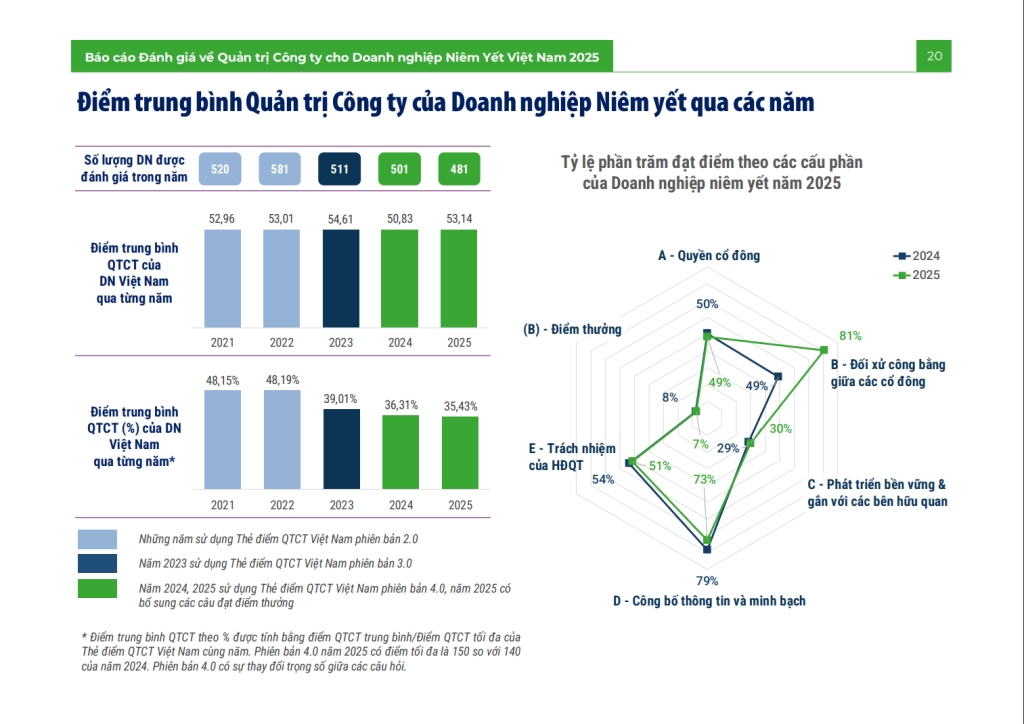
These results indicate that corporate governance practices among Vietnamese listed companies have improved to some extent, but significant room for improvement remains, particularly in areas such as Board independence, the functioning of specialized Board committees, management of conflicts of interest and practices that go beyond minimum compliance requirements.
Where should companies start?
Companies do not necessarily need to adopt all international good practices at once. A more appropriate approach is to assess the gaps between regulations, standards and actual governance practices; identify the issues with the greatest impact on governance quality; and then develop an improvement roadmap aligned with the company’s level of maturity.
For listed companies or companies seeking to raise capital, typical priorities include Board effectiveness and independence, the functioning of Board committees, management of conflicts of interest and related-party transactions, risk governance, quality of disclosure and shareholder engagement.
The G20/OECD Principles 2023, VNCG Code 2026 and ACGS can be used as reference frameworks and tools to help companies understand where they currently stand, identify priority gaps and determine an appropriate level of improvement based on their specific circumstances.
CGS Vietnam supports companies on the journey to improve Corporate Governance quality
As expectations for corporate governance and transparency in capital markets continue to rise, companies need to progressively align with international good practices to strengthen governance quality and respond to the expectations of shareholders, investors and capital providers.
CGS Vietnam supports companies in:
- Assessing current practices and strengthening Corporate Governance systems in line with international good practices;
- Improving the quality of disclosure and accountability;
- Strengthening the Board’s role in providing direction and oversight over strategy, risk governance, control systems and resource allocation;
- Enhancing investor relations practices to reinforce the confidence of shareholders, bondholders and other capital providers.
References:
- G20/OECD Principles of Corporate Governance 2023
- OECD Guidelines on Corporate Governance of State-Owned Enterprises 2024
- Information on the VNCG Code 2026 – State Securities Commission of Vietnam
- ASEAN Corporate Governance Scorecard 2024
- Vietnam Listed Company Awards 2025
- 2025 Corporate Governance Assessment Report for Vietnamese Listed Companies
- Bui Anh Thanh, Nguyen Minh Sang & Nguyen Vinh Khuong (2024) – Corporate governance mechanism and firm value
- Thai, Nguyen & Kabir (2026) – Effects of Corporate Governance Code on Corporate Governance Practices and Firm Performance in Vietnam
About CGS Vietnam
CGS Vietnam Consulting Joint Stock Company provides specialized advisory services in Corporate Governance, Sustainability (ESG), Risk Management, and Internal Audit. Backed by a team of experienced professionals with deep expertise in international best practices, CGS Vietnam partners with businesses to strengthen corporate governance, enhance management capabilities, meet investor expectations, and achieve long-term sustainable growth.
Contact CGS Vietnam:
Hotline: (+84) 363 581 520 | Email: [email protected] | Website: https://cgsvietnam.com/
LinkedIn: https://www.linkedin.com/company/cgs-vietnam | Facebook: https://www.facebook.com/CGSVietnamCompany/