

A company may be profitable while simultaneously depleting the forms of capital needed to sustain its ability to create value in the future. Here, “capital” does not refer only to financial capital in the accounting sense, but also to the resources and relationships on which a company depends to create value.
Higher profits may result from improved productivity, market expansion, or more efficient use of capital. However, short-term profits can also be improved through decisions such as cutting training, postponing necessary investments, placing excessive pressure on suppliers, or exploiting natural resources beyond their ability to recover. These decisions may improve current financial performance while at the same time weakening the resources and relationships the company needs to sustain its ability to create value in the future.
This is one of the issues that Integrated Reporting seeks to clarify: companies do not create value through financial capital alone. Their ability to create value also depends on a range of other resources and relationships that they use or affect. The Integrated Reporting Framework refers to these resources and relationships as “capitals.”
From financial capital to the six capitals of a business
Financial statements reflect a company’s financial position, performance, and cash flows. However, not all resources and relationships that determine its ability to create value are fully reflected in financial indicators. A more important question, therefore, is: What does the company rely on to generate its current results and sustain its ability to create value in the future?
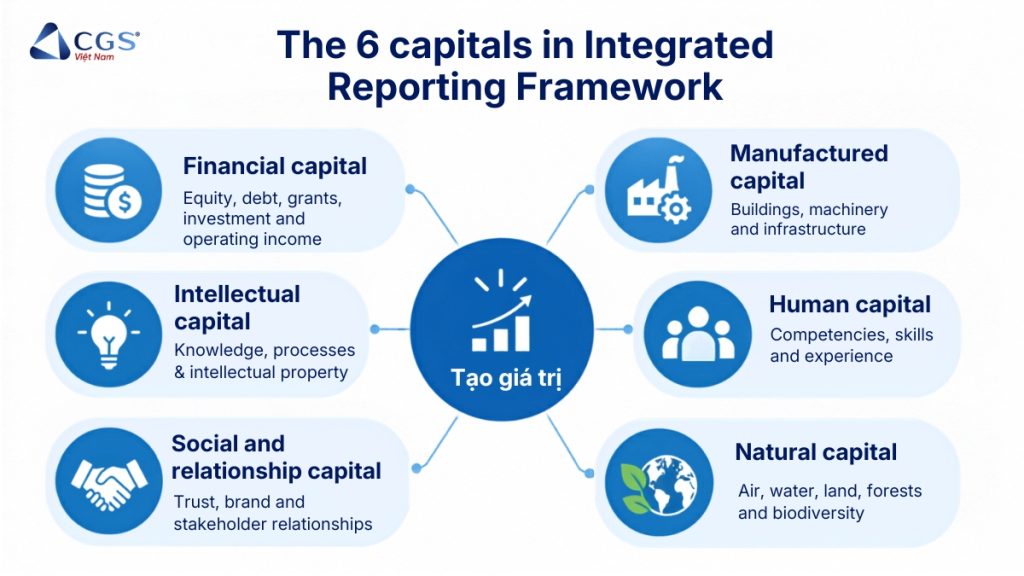
According to the Integrated Reporting (IR) Framework, capitals are “stocks of value” — resources and relationships in which value accumulates and which a company uses or affects. They may increase, decrease, or be transformed through the company’s activities and outputs. The Framework classifies them into six categories: financial, manufactured, intellectual, human, social and relationship, and natural capital.
Financial capital
Financial resources available to a company for producing goods, providing services, and carrying out business activities. These resources may come from equity, debt, grants, or be generated through the company’s own operations and investments.
Governance question: How is the company raising and allocating financial capital to meet current needs while also supporting its strategy and long-term value creation?
Manufactured capital
Human-made physical assets that a company uses in producing goods or providing services, such as:
- Buildings and facilities;
- Machinery and equipment;
- Infrastructure such as roads, ports, bridges, and water and waste treatment systems.
These assets do not necessarily have to be created by the company itself. A company may use infrastructure developed by other organizations, while also creating assets for its own use or for sale.
Governance question: Are the company’s current production capacity and infrastructure sufficient to execute its strategy, maintain operational efficiency, and support future growth?
Intellectual capital
Knowledge-based intangible assets that a company accumulates and uses to operate, innovate, and build competitive advantage. Intellectual capital includes:
- Intellectual property such as patents, copyrights, software, rights, and licences;
- Tacit knowledge, systems, processes, procedures, and ways of working accumulated within the organization.
Governance question: What knowledge, systems, and intellectual assets are critical to the company, and what is it doing to protect, develop, and convert them into value?
Human capital
The competencies, skills, experience, and motivation of people within the organization, including their ability to innovate, lead, collaborate, and execute strategy. Human capital also encompasses:
- Alignment with the organization’s governance framework, risk management approach, and ethical values;
- The ability to understand, develop, and implement strategy;
- Engagement and motivation to improve processes, products, and services;
- Leadership, management, and collaboration capabilities within the organization.
Governance question: Does the company have and continue to develop the human capabilities required to execute its strategy, and what would happen if key people or critical capabilities were lost?
Social and relationship capital
The relationships, networks, norms, and levels of trust that a company develops with stakeholders and communities, supporting collaboration and the ability to operate sustainably over time. This capital includes:
- Shared norms, values, and behaviours;
- Relationships with customers, suppliers, partners, communities, and other stakeholders;
- Trust and willingness to engage that the company has built;
- Intangible value associated with brand and reputation;
- The level of social acceptance of the company’s operations — often referred to as its “social licence to operate.”
Governance question: Which relationships and levels of trust are essential for the company to retain customers, sustain its supply chain, maintain market access, and secure stakeholder acceptance?
Natural capital
Renewable and non-renewable environmental resources and processes that a company depends on or affects through its activities. Natural capital includes:
- Air, water, land, minerals, and forests;
- Biodiversity and ecosystem health.
Governance question: Which natural resources and ecosystems does the company depend on, how are its activities changing those resources, and how could their degradation affect the company’s ability to operate in the future?
The capitals do not exist in isolation
The key point of the six-capitals approach is not to divide a company’s assets into six separate “boxes.” In practice, the capitals continuously interact with and transform one another as a business operates. A single business decision may increase one form of capital while reducing another.
For example, investing in machinery reduces financial capital in the short term but may increase manufactured capital and future productivity. Investing in training creates costs but strengthens human capital. Investing in research and development may not generate immediate revenue but can contribute to the development of intellectual capital.
The reverse is also true.
Cutting training may reduce short-term costs but weaken workforce capabilities. Excessive resource extraction may support current production but deplete natural capital. Placing excessive pressure on suppliers may create short-term price advantages while weakening relationships and supply-chain resilience.
Therefore: Higher profits do not necessarily mean stronger long-term value creation.
What companies need to understand is not only whether financial results have increased or decreased, but also: “How were those results created, and how did the underlying capitals change in the process?”
This is precisely what makes the six capitals a useful lens for corporate governance, rather than merely a concept for reporting.
The six capitals and the value creation process
The logic of the value creation process can be summarized as follows:
Capital inputs → Business activities → Outputs → Outcomes/impacts on the capitals → The ability to create, preserve, or erode value over time
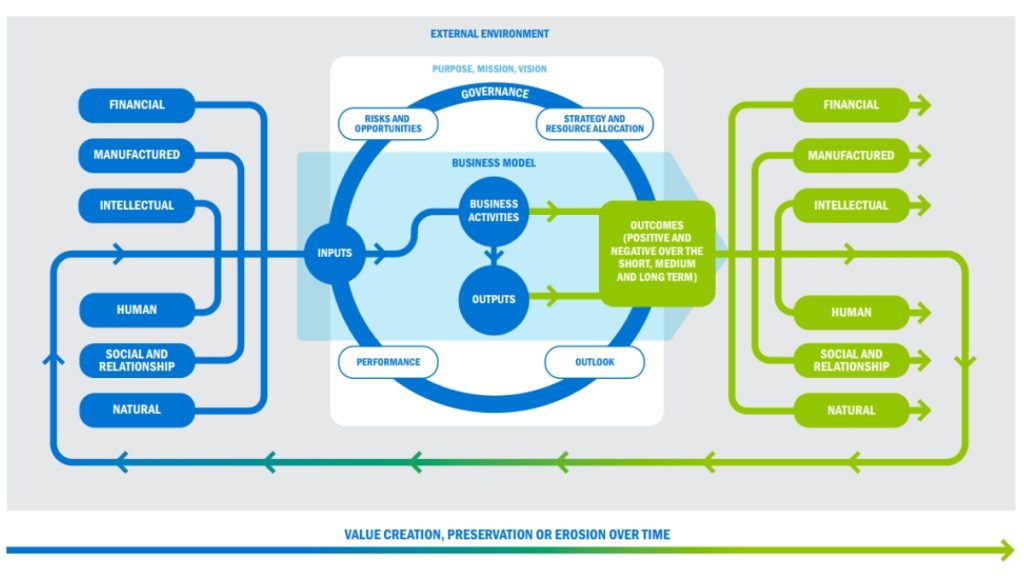
A company uses the capitals as inputs and transforms them through its business activities to produce products, services, and other outputs. These activities and outputs then generate outcomes or impacts on the capitals themselves.
For example, a factory expansion project may increase production capacity while also increasing demand for financial capital, human resources, energy, and water. If managed well, the project may create jobs, strengthen technological capabilities, and improve community relationships. However, if environmental or social impacts are not properly managed, the project may also erode natural capital or social and relationship capital.
Value creation is therefore not a one-way process from “investment” to “profit.” It is a continuous process through which companies use, affect, and transform different forms of capital.
The six capitals are a lens, not just a list
The six capitals help companies broaden their understanding of the resources and relationships that influence their ability to create value. However, the degree of dependence on and impact on each capital will differ depending on the industry, business model, strategy, and operating context.
A mining company may depend heavily on natural capital and relationships with local communities. A professional services firm may depend more on human and intellectual capital. A manufacturing company, meanwhile, may need to manage financial, manufactured, human, natural, and social and relationship capital simultaneously across its supply chain.
Therefore, when applying the six-capitals approach, three important questions are:
- Which capitals does the company depend on to operate its business model and execute its strategy?
- Which capitals are the company’s activities increasing, decreasing, or transforming?
- Could those changes significantly affect the company’s ability to create value in the short, medium, and long term?
The capital categories in the Framework can therefore be used as a completeness guide, helping companies avoid overlooking important resources and relationships when considering their ability to create value.
More importantly, companies need to understand the connections and trade-offs between the capitals rather than viewing them as separate topics.
Integrated Thinking: How companies think and make decisions
For the six capitals to be meaningful, they need to be embedded in how a company thinks before they are reflected in reporting. This is the role of Integrated Thinking. The Integrated Reporting Framework defines Integrated Thinking as the active consideration by an organization of the relationships between its various operating and functional units and the capitals that it uses or affects.
Under this approach, when making a decision, a company does not consider only the impact on revenue, costs, or profit. It also takes a broader view of:
- Dependencies and trade-offs between the capitals;
- Relationships with stakeholders;
- The alignment of the business model and strategy with the external environment;
- Risks and opportunities;
- The connections between activities, performance, and impacts on the capitals;
- The ability to create, preserve, or erode value in the short, medium, and long term.
For example, a decision to reduce the training budget should not be considered only from the perspective of cost savings. The company should also consider the implications for workforce capability, innovation, productivity, succession, and ultimately its ability to execute strategy.
Similarly, a new investment project should not be assessed solely through NPV, IRR, or payback period. The decision may also need to consider operational capacity, people, technology, raw-material availability, environmental impacts, community relationships, and risks that could affect the company’s future ability to create value.
Integrated Thinking is therefore not a reporting exercise.
It is a way of thinking and making decisions in which financial and non-financial factors are viewed as interconnected components of the same value creation system.
From Integrated Thinking to action
Integrated Thinking only becomes meaningful when it is translated into the way a company makes decisions and governs itself. Rather than allowing strategy, risk management, ESG, finance, human resources, and operations to exist as separate information “silos,” companies need to understand how these elements interact within the same value creation system:
Business model ↔ Material matters ↔ Capitals ↔ Risks & opportunities ↔ Strategy & resource allocation ↔ Performance/KPIs ↔ Governance
At that point, the six capitals are no longer merely a concept used to describe the company. They become a lens that helps the Board and Management understand which resources the company depends on, what trade-offs are taking place, and whether current decisions are strengthening or weakening its future ability to create value.
From Integrated Thinking to Integrated Reporting
Once these connections have been embedded in governance and decision-making, Integrated Reporting becomes the means through which the company communicates how it creates value externally. A good integrated report does not simply combine financial and non-financial information; it should help readers understand the connections between the business model, capitals, risks and opportunities, strategy, performance, governance, and outlook.
This logic can be summarized as follows:
Integrated Thinking → Integrated decisions and actions → Integrated Reporting
This is also how CGS Vietnam approaches the issue: rather than starting with the question “What additional content should be added to the report?”, the starting point is “How does the company create value, which capitals does it depend on, and does its current governance system adequately reflect those connections?”
From this perspective, the value of the six capitals does not lie in giving companies another reporting structure. Rather, it lies in helping companies better understand which resources they use to create value, how current decisions are changing those resources, and how those changes affect their ability to create value in the future.
Key references:
- IFRS Foundation – Integrated Reporting Framework
- ACCA – Integrated reporting and performance management
- IFRS – Transition to integrated thinking
About CGS Vietnam
CGS Vietnam Consulting Joint Stock Company provides specialized advisory services in Corporate Governance, Sustainability (ESG), Risk Management, and Internal Audit. Backed by a team of experienced professionals with deep expertise in international best practices, CGS Vietnam partners with businesses to strengthen corporate governance, enhance management capabilities, meet investor expectations, and achieve long-term sustainable growth.
Contact CGS Vietnam:
Hotline: (+84) 363 581 520 | Email: [email protected] | Website: https://cgsvietnam.com/
LinkedIn: https://www.linkedin.com/company/cgs-vietnam | Facebook: https://www.facebook.com/CGSVietnamCompany/