

Lobbying strategies and tax planning have traditionally been regarded as the responsibility of executive management and specialized functions such as Finance and Accounting, Legal, or Government Affairs. Meanwhile, the Board of Directors (BoD) has primarily focused on setting strategic direction, overseeing business performance, and supervising the company’s most significant risks.
However, this traditional approach is evolving in response to globalization, the rise of ESG, and growing investor expectations. Today, investors are concerned not only with whether a company complies with the law, but also with whether its tax strategies and lobbying activities are conducted transparently, align with ethical standards, and support the company’s long-term sustainability commitments.
An overly aggressive tax strategy (for example, exploiting legal loopholes to minimize tax liabilities) or a non-transparent lobbying strategy may still be legally permissible. Nevertheless, such practices can increase legal and reputational risks, undermine investor confidence, and ultimately erode the company’s long-term value.
Against this backdrop, the G20/OECD Principles of Corporate Governance 2023 place greater emphasis on the Board’s responsibility for overseeing lobbying strategies, financial strategies, and tax planning. This reflects a broader evolution in corporate governance, expanding the Board’s role from merely overseeing compliance to supervising strategic decisions that may significantly affect the company’s long-term value.
What do the G20/OECD Principles of Corporate Governance 2023 say?
Principle V.C of the G20/OECD Principles of Corporate Governance 2023 emphasizes the Board’s responsibility for promoting high ethical standards, fostering a culture of integrity, and guiding ethical conduct throughout the organization.
The accompanying implementation guidance further notes that an increasing number of jurisdictions expect Boards to oversee lobbying strategies, financial strategies, and tax planning. Such oversight is intended to discourage practices that may expose companies to legal or reputational risks or fail to serve the long-term interests of the company and its shareholders.
Importantly, the OECD does not address lobbying and tax planning solely from the perspectives of regulatory compliance or disclosure. Instead, these issues are incorporated within the broader framework of business ethics and Board responsibilities. This demonstrates that the key question is not whether a company engages in lobbying or tax planning, but whether the Board exercises effective oversight to ensure these activities are consistent with ethical standards, the company’s long-term interests, and stakeholder expectations.
Why should the Board oversee Lobbying Strategies?
Lobbying refers to activities through which companies – either directly or via industry associations – engage with policymakers by participating in consultations, providing recommendations, and contributing to the development, amendment, or implementation of laws and regulations. Such activities are a legitimate part of a market economy. However, without appropriate governance mechanisms, they may give rise to conflicts of interest, a lack of transparency, or inconsistencies with the company’s sustainability commitments.
Under the G20/OECD Principles of Corporate Governance 2023, the Board is not expected to conduct lobbying activities directly. Rather, it is responsible for overseeing strategic activities that may have a material impact on the company, including lobbying strategies. In fulfilling this oversight role, the Board should ensure that lobbying activities are conducted transparently, adhere to ethical standards, remain aligned with the company’s long-term interests, and help mitigate legal and reputational risks while maintaining the confidence of investors and other stakeholders.
Board Oversight of Tax Planning: The focus is Risk Governance, not Tax Engineering
The OECD does not oppose companies from undertaking tax planning within the boundaries of applicable laws and regulations. However, the G20/OECD Principles of Corporate Governance 2023 acknowledge a growing international trend in which Boards are increasingly expected to oversee corporate tax strategies in order to discourage aggressive tax planning (*), as such practices may create legal and reputational risks while failing to serve the long-term interests of the company and its shareholders.
(*) Aggressive tax planning generally refers to tax strategies that exploit loopholes, inconsistencies, or differences in tax rules to reduce tax liabilities, even though such arrangements may remain legally permissible.
The fact that the OECD discusses tax strategy alongside financial strategy and lobbying strategy demonstrates that taxation is no longer viewed merely as a technical or compliance issue. Instead, the way a company designs and implements its tax strategy can significantly influence its reputation, investor confidence, and long-term value creation.
Accordingly, the Board’s role is not to design tax structures or determine tax-saving mechanisms. Rather, it is to oversee how management identifies, assesses, and manages tax-related risks, ensuring that tax strategies are appropriately governed and remain consistent with ethical standards as well as the long-term interests of the company and its shareholders. A tax strategy may be fully compliant with the law yet still expose the company to significant reputational damage if it undermines investor trust or public confidence.
Alignment with International Frameworks
The principles embodied in the G20/OECD Principles of Corporate Governance 2023 are also reflected in a number of internationally recognized frameworks on corporate governance, enterprise risk management, and sustainability-related disclosures. Although these frameworks differ in scope and objectives, they all emphasize the Board’s responsibility for overseeing decisions that may affect the company’s long-term value, transparency, and accountability.
- GRI 207: Tax recommends that companies disclose their approach to taxation, tax governance arrangements, tax risk management processes, and engagement with tax authorities to enhance transparency and accountability.
- IFRS S1 – General Requirements for Disclosure of Sustainability-related Financial Information requires companies to disclose sustainability-related risks and opportunities that could reasonably be expected to affect the entity’s prospects, including its cash flows, access to finance, or cost of capital. Where tax risks or reputational risks arising from lobbying activities are considered material, companies should evaluate whether such matters require disclosure in accordance with the standard’s materiality principle.
- COSO Enterprise Risk Management (ERM) provides an integrated framework for incorporating significant risks – including tax-related risks, where relevant – into the enterprise risk management system, thereby supporting the Board in fulfilling its oversight responsibilities more effectively.
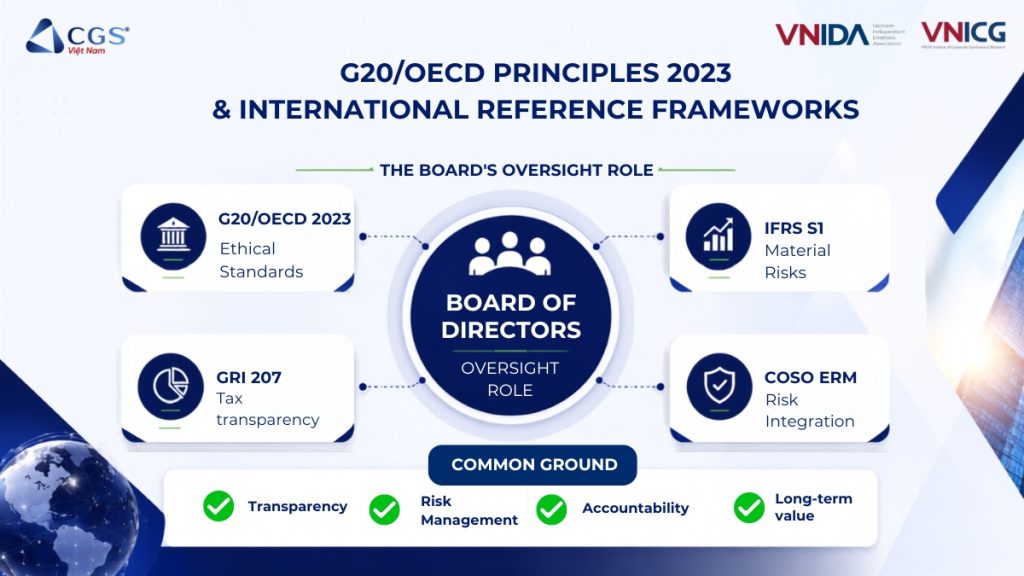
A common feature across these international frameworks is that they extend beyond legal compliance to emphasize governance, transparency, and accountability. Within this context, the Board plays a central role in providing strategic direction and effective oversight to ensure that key decisions are aligned with the company’s long-term interests and stakeholder expectations.
Relevance to the Vietnamese Legal Framework
Vietnam currently does not have a dedicated law governing lobbying activities. Nevertheless, various existing legal provisions establish an important foundation for strengthening the Board’s oversight role in relation to transparency, business ethics, and risk governance.
The Law on Enterprises 2020 requires Board members to perform their duties with loyalty, prudence, honesty, and in the best interests of the company, while appropriately managing conflicts of interest. For listed companies, the Law on Securities 2019 and Decree No. 155/2020/ND-CP introduce corporate governance, disclosure, and related-party transaction requirements aimed at enhancing transparency and accountability.
In the area of taxation, the Law on Tax Administration 2019, together with regulations on transfer pricing, requires enterprises to comply with tax filing obligations, maintain transfer pricing documentation, and manage tax-related risks in accordance with applicable regulations.
Although Vietnamese law does not explicitly regulate lobbying governance, the existing legal framework on corporate governance, transparency, conflict-of-interest management, and Board responsibilities provides a solid basis for companies to progressively adopt the governance practices recommended under the G20/OECD Principles of Corporate Governance 2023.
Three International Case Studies
Case 1: Starbucks in the United Kingdom: Tax Strategy and Reputational Risk
Starbucks faced significant public criticism in the United Kingdom after reports revealed that its corporate income tax payments were disproportionately low relative to the scale of its operations, despite the fact that many of its tax arrangements complied with the applicable laws at the time.
In response to mounting pressure from the public, regulators, and members of Parliament, the company voluntarily revised its tax approach, committed to making additional tax payments, and strengthened its engagement with stakeholders in an effort to restore public trust.
This case illustrates that a tax strategy may be legally compliant yet still expose a company to substantial reputational risk. Consequently, the Board should oversee not only the legality of tax strategies but also their potential impact on corporate reputation and long-term value creation.
Case 2: Apple and Tax Rulings in Ireland: When Tax Strategy Becomes a Governance Issue
The long-running dispute involving Apple, Ireland, and the European Commission over tax rulings demonstrates how tax decisions can extend beyond technical tax matters and become governance issues requiring Board-level oversight. Following years of litigation, the Court of Justice of the European Union ruled that Ireland must recover tax benefits deemed to constitute unlawful State aid.
The case highlights that tax strategies should be assessed not only from legal and financial perspectives but also in terms of reputational implications and investor relations. Boards therefore need to ensure that tax-related decisions are aligned with the company’s risk appetite and long-term strategic objectives.
Case 3: Volkswagen’s Dieselgate Scandal: Lessons in Business Ethics and Oversight
In 2015, Volkswagen was found to have installed software designed to manipulate emissions testing for diesel vehicles, resulting in tens of billions of dollars in fines, settlements, and severe reputational damage. In the aftermath, the company undertook extensive governance reforms by strengthening its compliance framework, enhancing internal controls, introducing a renewed ethics and compliance programme, and reinforcing the Board’s oversight responsibilities.
The case demonstrates how business decisions can expose a company to significant risks when effective oversight and ethical governance are lacking. It also underscores the importance of the Board’s role in fostering a culture of integrity, overseeing material risks, and ensuring that strategic decisions support the company’s long-term interests.
Recommendations for Companies
To align with the spirit of the G20/OECD Principles of Corporate Governance 2023, companies may consider the following actions:
- Establish a comprehensive governance framework for lobbying strategies and tax planning, clearly defining the underlying principles, scope, and responsibilities of relevant parties.
- Strengthen the Board’s oversight role by ensuring that lobbying activities and tax strategies are evaluated not only from a legal compliance perspective but also in terms of legal, reputational, and long-term value creation risks.
- Integrate lobbying- and tax-related risks into the company’s Enterprise Risk Management (ERM) framework and establish regular reporting mechanisms to provide the Board with timely and comprehensive information for effective oversight.
- Enhance the Board’s competencies in corporate governance, enterprise risk management, sustainability, and international governance practices to meet the evolving expectations of investors and capital markets.
For listed companies in particular, adopting these governance practices can not only improve the quality of corporate governance but also strengthen investor confidence and enhance long-term access to capital.
Conclusion
The G20/OECD Principles of Corporate Governance 2023 place greater emphasis on the Board’s responsibility for overseeing lobbying strategies and tax planning, reflecting an important development in modern corporate governance. The Board’s role extends beyond ensuring legal compliance to providing strategic oversight that ensures key decisions are consistent with ethical standards, shareholder interests, and the objective of creating sustainable long-term value.
For Vietnamese companies, proactively adopting these international governance practices can enhance corporate governance quality, strengthen enterprise risk management capabilities, reinforce investor confidence, and improve integration with international capital markets.
CGS Vietnam supports companies in assessing their alignment with the G20/OECD Principles of Corporate Governance 2023, strengthening tax governance frameworks, establishing effective oversight mechanisms for lobbying activities, developing business ethics policies, and enhancing Board effectiveness in accordance with internationally recognized corporate governance practices.
This article is part of a content series on the G20/OECD Principles of Corporate Governance, developed through the professional collaboration between CGS Vietnam, the Vietnam Independent Directors Association (VNIDA) and the VNIDA Institute of Corporate Governance (VNICG). The series aims to share knowledge, assessment approaches, and practical guidance on applying corporate governance principles in business practice.
—————-
References:
- G20/OECD Principles of Corporate Governance 2023
- https://www.globalreporting.org/standards/standards-development/topic-standard-project-for-tax/
- https://www.ifrs.org/issued-standards/ifrs-sustainability-standards-navigator/ifrs-s1-general-requirements/
- https://www.coso.org/guidance-erm
- https://www.iso.org/standard/37001
- https://www.sciencedirect.com/science/article/abs/pii/S0748575115300130
- https://www.reuters.com/technology/why-does-apple-have-pay-ireland-144-billion-2024-09-10/
- https://www.epa.gov/enforcement/learn-about-volkswagen-violations
About CGS Vietnam
CGS Vietnam Consulting Joint Stock Company provides specialized advisory services in Corporate Governance, Sustainability (ESG), Risk Management, and Internal Audit.
Backed by a team of experienced professionals with deep expertise in international best practices, CGS Vietnam partners with businesses to strengthen corporate governance, enhance management capabilities, meet investor expectations, and achieve long-term sustainable growth.
Contact CGS Vietnam:
Hotline: (+84) 363 581 520 | Email: [email protected] | Website: https://cgsvietnam.com/
LinkedIn: https://www.linkedin.com/company/cgs-vietnam | Facebook: https://www.facebook.com/CGSVietnamCompany/