

ESG is becoming an increasingly important concept in business. When exploring ESG, companies may encounter a wide range of ESG standards and frameworks, such as GRI Standards, IFRS S1 and IFRS S2, SASB Standards, and TCFD. However, there is no single ESG standard that applies universally to all companies. ESG encompasses three broad areas – Environmental (E), Social (S), and Governance (G) – while different standards and frameworks provide different approaches to identifying, measuring, and disclosing related information.
Understanding these distinctions helps companies choose an approach that aligns with their business activities, market requirements, and stakeholder expectations.
What are ESG standards?
ESG standards is a term commonly used to refer to standards, frameworks, and requirements related to identifying, measuring, managing, and/or disclosing information on environmental, social, and governance matters. However, ESG itself is not the name of a single, unified set of standards.
ESG is generally considered across three broad areas, which may include:
- Environmental: climate change, greenhouse gas emissions, energy, natural resources, water, waste, biodiversity, and other environmental impacts.
- Social: employees, health and safety, human rights, customers, communities, supply chains, and other social matters.
- Governance: governance structures and effectiveness, business ethics, risk management, internal control, conflicts of interest, transparency, and accountability.
Companies may need to manage multiple issues across all three areas simultaneously. Depending on their industry, business model, markets of operation, intended users of information, and regulatory requirements, the issues that should be prioritized and the material information that should be disclosed may vary.
Therefore, before selecting ESG standards, companies should first determine which ESG issues need to be managed, what information needs to be disclosed, and which stakeholder requirements need to be addressed. This provides the basis for selecting ESG standards or frameworks that are appropriate to the company’s objectives and specific circumstances.

Common ESG standards and frameworks
Frameworks and standards related to ESG and sustainability vary considerably in their purpose, scope, and intended users. For ease of understanding, companies can consider them in three broad groups: Principle-based frameworks and standards, Reporting frameworks and standards, and Sector-specific frameworks and standards.
Principle-based frameworks and standards
This group provides principles, guidance, or goals that companies can use as a foundation for developing their approach to sustainability and responsible business conduct. Rather than focusing primarily on specific metrics to be disclosed, these frameworks provide direction on the principles companies should follow, the responsibilities they should consider, and the issues they should integrate into their business activities.
Examples include the UN Global Compact, the OECD Guidelines for Multinational Enterprises on Responsible Business Conduct, and the Sustainable Development Goals (SDGs).
Reporting frameworks and standards
This group focuses on identifying, organizing, and disclosing information on sustainability matters, helping companies determine what should be reported and how information can be presented systematically.
The focus of disclosure varies across different systems. Some standards focus on a company’s impacts on the economy, environment, and people, while others focus on sustainability-related risks and opportunities that could affect the company’s prospects.
Prominent examples include GRI Standards and IFRS S1 and IFRS S2 issued by the ISSB. Companies may also refer to issue-specific disclosure systems, such as CDP (Carbon Disclosure Project) for environmental information.
Sector-specific frameworks and standards
ESG issues can vary significantly across industries. This group therefore provides guidance, topics, or metrics based on the characteristics and sustainability issues of specific industries or sectors.
Referring to sector-specific standards can help companies focus on issues that are more relevant to their operations and to the impacts, risks, and opportunities associated with their industry. Examples include SASB Standards, GRI Sector Standards, and sector-specific guidance such as Ipieca’s Sustainability Reporting Guidance for the Oil and Gas Industry.
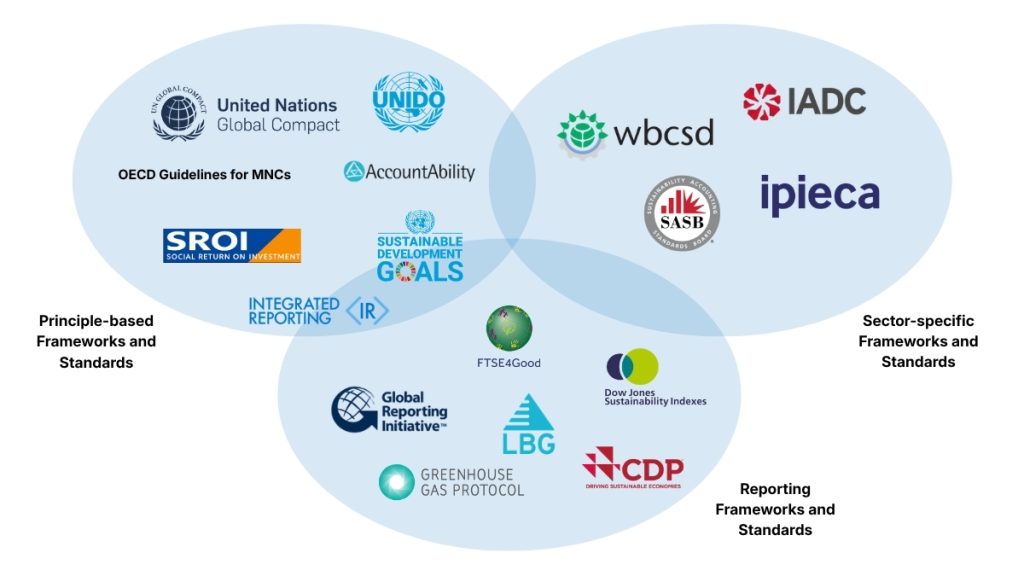
Importantly, these three groups of ESG frameworks and standards are not entirely separate. A particular system may support both disclosure and sector-specific guidance, and companies may refer to multiple systems at the same time.
Therefore, rather than simply asking, “Which ESG standards are the best?”, companies should understand the purpose of each framework and select an approach that is appropriate to their needs.
More Vietnamese companies are referring to ESG standards
Insights from the Vietnam Listed Company Awards (VLCA) indicate that listed companies are showing increasing interest in applying international standards and frameworks in their sustainability reporting.
According to VLCA, in 2024, the number of companies preparing and publishing Sustainability Reports in accordance with international standards and frameworks such as GRI, Integrated Reporting, SASB, and ISSB (incorporating TCFD) increased by 40% compared with 2023. In addition to GRI, some companies also adopted other frameworks such as CDP, SASB, and the SDGs.
This trend continued at VLCA 2025. According to the assessment results, an increasing number of companies are applying industry-specific SASB Standards, particularly in sectors with significant ESG-related financial risks, such as Petrovietnam Ca Mau Fertilizer Joint Stock Company (PVCFC) and Viet Dragon Securities Corporation. This helps sustainability reports better address investors’ analytical needs. The 2025 Sustainability Reporting criteria also encouraged the use of multiple standards and frameworks. In addition to GRI, companies could apply TCFD, SASB, IFRS S1/S2, CDP, or sector-specific frameworks.
These developments indicate that companies are not only paying greater attention to sustainability reporting but are also gradually broadening their use of different standards and frameworks.
ESG practice goes beyond ESG reporting
A common misconception is to equate ESG practice with ESG reporting or sustainability reporting. Reporting, however, should be understood as a disclosure tool that reflects a company’s ESG management and practices, rather than representing the entirety of its ESG activities.
To produce high-quality information, companies need to identify material issues, establish governance mechanisms and responsibilities, develop policies, targets, metrics, and data systems, and implement concrete actions. Reporting and disclosure are outcomes of this process, built upon governance, strategy, risk management, measurement, and ESG practices.
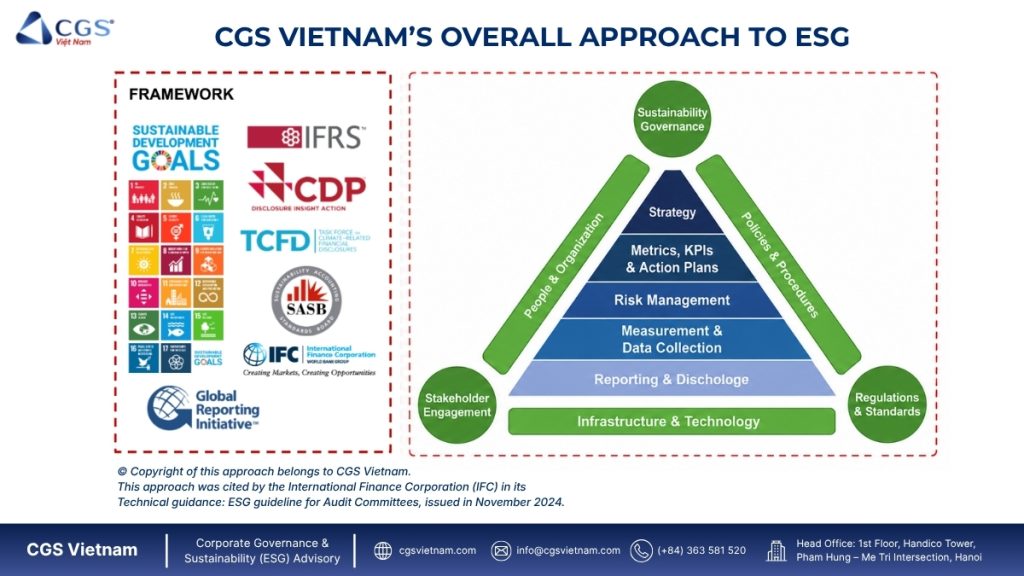
Therefore, an ESG report running to hundreds of pages does not necessarily mean that a company is managing ESG effectively. Conversely, a company that has not published a standalone ESG report may still be managing many ESG issues through environmental management, occupational health and safety, employee welfare, risk management, internal control, or business ethics.
In other words, reporting reflects what a company is doing, but it cannot replace effective governance systems and concrete actions.
Instead of asking only, “What metrics do we need to disclose?”, companies should begin with a more fundamental question: “How are we managing these ESG issues?”
Which ESG standards should companies apply?
There is no single answer that applies to every company.
The selection of ESG standards should be based on the company’s disclosure objectives, intended users of information, industry, markets of operation, regulatory requirements, customers, supply chain, and stakeholder expectations.
For example, companies seeking to disclose their impacts on the environment and society may refer to GRI Standards. Companies focused on investors and capital markets should consider IFRS S1 and IFRS S2, together with applicable regulatory requirements. Meanwhile, SASB Standards can help companies identify sustainability issues and metrics that are specific to their industry.
Companies may also combine multiple standards, provided that the purpose of each system is clearly defined and consistency is maintained.
Therefore, rather than selecting an ESG standard simply because it is widely used, companies should first determine what issues they need to address and who needs the information.
—————-
References:
- GRI – GRI Standards và GRI Sector Standards. GRI Standards
- IFRS Foundation / ISSB – IFRS S1, IFRS S2 và SASB Standards. IFRS Sustainability Standards
- UN Global Compact – The Ten Principles. UN Global Compact
- United Nations – Sustainable Development Goals (SDGs). SDGs
- OECD – Guidelines for Multinational Enterprises on Responsible Business Conduct. OECD Guidelines
- Ipieca – Sustainability Reporting Guidance for the Oil and Gas Industry. Ipieca Guidance
- VLCA – Sustainability Reporting Review 2024–2025. VLCA 2024 · VLCA 2025
About CGS Vietnam
CGS Vietnam Consulting Joint Stock Company provides specialized advisory services in Corporate Governance, Sustainability (ESG), Risk Management, and Internal Audit. Backed by a team of experienced professionals with deep expertise in international best practices, CGS Vietnam partners with businesses to strengthen corporate governance, enhance management capabilities, meet investor expectations, and achieve long-term sustainable growth.
Contact CGS Vietnam:
Hotline: (+84) 363 581 520 | Email: [email protected] | Website: https://cgsvietnam.com/
LinkedIn: https://www.linkedin.com/company/cgs-vietnam | Facebook: https://www.facebook.com/CGSVietnamCompany/