

An ESG strategy is a long-term direction that helps a company identify, prioritize, and manage environmental, social, and governance issues affecting its operations, risks, opportunities, and ability to create value. When integrated into business strategy, risk management, and decision-making, ESG not only supports disclosure requirements but also helps companies strengthen resilience and create long-term value.
However, many companies still begin with the question, “Which indicators should we report?”, instead of determining which ESG issues are genuinely material, what outcomes they seek to achieve, and how those outcomes will be managed and measured.
What is an ESG strategy?
An ESG strategy is a long-term direction for integrating material environmental, social, and governance issues into a company’s business strategy, risk management, and decision-making processes.

Depending on its objectives and the framework applied, a company may consider two dimensions: how ESG issues financially affect the company; and how the company affects the environment, people, and society. These dimensions form the foundation of the double materiality approach.
An ESG strategy should answer four key questions:
- Which ESG issues are genuinely material to the company and its stakeholders?
- What outcomes does the company seek to achieve?
- How are ESG objectives connected to the business strategy?
- How will the company implement the strategy, assign responsibilities, and measure performance?
Therefore, an ESG strategy is not merely a list of commitments, corporate social responsibility initiatives, or reporting indicators. It should be grounded in the company’s business model, value chain, regulatory requirements, stakeholder expectations, and material risks, opportunities, and impacts.
This approach is consistent with international governance trends. The G20/OECD Principles of Corporate Governance 2023 emphasize the role of the Board of Directors in considering material sustainability-related risks and opportunities when performing its responsibilities for strategy, risk management, internal control, and oversight of corporate disclosure.
Why do companies need an ESG strategy?
Climate change, regulatory requirements, supply chain standards, occupational safety, human capital management, data security, and customer expectations can all affect a company’s costs, revenue, market access, access to capital, and reputation.
An ESG strategy enables a company to shift from reacting to external requirements to proactively managing ESG issues. Instead of acting only when new regulations or requests from customers and investors arise, the company can identify material issues early, assess associated risks and opportunities, and then select appropriate objectives and responses.
An ESG strategy also helps the company focus its resources on the issues that matter most, avoiding fragmented initiatives that fail to create meaningful change. When properly governed, ESG can help protect value, strengthen resilience, and identify long-term growth opportunities.
Where does ESG strategy sit within the ESG governance system?
ESG strategy is a component of the overall ESG governance system, rather than a standalone operating system. To deliver results, the strategy must be connected to implementation mechanisms, risk management, policies, procedures, data, oversight, and disclosure.
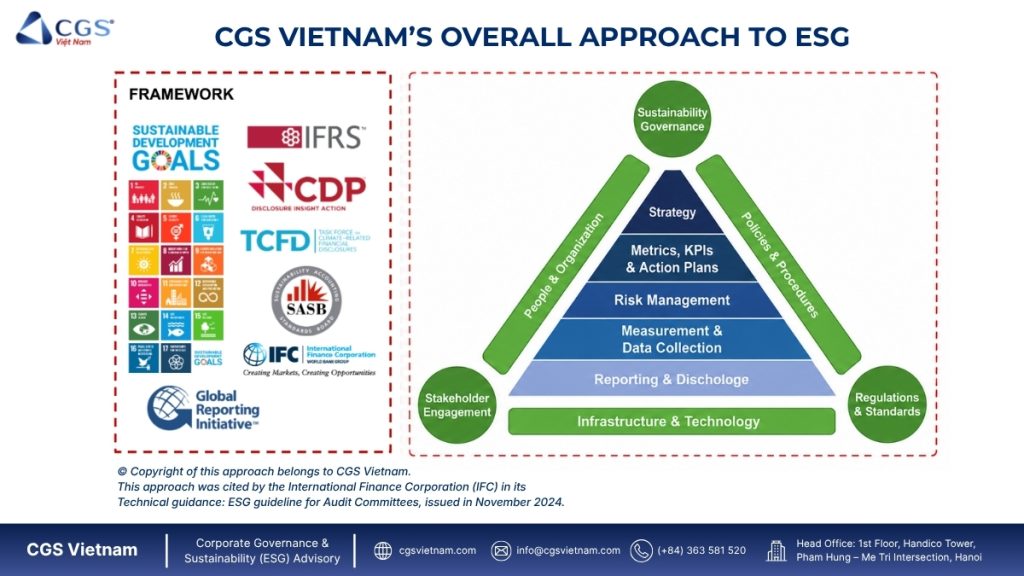
Under CGS Vietnam’s approach, Sustainability Governance encompasses the entire system, while ESG strategy sits at the highest directional level of the implementation chain. The strategy connects business direction with ESG priorities and identifies the material issues, objectives, and intended outcomes.
Based on the strategy, the company establishes metrics, KPIs, and action plans; integrates ESG issues into risk management; measures and collects relevant information; and subsequently reports and discloses its performance. The two pillars of people and organizational structure, and policies and procedures support this process. Infrastructure and technology provide the foundation, while stakeholders, regulations, ESG standards, and reference frameworks provide inputs for designing and adjusting the system.
Therefore, ESG strategy is not the entire ESG governance system; it is the system’s starting point. Without a strategy, initiatives can become fragmented and resources difficult to prioritize. Conversely, without implementation mechanisms, data, and oversight, the strategy may remain merely a commitment. Within this system, the Board of Directors approves or oversees the strategic direction; executive management organizes implementation; and functional units are responsible for actions and data.
Thaioil Group: Turning ESG direction into meaningful action
Thaioil Group pursues sustainable growth in the energy and chemicals sector while integrating environmental, social, and governance issues into its business operations. Thaioil Group illustrates how a company can translate ESG priorities into objectives, implementation processes, and specific accountability mechanisms.
Establishing a climate pathway and emissions targets
From an environmental perspective, Thaioil Group has developed a pathway toward achieving net-zero emissions by 2060. The Group is also considering accelerating this target to 2050, subject to the maturity and economic viability of relevant technologies and their ability to preserve the company’s long-term competitiveness.
This direction has been translated into quantitative targets for Scope 1 and Scope 2 greenhouse gas emissions. Thaioil Group has also implemented measures to improve energy efficiency, manage emissions, and gradually shift its business portfolio toward lower-carbon activities. This demonstrates that its net-zero objective is connected to operations and business development, rather than remaining solely a long-term commitment.
Integrating ESG into supply chain management
Within its supply chain, Thaioil Group applies a Supplier Sustainable Code of Conduct covering environmental, social, and governance requirements. According to the Group’s disclosures, all newly registered suppliers undergo ESG risk assessments, while the entire supplier base is included in a periodic assessment process.
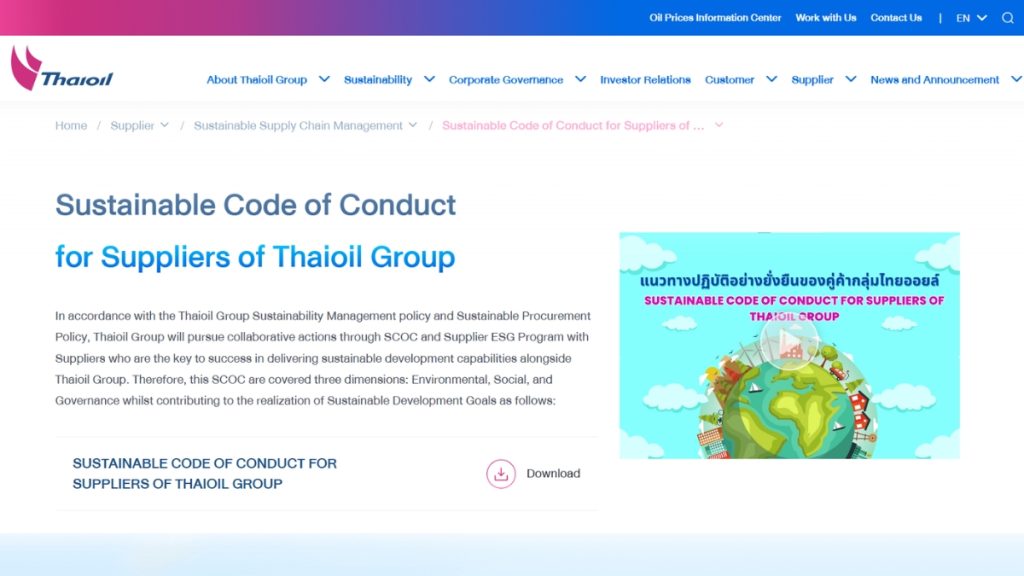
The management process includes supplier screening, risk classification, desktop or on-site assessments, and corrective action plans where potential adverse impacts are identified. By referring to ISO 20400 sustainable procurement principles, Thaioil Group also incorporates ESG considerations into its supplier selection and management criteria, extending the scope of governance beyond its internal operations.
Establishing governance structures and implementation responsibilities
To support implementation, Thaioil Group has established a Corporate Sustainability Function to coordinate its ESG agenda and assist specialized units in managing material issues. For its net-zero objective, the Group has developed a dedicated governance structure to coordinate, monitor, and support implementation across its business units.
This organizational arrangement connects the ESG strategic direction with implementation responsibilities throughout the company. Long-term objectives are translated into action programmes, assigned to accountable functions, and placed within monitoring and reporting mechanisms. Thaioil Group therefore demonstrates three fundamental layers of an implementable ESG strategy: setting objectives, integrating them into operations, and establishing governance mechanisms.
The information above has been compiled from Thaioil Group’s disclosures to illustrate how a company can translate its ESG direction into objectives, actions, and governance mechanisms. It does not constitute an independent assessment of the Group’s ESG performance.
Common mistakes when developing an ESG strategy
When developing an ESG strategy, companies may make mistakes that result in unfocused objectives, implementation difficulties, or a lack of meaningful outcomes. Common mistakes include:
- Starting with standards rather than the company: Standards are useful reference tools, but strategic priorities should be based on the company’s operating model, value chain, risks, opportunities, and impacts.
- Equating ESG with CSR: Community initiatives may form part of ESG, but they cannot replace the management of material issues arising from business operations.
- Setting too many objectives without clear priorities: A long list of commitments does not necessarily constitute a sound strategy. Companies should concentrate their resources on the issues that matter most.
- Establishing KPIs without baselines, data, or accountability: Without a defined calculation methodology, data sources, responsible parties, and timelines, KPIs are difficult to monitor and verify.
- Separating ESG from business strategy and risk management: When ESG is assigned solely to a separate department, the company may fall into the practice of “doing ESG” rather than genuinely managing ESG issues.
- Treating reporting as the end goal: A high-quality report should reflect genuine governance processes; it cannot substitute for a strategy and its implementation outcomes.
Where should Vietnamese companies begin?
Companies can begin by analyzing their business environment, assessing their current position, selecting a limited number of genuinely material issues, and clearly defining the objectives, responsibilities, and data to be monitored.

From there, they can progressively connect direction → objectives and actions → risk management → data and oversight → performance and disclosure. The scope of implementation can be expanded according to the company’s maturity, available resources, and market requirements.
An ESG strategy creates value only when the company establishes mechanisms for turning its direction into measurable decisions, actions, and outcomes. This is also what distinguishes an implementable strategy from a set of largely symbolic commitments.
CGS Vietnam provides ESG strategy consulting services
CGS Vietnam supports companies in developing an ESG strategy suited to their business model, maturity, resources, and stakeholder requirements. CGS’s approach focuses on integrating ESG into the company’s business strategy and governance system, rather than developing a separate sustainability plan.
The scope of consulting services may include:
- Analyzing the business context, regulatory requirements, market trends, and stakeholder expectations.
- Assessing the company’s current ESG governance and practices.
- Identifying material ESG issues and strategic priorities.
- Developing ESG objectives, roadmaps, and action plans.
- Establishing metrics, KPIs, baselines, and performance-monitoring mechanisms.
- Defining governance structures and the responsibilities of the Board of Directors, executive management, and functional units.
- Connecting the ESG strategy with risk management, policies, procedures, data, and disclosure.
Throughout the implementation process, CGS Vietnam emphasizes feasibility, senior leadership involvement, and the implementation capabilities of individual business units. The strategy may be implemented in phases, enabling the company to prioritize resources, monitor progress, and gradually expand its scope in line with its level of maturity.
Through this approach, companies can translate ESG commitments into measurable objectives, responsibilities, and outcomes while strengthening governance capabilities, resilience, and long-term value creation.
Learn more at: https://cgsvietnam.com/en/dich-vu/sustainable-development-strategy/
———————
References:
- OECD, G20/OECD Principles of Corporate Governance 2023
- Thaioil, Climate Strategy
- Thaioil, Sustainability Management Structure
- Thaioil, Sustainable Supply Chain Management
- Thaioil, Sustainability Reports
About CGS Vietnam
CGS Vietnam Consulting Joint Stock Company provides specialized advisory services in Corporate Governance, Sustainability (ESG), Risk Management, and Internal Audit. Backed by a team of experienced professionals with deep expertise in international best practices, CGS Vietnam partners with businesses to strengthen corporate governance, enhance management capabilities, meet investor expectations, and achieve long-term sustainable growth.
Contact CGS Vietnam:
Hotline: (+84) 363 581 520 | Email: [email protected] | Website: https://cgsvietnam.com/
LinkedIn: https://www.linkedin.com/company/cgs-vietnam | Facebook: https://www.facebook.com/CGSVietnamCompany/