

In the context of increasing demands for transparency, risk management, and sustainability, Boards of Directors (BoDs) need effective support mechanisms to fulfill their strategic direction and oversight responsibilities.
Board committees are established to strengthen specialized expertise, enhance the independence of oversight, and support the Board in making well-informed, objective decisions.
The establishment and effective operation of board committees are also important elements of the G20/OECD Principles of Corporate Governance 2023 and the Vietnam Corporate Governance Code 2026 (VNCG Code 2026).
What are Board committees?
Board committees are specialized bodies established to support the Board of Directors in fulfilling its governance and oversight responsibilities in specific areas, such as audit, risk management, nomination, remuneration, and sustainability.
According to Principle V.E.2 of the G20/OECD Principles of Corporate Governance 2023, board committees enable the Board to focus more closely on important matters, particularly those requiring specialized expertise or involving potential conflicts of interest.
The establishment of board committees serves three main objectives:
- Enhancing oversight quality: Assigning specific areas of responsibility for more in-depth review, assessment, and constructive challenge before matters are submitted to the Board.
- Strengthening independence: Promoting the role of independent and non-executive directors in matters where conflicts of interest may arise.
- Improving decision-making effectiveness: Providing the Board with well-founded analyses, assessments, and recommendations.
In terms of operations, committees perform their duties in accordance with the company’s Charter, internal regulations, and responsibilities assigned by the Board. Oversight findings, recommendations, and material matters are reported to the Board for consideration.
The establishment of committees does not diminish the Board’s ultimate responsibility for decisions made, except where otherwise provided by law.
Common types of board committees
Depending on their size, organizational structure, industry, and business complexity, companies may establish different specialized committees. Four commonly recognized types of board committees include:
| Committee | Key responsibilities |
|---|---|
| Audit Committee | Oversees financial reporting, auditing, internal controls, and compliance. |
| Nomination and Remuneration Committee | Oversees nominations, succession planning, leadership evaluation, and remuneration policies. |
| Risk Management Committee | Oversees the risk management framework, risk appetite, and material risks. |
| Sustainability/ESG Committee | Oversees sustainability-related strategies, objectives, risks, and opportunities. |
In addition, some companies establish Strategy Committees, Investment Committees, or Technology Committees to address specific governance needs. There is no one-size-fits-all model. The committee structure should comply with applicable legal requirements while reflecting the Board’s actual oversight needs.
Roles and responsibilities of each board committee
Audit Committee

The Audit Committee plays an important role in ensuring the quality of financial reporting, the effectiveness of internal control systems, and the independence of audit activities.
Under Article 161 of Vietnam’s Law on Enterprises 2020, the Audit Committee has the following key responsibilities:
- Overseeing the integrity of financial statements and related disclosures.
- Reviewing internal control systems, risk management, and related-party transactions.
- Overseeing internal audit activities and assessing the independence and objectivity of external auditors.
- Monitoring compliance with laws and internal regulations.
VNCG Code 2026 recommends that the Audit Committee comprise a majority of independent directors, including its Chair, and meet at least four times per year (Principles 3.1.1 and 3.1.3.j).
Nomination and Remuneration Committee
The Nomination and Remuneration Committee supports the Board in establishing transparent and objective mechanisms for selecting, evaluating, and developing the company’s leadership team.
According to Principle 3.3.4 of the VNCG Code 2026, the committee’s primary responsibilities include identifying suitable Board candidates, coordinating annual evaluations of the Board and its committees, supporting reviews of remuneration policies, and overseeing the implementation of relevant governance policies.
This committee is particularly important in mitigating conflicts of interest when evaluating performance or determining remuneration policies for senior executives. The VNCG Code 2026 also recommends that the majority of committee members be independent directors, that the Board Chair should not concurrently chair the committee, and that the committee meet at least twice a year.
Risk Management Committee
The Risk Management Committee supports the Board in overseeing the establishment and operation of the risk management framework, ensuring that material risks are appropriately identified and managed.
According to Principle 3.2.3 of the VNCG Code 2026, the committee is responsible for reviewing the company’s risk appetite and risk management strategy, overseeing the implementation of risk management policies, and monitoring the effectiveness of the dedicated risk management function.
Its oversight scope extends beyond financial, operational, and compliance risks to emerging risks related to climate change, environmental, and social issues. For companies that have not established a separate Risk Management Committee, the VNCG Code 2026 recommends an interim approach of expanding the Audit Committee’s responsibilities to form a combined Audit and Risk Management Committee.
Sustainability/ESG Committee

The Sustainability/ESG Committee supports the Board in integrating environmental, social, and governance considerations into the company’s strategy and operations.
According to the G20/OECD Principles of Corporate Governance 2023, some companies establish Sustainability Committees to advise the Board on environmental and social risks, opportunities, objectives, and strategies, including those related to climate change.
Accordingly, the ESG Committee’s oversight responsibilities may cover ESG strategy, ESG objectives and targets, material risks and opportunities, and progress toward long-term commitments.
However, companies are not necessarily required to establish a separate ESG Committee. The OECD Guidelines on Corporate Governance of State-Owned Enterprises 2024 recommend that companies may establish a dedicated committee or clearly assign sustainability oversight responsibilities within the Board, depending on their circumstances.
Distinguishing Board committees from the Board of supervisors
In Vietnam, the Audit Committee and the Board of Supervisors are often confused because they share certain oversight responsibilities.
Under Article 137 of the Law on Enterprises 2020, joint-stock companies may choose between two corporate governance structures, unless otherwise provided by securities legislation:
- A structure comprising a Board of Directors and a Board of Supervisors, with certain exceptions under which joint-stock companies are not required to establish a Board of Supervisors.
- A structure without a Board of Supervisors, in which at least 20% of Board members must be independent directors and an Audit Committee must be established under the Board.
The two bodies differ in several key aspects:
| Criteria | Audit Committee | Board of Supervisors |
|---|---|---|
| Organizational position | Operates under the Board of Directors. | Does not operate under the Board of Directors. |
| Composition | At least two members; the Chair must be an independent director, while other members must be non-executive. | Typically comprises three to five supervisors elected by the General Meeting of Shareholders. |
| Oversight responsibilities | Financial reporting, auditing, internal controls, risk management, and compliance. | Oversees the Board of Directors and executive management in corporate governance and business operations. |
| Reporting responsibilities | Reports to and supports the Board in fulfilling its oversight responsibilities. | Reports and makes recommendations to the General Meeting of Shareholders in accordance with applicable regulations. |
Notably, the VNCG Code 2026 recommends establishing an Audit Committee even when a company already has a Board of Supervisors. This represents an enhanced corporate governance recommendation rather than a mandatory requirement applicable to all joint-stock companies.
Board committee practices in Vietnamese companies
Case study 1: PVCFC – Strengthening specialized oversight and integrating ESG into corporate governance
According to the 2025 Annual Report of PetroVietnam Ca Mau Fertilizer Corporation (PVCFC), its Board of Directors has four specialized committees: the Audit Committee, Risk Management Committee, Nomination and Remuneration Committee, and ESG Committee.
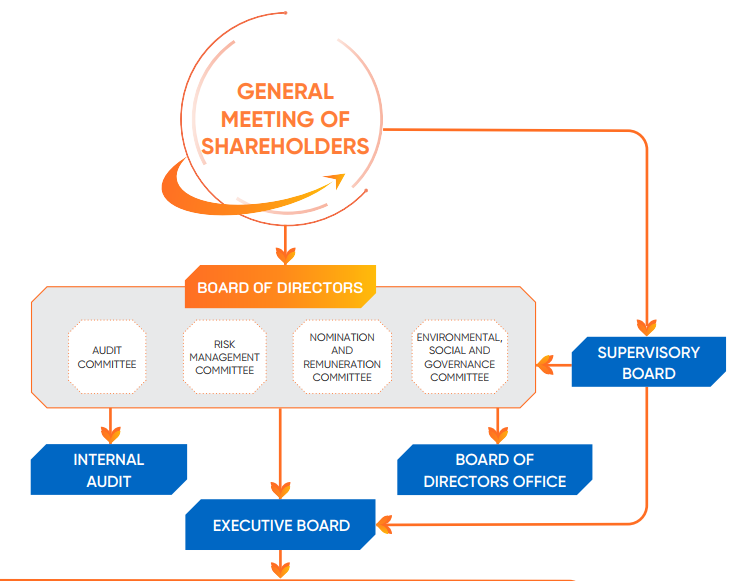
A notable development in 2025 was PVCFC’s establishment of a separate Risk Management Committee under Decision No. 2137/NQ-PVCFC dated September 3, 2025, following its separation from the Audit and Risk Management Committee. This restructuring facilitated greater specialization in audit oversight and risk management.
In addition, the ESG Committee, established in February 2024, continued to strengthen its sustainability oversight role. In 2025, the committee held four meetings focused on reviewing sustainability reporting, overseeing greenhouse gas inventories, reviewing ESG policies, and promoting transparent disclosures.
Governance takeaway: PVCFC demonstrates how companies can progressively refine their board committee structures while aligning specialized oversight with risk management and corporate sustainability strategies.
Case study 2: PV Drilling – Enhancing specialized oversight through board committee restructuring
According to PV Drilling’s 2025 Corporate Governance Report, from the beginning of the year until November 2025, its Board operated three specialized committees: the Audit and Risk Management Committee, Strategy and ESG Sustainability Committee, and Nomination and Remuneration Committee.
On November 3, 2025, PV Drilling established a separate Risk Management Committee by separating it from the Audit and Risk Management Committee, increasing the total number of board committees to four. This restructuring aimed to strengthen the independence and depth of oversight in financial matters, internal auditing, and risk management.
Notably, the Strategy and ESG Sustainability Committee supports the Board in developing, adjusting, and overseeing corporate development strategies, business plans, and medium- to long-term investment plans. In 2025, the committee also participated in reviewing the Sustainability Policy Framework and ESG targets through 2030.
Governance takeaway: PV Drilling illustrates how restructuring board committees can not only enhance oversight independence and effectiveness but also help the Board allocate resources in response to increasingly specialized governance requirements.
How can companies improve the effectiveness of Board committees?
Establishing board committees does not automatically improve corporate governance quality. Based on recommendations from the OECD and the VNCG Code 2026, companies should focus on five key areas:
- First, ensuring appropriate composition and independence. Committee members should possess relevant expertise, while independent and non-executive directors should play an active role, particularly in matters involving potential conflicts of interest.
- Second, establishing clear committee charters. Committee charters should define functions, authority, responsibilities, coordination mechanisms, and reporting arrangements to prevent overlapping responsibilities or oversight gaps.
- Third, developing annual work plans. Committee activities should be aligned with Board meeting schedules, financial reporting cycles, risk assessments, succession planning, and strategic decisions.
- Fourth, ensuring adequate resources and access to information. Committees should receive complete and timely information and have access to external experts or independent advisors when necessary.
- Fifth, conducting periodic performance evaluations. Evaluations should not focus solely on the number of meetings held but should also consider the quality of recommendations, the ability to identify material issues, and the effectiveness of follow-up actions.
For large companies or complex corporate groups, coordination among committees is also essential to ensure adequate oversight of cross-functional matters such as ESG risk management, corporate disclosures, and internal controls.
Good corporate governance practices from the OECD and Vietnam
Three major corporate governance frameworks provide important references for companies seeking to establish and enhance their board committees:
- G20/OECD Principles of Corporate Governance 2023: Principle V.E.2 recommends establishing specialized committees appropriate to a company’s size, structure, and risk profile; clearly defining their mandates, composition, and operating mechanisms; and maintaining the Board’s ultimate responsibility.
- OECD Guidelines on Corporate Governance of State-Owned Enterprises 2024: Principle VI.H particularly emphasizes the role of Audit Committees, independence, professional expertise, and oversight mechanisms of board committees in state-owned enterprises.
- Vietnam Corporate Governance Code 2026 (VNCG Code 2026): Principle 3 provides specific recommendations concerning Audit Committees, Risk Management Committees, and Nomination and Remuneration Committees, including their composition, operating regulations, and oversight responsibilities.
Companies should also distinguish between mandatory legal requirements and recommended good corporate governance practices. The OECD principles and VNCG Code 2026 serve as references for improving governance quality and do not replace the provisions of the Law on Enterprises, the Law on Securities, or other relevant sector-specific legislation.
References:
- OECD (2023), G20/OECD Principles of Corporate Governance 2023.
- OECD (2024), OECD Guidelines on Corporate Governance of State-Owned Enterprises 2024.
- Vietnam Corporate Governance Code 2026.
- Consolidated Law on Enterprises No. 67/VBHN-VPQH (2025).
- PVCFC (2025), Annual Report 2025 – Board Structure and Activities.
- PV Drilling (2025), Corporate Governance Report 2025.
Conclusion
Board committees play a crucial role in strengthening the Board’s oversight capacity, decision-making quality, and accountability. The experiences of PVCFC and PV Drilling demonstrate how refining board committee structures can help companies enhance specialized oversight, strengthen risk management, and integrate sustainability into corporate governance.
However, effective governance is not determined by the number of committees established, but rather by the suitability of their structure, the independence and competence of their members, clear operating mechanisms, and the quality of oversight in practice.
For Vietnamese companies, adopting good practices from the OECD and VNCG Code 2026 provides a foundation for reviewing and enhancing board committee structures, thereby improving Board effectiveness and supporting long-term sustainable value creation.
About CGS Vietnam
CGS Vietnam Consulting Joint Stock Company provides specialized advisory services in Corporate Governance, Sustainability (ESG), Risk Management, and Internal Audit. Backed by a team of experienced professionals with deep expertise in international best practices, CGS Vietnam partners with businesses to strengthen corporate governance, enhance management capabilities, meet investor expectations, and achieve long-term sustainable growth.
Contact CGS Vietnam:
Hotline: (+84) 363 581 520 | Email: [email protected] | Website: https://cgsvietnam.com/
LinkedIn: https://www.linkedin.com/company/cgs-vietnam | Facebook: https://www.facebook.com/CGSVietnamCompany/