

On 17 September 2026, the Prime Minister issued Decision No. 46/2026/QD-TTg providing guidance on the identification of green projects, projects meeting circular economy criteria, and the application of the environmental, social and governance standards framework, effective from 1 November 2026.
This is an important regulatory development for businesses investing in green projects, pursuing circular economy initiatives, developing ESG systems, or seeking access to sustainable finance.
An important point when reading Decision 46 is that it should not be viewed simply as a new green project taxonomy. In practice, the Decision covers three closely connected areas: green projects, circular projects, and the ESG standards framework.
What does Decision 46 cover?
First, green projects
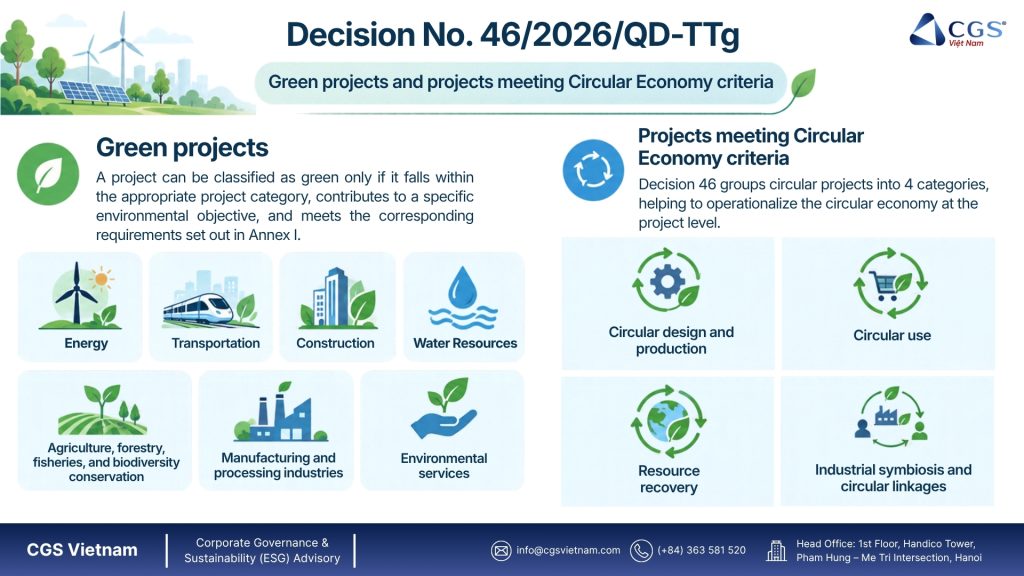
Under Decision 46, a project can be identified as green only if it falls within the appropriate project category, contributes to a specific environmental objective, and meets the corresponding requirements set out in Annex I. The list covers seven sectors:
- Energy;
- Transportation;
- Construction;
- Water resources;
- Agriculture, forestry, fisheries, and biodiversity conservation;
- Manufacturing and processing industries;
- Environmental services.
A key point is that having energy-saving, emissions-reduction, or environmental protection elements does not automatically make a project green. Businesses still need to assess the project against the relevant project category and the specific criteria prescribed.
Decision 46 also includes a separate component for projects meeting circular economy criteria
Circular projects are divided into four groups:
- Circular design and production;
- Circular use;
- Resource recovery;
- Industrial symbiosis and circular linkages.
This helps translate the circular economy into a more concrete framework at the project level. From a business perspective, activities such as reducing material use, extending product life cycles, reuse, repair, recycling, resource recovery, or using by-products across businesses may need to be considered within this framework.
Importantly, the documentation for a circular project does not stop at describing an initiative. Businesses are also required to clarify the current baseline, proposed solutions, objectives, indicators, and risks that may affect implementation outcomes.
The third component is the ESG standards framework in Annex VI
The ESG standards framework in Annex VI consists of two layers: legally required compliance criteria and voluntary compliance criteria.
Legally required compliance criteria
The legally required compliance criteria cover all three E, S and G pillars:
- Environmental (E): requirements relating to environmental impact assessment approval/environmental permits/environmental registration; periodic and continuous automatic environmental monitoring; waste, wastewater and air emissions management; greenhouse gas inventories and emissions reduction targets and plans; energy efficiency; biodiversity protection, among others.
- Social (S): criteria relating to employment contracts; insurance; occupational health and safety; internal dialogue and grievance mechanisms; prohibition of child labour and forced labour; regional minimum wages and equal pay; product information transparency and safety; fire prevention and firefighting, among others.
- Governance (G): corporate governance regulations; codes of business ethics; anti-corruption and anti-bribery policies; internal control systems; independent board members; personal data protection; mechanisms for identifying, declaring and managing conflicts of interest; whistleblowing and whistleblower protection mechanisms; tax compliance, among others.
Voluntary compliance criteria
The voluntary criteria go further in assessing a company’s ESG maturity. Examples include:
- Environmental: periodic assessment of environmental and climate risks; quantified environmental and climate targets; independently audited or verified greenhouse gas inventory reports; transition pathways towards net zero; allocation of costs and investments for emissions reduction measures; management of energy, water, materials and biodiversity; climate-related disclosures; policies and targets for circular economy development.
- Social: ESG assessments of suppliers; sustainable procurement policies; human rights due diligence in the supply chain; employee training and development; diversity, equity and inclusion; community investment; grievance mechanisms aligned with the UN Guiding Principles on Business and Human Rights.
- Governance: anti-corruption and anti-bribery systems; mechanisms for managing conflicts of interest and disclosing material transactions; publication of sustainability reports subject to audit or independent assurance; linking executive remuneration to ESG indicators; cybersecurity policies and IT risk management.
How does Decision 46 expand upon Decision 21?
Before Decision 46, Decision No. 21/2025/QD-TTg had already established the environmental criteria and process for confirming investment projects under Vietnam’s green taxonomy. Decision 21 covered 45 project types across seven sectors. Therefore, the seven green sectors were not introduced for the first time under Decision 46.
The key expansion lies in scope.
While Decision 21 mainly focused on whether a project falls within the green taxonomy, Decision 46 adds two further layers:
- Does the project meet circular economy criteria?
- To what extent does the business apply the ESG standards framework?
Who can determine whether a project is green or circular?
Under Article 4 of Decision 46, project identification is carried out by an independent assessment organisation that meets the conditions prescribed in the Decision. It is therefore important to use the correct terminology. Decision 46 does not establish a system under which a single state authority issues a green certificate for all projects.
In general, businesses will go through four steps.
- First, prepare the required documentation. For green projects, this includes an application for project identification, an explanatory report using the prescribed form, and supporting evidence. Circular projects are subject to corresponding documentation requirements under the relevant annexes.
- Next, the independent assessment organisation reviews the documentation and may conduct an on-site assessment, engage experts, or apply appropriate assessment methods. The timing and cost are agreed between the parties.
- If the project meets the relevant requirements, the assessment organisation issues a written confirmation identifying the project as green or as meeting circular economy criteria.
- After receiving this confirmation, the business must notify the provincial People’s Committee where the project is implemented within 30 days. If the project no longer meets the criteria, the business must provide notification within five working days.
This means that project identification is not a one-off procedure. Businesses must continue to maintain the relevant conditions during implementation.
How do green projects, circular projects and the ESG framework relate to the 2% interest rate support mechanism?

This is an issue businesses should pay particular attention to.
Under Article 9 of Resolution No. 198/2025/QH15, private-sector enterprises, household businesses and individual businesses are entitled to state interest rate support of 2% per year when borrowing to implement green projects, circular projects and apply the ESG standards framework. Decision 46 further specifies these three components by setting out criteria for green projects, circular projects and the application of the ESG framework. However, businesses need to understand one important point:
Compliance with Decision 46 does not mean that a business will automatically receive a 2% interest rate reduction.
Instead, Decision 46 provides part of the conditions and supporting basis for consideration under the interest rate support mechanism. Whether a specific loan qualifies for support will also depend on the eligible borrower, the loan itself, available budget sources, credit appraisal, the support calculation mechanism, and relevant implementation guidance.
In other words, written confirmation of a green project or the application of ESG is an important part of the documentation, but it does not guarantee that a loan will qualify for support.
How should businesses apply the ESG standards framework?
Under Decision 46, private-sector enterprises, household businesses and individual businesses implementing green projects or projects meeting circular economy criteria are required to prepare a Report on the application of the environmental, social and governance standards framework in accordance with the form provided in Annex VII.
The ESG framework consists of two layers:
- Legally required compliance criteria: review of applicable legal requirements relating to environmental, labour and social matters, and governance;
- Voluntary compliance criteria: selection of a minimum number of criteria appropriate to the size of the business, while ensuring representation across all three E, S and G pillars.
The minimum number of voluntary criteria is three for household businesses and individual businesses; six for micro and small enterprises; 12 for medium-sized enterprises; and 18 for other enterprises.
What businesses should note is that ESG implementation is not limited to policies or commitments. Many criteria require businesses to maintain data, indicators, documentation and evidence to demonstrate their level of implementation.
ESG is moving closer to investment decision-making
One notable feature of Decision 46 is that ESG is placed in a more direct relationship with investment projects.
In the past, many businesses approached ESG mainly through strategy, policies or sustainability reporting. Under Decision 46, businesses need to ask additional questions at the project level:
- Could the project meet green or circular economy criteria?
- Does the current project design already meet the relevant requirements?
- Which indicators and data should be established from the outset?
- Which records should be retained for future verification and review?
This is particularly important because a project cannot simply be described as “energy-saving”, “emissions-reducing” or “increasing resource reuse”. Businesses need to progressively demonstrate the baseline, measurement methodology, achieved results and supporting data sources.
From this perspective, ESG can become an input into project evaluation, capital allocation and investment performance management, rather than appearing only at the final reporting stage.
Which businesses should pay attention?
Based on the scope and content of Decision 46, the following groups of businesses should pay particular attention:
- First, private-sector enterprises currently implementing or planning projects in the seven green sectors: energy; transportation; construction; water resources; agriculture, forestry, fisheries and biodiversity conservation; manufacturing and processing industries; and environmental services.
- Second, businesses with potential to implement circular economy models, particularly in industries with high use of materials, energy and water, or significant generation of by-products and waste.
- Third, businesses preparing green or circular projects that need to assess ESG readiness, data systems and supporting evidence for project assessment.
- Finally, private-sector enterprises seeking financing for green and circular projects should monitor the implementation of the interest rate support mechanism under Resolution No. 198/2025/QH15 and related guidance.
Which authorities and stakeholders are involved in implementation?
Decision 46 assigns responsibilities to multiple authorities and stakeholders rather than concentrating the entire process within a single body.
The Ministry of Agriculture and Environment is responsible for guidance, consolidation, monitoring and proposing adjustments to the criteria. Provincial People’s Committees monitor projects within their respective jurisdictions and perform the assigned functions. The State Bank of Vietnam and the Ministry of Finance are responsible for implementation within their respective areas of authority.
At project level, businesses also work with independent assessment organisations to identify green projects or projects meeting circular economy criteria in accordance with the Decision.
From a business perspective, the implementation ecosystem can broadly be viewed as involving: businesses – independent assessment organisations – regulatory authorities – banks or financial institutions. However, this is only a simplified illustration of the respective roles and should not be interpreted as a single prescribed credit or interest rate support process under Decision 46.
How should businesses prepare?
Rather than starting by producing another ESG report, businesses can focus on three main areas.
- First, review the project portfolio. Compare ongoing projects and planned CAPEX against green and circular economy criteria to identify projects with potential to qualify.
- Second, assess ESG readiness. Determine which criteria are already met, identify remaining gaps, and clarify the policies, processes or practices that need to be improved.
- Third, standardise data and evidence. Clearly define indicators, calculation methodologies, data sources, responsible functions and supporting documentation for key areas such as energy, greenhouse gas emissions, water, materials, waste and relevant governance matters.
Early preparation can help businesses engage more proactively with assessment organisations, regulators and relevant financial institutions.
How can CGS Vietnam support businesses?
Drawing on its experience in ESG and corporate governance advisory, CGS Vietnam can support businesses in translating the requirements of Decision 46 into practical implementation steps. Areas of support may include:
- Conducting a preliminary review of the project portfolio against green and circular economy criteria;
- Performing an ESG gap assessment and identifying priority areas for improvement;
- Developing or reviewing ESG objectives, KPIs, measurement methodologies and data systems;
- Standardising documentation, data and supporting evidence for preparation of the ESG framework application report;
- Supporting businesses in improving their readiness when working with independent assessment organisations and financial institutions.
For businesses seeking access to sustainable finance solutions, having a clear ESG foundation, measurable indicators and reliable data systems is also important for enabling more effective discussions with banks about suitable financing products.
From green classification to ESG implementation capability
The significance of Decision 46 goes beyond identifying whether a project is green.
The Decision creates a clearer connection between project criteria – ESG practices – data and evidence – sustainable finance.
For businesses, the key issue is therefore not only whether a project falls within the green or circular project categories, but also whether the business has sufficient capability to demonstrate, monitor and maintain the relevant criteria throughout implementation.
When ESG is integrated from the project preparation stage, businesses can move beyond a compliance-focused mindset and use ESG as a tool to support investment project governance and better prepare for sustainable finance opportunities.
References:
About CGS Vietnam
CGS Vietnam Consulting Joint Stock Company provides specialized advisory services in Corporate Governance, Sustainability (ESG), Risk Management, and Internal Audit. Backed by a team of experienced professionals with deep expertise in international best practices, CGS Vietnam partners with businesses to strengthen corporate governance, enhance management capabilities, meet investor expectations, and achieve long-term sustainable growth.
Contact CGS Vietnam:
Hotline: (+84) 363 581 520 | Email: [email protected] | Website: https://cgsvietnam.com/
LinkedIn: https://www.linkedin.com/company/cgs-vietnam | Facebook: https://www.facebook.com/CGSVietnamCompany/