

As ESG becomes increasingly connected with strategy, risk management, investment and operations, the role of corporate sustainability leaders is also evolving. They are no longer responsible only for environmental programmes or ESG disclosures. Increasingly, they are expected to answer a more challenging question: How can sustainability goals genuinely create or protect business value?
The World Economic Forum’s (WEF) Chief Sustainability Officers’ Outlook 2026 offers valuable insights into this question through a survey of Chief Sustainability Officers (CSOs) at major companies around the world.
The findings suggest that ESG is not becoming less important, but the way companies approach it is changing. As growth pressures, geopolitical uncertainty and climate risks increasingly affect business operations, sustainability initiatives are being expected to demonstrate more clearly how they contribute to strategy, operational efficiency, risk management and organizational resilience.
Who are CSOs and why do their perspectives matter?
A Chief Sustainability Officer (CSO) is a senior executive responsible for leading a company’s sustainability agenda.
The CSO’s role is becoming much broader than managing environmental programmes or preparing ESG reports. According to WEF, CSOs sit at the intersection of business strategy, environmental objectives and policy, while also contributing to areas such as finance and reporting, procurement, investor relations, technology and human rights.
Their perspectives therefore deserve particular attention, as CSOs are among the executives most directly involved in addressing a critical challenge: how to translate sustainability goals into practical business decisions.
Chief Sustainability Officers’ Outlook 2026 is WEF’s first report to consolidate these perspectives. It is based on a survey of 103 CSOs from a community of 189 sustainability leaders representing major companies across five continents.
CSOs see a shift in how companies approach ESG
One of the report’s notable findings is the gap between ESG awareness and the ability to translate ESG into business value.
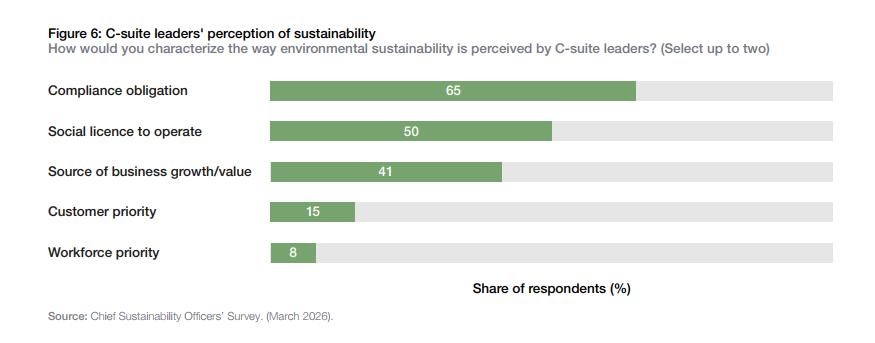
According to the survey, compliance obligations remain the most common lens through which C-suite leaders view sustainability: 65% of surveyed CSOs selected this factor, while 41% said sustainability is viewed as a source of growth or business value.
This gap is particularly significant as companies face increasing pressure to deliver short-term performance. Two-thirds of surveyed CSOs expect corporate decision-making over the next 12 months to place greater emphasis on short-term business performance priorities.
However, this does not mean ESG is becoming less important. On the contrary, these pressures require ESG initiatives to demonstrate more clearly how they can contribute to:
- operational efficiency and cost control;
- risk management;
- supply chain resilience;
- better investment decisions;
- access to capital;
- long-term competitiveness.
In other words, a strong business case is becoming an increasingly important condition for ESG to remain a corporate priority.
Business value will be a key driver of ESG transformation
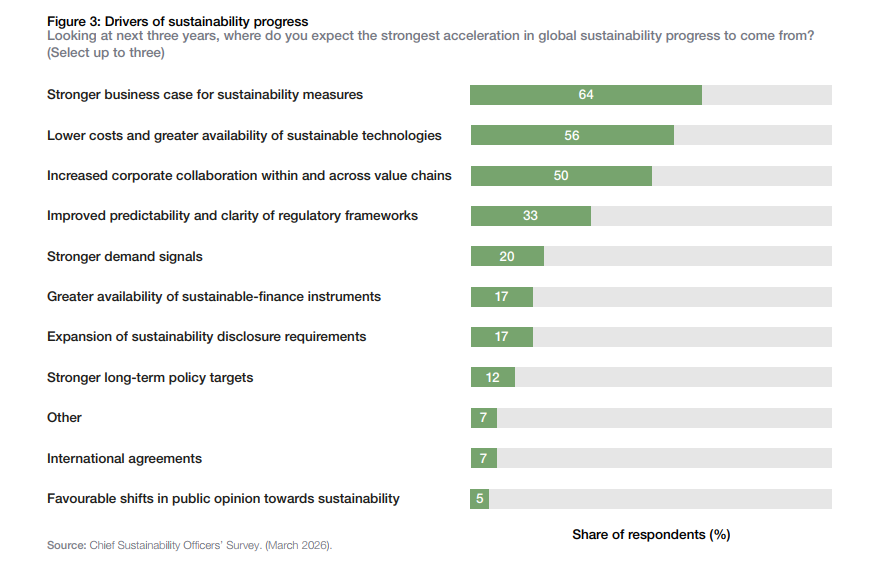
WEF’s survey shows that over the next three years, 64% of CSOs believe that the ability to clearly demonstrate the business value of sustainability solutions will be the most important driver of transformation. This is followed by lower costs and improved access to sustainable technologies, cited by 56%.
These findings suggest that the focus of sustainability is shifting from simply setting targets to demonstrating why an ESG initiative deserves to be prioritized and allocated resources.
Companies therefore need to go beyond setting targets for emissions reduction, energy efficiency or supply chain management. They also need to clarify:
- What business problem does this initiative address?
- What value can the company create or protect?
- How can the expected investment costs and benefits be quantified?
- How will the initiative affect risk, cash flow, assets or competitiveness?
This represents a shift from ESG as a standalone programme to ESG as part of the corporate governance and decision-making system.
Resilience is emerging as a new priority
The report shows that adaptation to climate- and nature-related risks is increasingly being viewed through the lens of business continuity, risk management and capital allocation, rather than solely as an environmental issue. As many as 85% of CSOs believe adaptation will become a greater focus of the global sustainability agenda over the next three years.
The areas considered most exposed to climate- and nature-related risks include distribution and logistics (54%), business and production operations (53%), and insurance costs and availability (42%).
The issue therefore goes beyond whether companies are able to identify climate risks. The greater challenge is demonstrating the value of investments that strengthen resilience and incorporating those investments into decision-making processes.
This remains a significant gap. 62% of CSOs identify uncertainty in cost-benefit assessments as the biggest barrier to adaptation investment, while 42% cite a lack of senior leadership support. Part of the challenge lies in the distinctive economics of adaptation investment: value is often created through avoided losses rather than additional revenue. As a result, the benefits can be difficult to quantify, depend on future climate scenarios, and often become visible only over longer time horizons.
This means companies need to take the next step: not only identifying risks, but also quantifying their financial impacts, assessing adaptation options and developing business cases for investments that strengthen resilience.
From the CSO perspective to corporate action
The key message from the WEF report is not about how many additional ESG initiatives companies should implement, but rather how ESG should be embedded into governance systems and business decision-making.
First, companies need to connect their ESG strategy with their broader business strategy. Material environmental, social and governance issues should be considered in relation to growth, costs, cash flow, assets, supply chains and competitiveness.
Second, every ESG programme should demonstrate a clear business value, whether through cost efficiency, risk mitigation, stronger resilience or improved competitiveness. The objective should not only be to define KPIs, but also to explain how an initiative creates or protects business value and why resources should be allocated to it.
At the same time, ESG needs to be integrated into the governance system. The roles of the Board of Directors, executive management, board committees and functional departments should be clearly defined, while ESG considerations should progressively be incorporated into strategy development, risk management, investment, budgeting and performance assessment processes.
Finally, when addressing climate- and nature-related risks, companies need to move from risk identification towards resilience management by assessing exposure, quantifying financial impacts, developing scenarios and prioritizing appropriate adaptation investments.
Implications for Vietnamese companies
For Vietnamese companies, the perspectives shared by sustainability leaders and CSOs in the WEF report are particularly relevant as requirements relating to ESG, emissions reduction, risk management and disclosure are becoming increasingly connected with market access, supply chains, capital and investor expectations.
In this context, producing a sustainability report or developing a portfolio of ESG initiatives alone may no longer be sufficient. Companies need to progressively establish an operational ESG governance system in which strategy, targets, data, risks, investments and governance responsibilities are interconnected.
Companies can begin by asking three questions:
- Which business decisions are currently being affected by ESG?
- Which ESG issues have a genuinely material impact on value and resilience?
- Does the company have the governance mechanisms, data and capabilities required to translate ESG objectives into action?
ESG needs to become a governance capability
If the previous phase of sustainability focused largely on commitments, targets and disclosure, the next phase will increasingly be defined by companies’ ability to translate those commitments into concrete decisions and actions. From the perspective of the sustainability leaders surveyed by WEF, sustainability is increasingly becoming a core business capability, embedded in how companies invest, operate, allocate capital, build competitiveness and strengthen resilience.
Companies therefore do not necessarily need to do more ESG. Instead, they need to embed ESG more deeply into how they make decisions and create value. This may be one of the clearest signs that ESG is evolving from a programme to be implemented into a governance capability that needs to be integrated across the organization.
As a consulting firm, CGS Vietnam supports companies in translating sustainability requirements and objectives into practical, implementable systems — from ESG strategy, materiality assessment, targets and KPIs to data governance, disclosure and the integration of ESG into corporate governance systems.
Read the full report: Here
About CGS Vietnam
CGS Vietnam Consulting Joint Stock Company provides specialized advisory services in Corporate Governance, Sustainability (ESG), Risk Management, and Internal Audit. Backed by a team of experienced professionals with deep expertise in international best practices, CGS Vietnam partners with businesses to strengthen corporate governance, enhance management capabilities, meet investor expectations, and achieve long-term sustainable growth.
Contact CGS Vietnam:
Hotline: (+84) 363 581 520 | Email: [email protected] | Website: https://cgsvietnam.com/
LinkedIn: https://www.linkedin.com/company/cgs-vietnam | Facebook: https://www.facebook.com/CGSVietnamCompany/