

ESG is becoming increasingly important in corporate strategy and governance. However, implementing ESG goes beyond developing environmental initiatives, fulfilling social responsibilities, or preparing sustainability reports. To create meaningful value, businesses need an appropriate governance system that ensures environmental, social, and governance issues are considered in strategic planning, decision-making, risk management, and performance evaluation.
So, what is ESG governance, how is it structured, and where should businesses begin to build an effective ESG governance system?
What is ESG governance?
ESG governance refers to the organizational structures, roles, responsibilities, policies, processes, and oversight mechanisms that ensure environmental, social, and governance considerations are integrated into a company’s strategy, operations, and decision-making processes.
ESG governance is not simply about managing individual ESG activities. While ESG activities focus on what a company does, such as reducing greenhouse gas emissions, improving occupational safety, or developing sustainable supply chains, ESG governance focuses on how the company directs, implements, controls, measures, and evaluates the effectiveness of those activities.
Under IFRS S1, issued by the International Sustainability Standards Board (ISSB), companies are required to disclose information about the governance processes, controls, and procedures used to monitor, manage, and oversee sustainability-related risks and opportunities that could affect their prospects.
Therefore, ESG governance is not merely about establishing a dedicated department. It involves creating mechanisms through which ESG matters are systematically considered, implemented, and monitored across the organization.

Why do businesses need ESG governance?
As ESG issues increasingly affect business operations, the absence of an appropriate governance mechanism may prevent companies from identifying risks in a timely manner, lead to inefficient resource allocation, or result in fragmented ESG initiatives that are disconnected from long-term objectives.
First, aligning ESG with business strategy and performance. ESG governance helps companies identify sustainability priorities based on their business characteristics, materiality, potential for value creation, and strategic direction. For example, investing in energy-efficient technologies can not only support environmental objectives but also reduce operating costs and enhance competitiveness.
Second, strengthening risk identification and response capabilities. Climate change, supply chain disruptions, occupational safety, human rights, and evolving regulatory requirements can affect costs, revenue, assets, and business continuity. ESG governance enables companies to incorporate these issues into their risk management systems rather than responding only after incidents occur.
Third, translating commitments into measurable objectives and results. An appropriate governance system enables companies to establish key performance indicators (KPIs), assign responsibilities, monitor progress, and evaluate the effectiveness of ESG programs. This helps prevent situations where sustainability commitments are announced without concrete implementation plans or mechanisms.
Fourth, enhancing transparency and accountability. Clearly defined responsibilities across governance levels, together with established data collection and control processes, help improve the quality of ESG information used for internal management, oversight, and external disclosure.
Fifth, strengthening investor and stakeholder confidence. Investors, customers, and business partners are interested not only in sustainability commitments but also in understanding the mechanisms companies use to implement, monitor, and evaluate progress toward those commitments.
According to the G20/OECD Principles of Corporate Governance 2023, the Corporate Governance framework should provide incentives for companies and investors to make decisions and manage risks in ways that contribute to corporate sustainability and resilience.
The value of ESG governance, therefore, extends beyond regulatory compliance and disclosure. It lies in transforming ESG considerations into meaningful inputs for business decision-making.
Key components of an ESG governance system based on CGS Vietnam’s approach
According to CGS Vietnam’s approach, sustainability governance plays a central role in guiding and connecting the entire ESG system, ensuring that ESG considerations are integrated into corporate governance and business operations while addressing stakeholder expectations, legal requirements, and applicable standards.
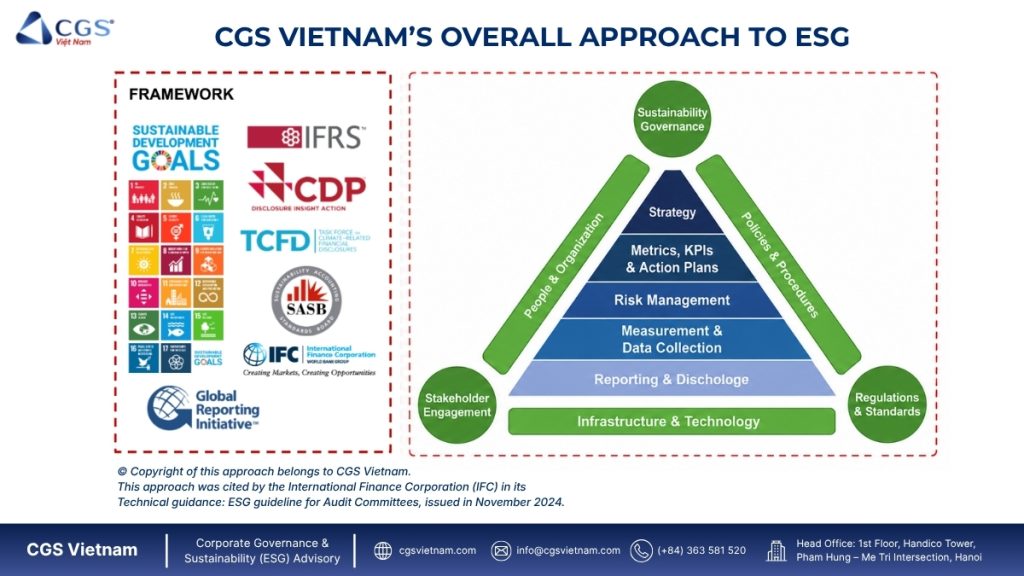
On this basis, companies need to establish an ESG governance system consisting of interconnected components, ranging from strategy, objectives, and action plans to risk management, data measurement, reporting, and disclosure.
Sustainability governance – Providing strategic direction and oversight across the system
ESG governance should be integrated into the existing corporate governance framework, with clearly defined responsibilities across different governance and management levels:
- Board of Directors (BoD): Provides strategic direction, oversees material ESG risks and opportunities, reviews ESG objectives and policies, and monitors management’s implementation of ESG initiatives.
- Board committees: Support the Board in fulfilling its oversight responsibilities within their respective mandates. For example, the Audit Committee may oversee risk management, internal controls, and the reliability of ESG information, while an ESG/Sustainability Committee, if established, may oversee ESG strategy, objectives, and performance.
- Executive management: Translates ESG strategy into objectives, KPIs, and action plans; allocates resources; organizes implementation; measures performance; and reports periodically to the Board.
- Functional departments: Implement ESG initiatives, manage relevant risks, collect data, and report results within their assigned areas of responsibility.
This governance structure ensures that ESG is not solely the responsibility of a dedicated sustainability department but is integrated into strategic planning, management, and oversight throughout the organization.
Key components of an ESG governance system
Under the direction and oversight of the governing body, the ESG system operates through five interconnected components:
- ESG strategy: Identifies material ESG issues and sustainability priorities aligned with business strategy, stakeholder expectations, and long-term value creation objectives.
- Performance indicators, KPIs, and action plans: Translates strategy into specific objectives, KPIs, and action plans, with defined resources, timelines, and responsibilities to facilitate performance monitoring and evaluation.
- ESG risk management: Identifies, assesses, responds to, and monitors ESG-related risks and opportunities; integrates them into the enterprise risk management (ERM) system; and manages material impacts on the environment and people.
- Measurement and data collection: Establishes processes for measuring, collecting, verifying, and managing ESG data, ensuring that information is complete, accurate, consistent, and verifiable to support governance and performance evaluation.
- Reporting and disclosure: Establishes internal reporting mechanisms for the Board and executive management while disclosing ESG information in accordance with applicable requirements and standards, thereby enhancing transparency and accountability.
These components form an interconnected system in which strategy guides implementation, risk management supports the achievement of objectives, and data provides the foundation for measurement, oversight, and reporting. Performance results and stakeholder feedback are then used to refine strategies, adjust objectives, and improve the ESG governance system.
Foundational elements and enabling conditions
For an ESG governance system to operate effectively, companies need to establish appropriate enabling conditions across the organization:
- People and organizational structure: Clearly define responsibilities, allocate resources, and strengthen ESG capabilities among governing bodies, executive management, and functional departments.
- Policies and procedures: Translate ESG commitments and strategic directions into policies and procedures for implementation, coordination, control, and oversight.
- Infrastructure and technology: Support ESG data management, KPI tracking, information analysis, and the automation of ESG reporting processes.
In addition, stakeholder engagement and regulations and standards are two external factors that influence the entire system. Companies should maintain mechanisms for stakeholder consultation and feedback, stay informed about evolving legal requirements, and select appropriate frameworks and standards to guide their activities and disclosures.
Through this approach, CGS Vietnam aims to support businesses in developing an integrated ESG governance system that connects strategic direction, implementation, oversight, and continuous improvement, rather than pursuing ESG initiatives in isolation.
CGS Vietnam supports businesses in building effective ESG governance systems
With expertise in corporate governance, sustainability, risk management, and internal audit, CGS Vietnam supports businesses in developing and strengthening ESG governance systems through an integrated approach that connects governance and strategy with implementation, measurement, oversight, and disclosure.
Building on its integrated ESG approach, CGS Vietnam assists companies in assessing their current practices, strengthening governance structures, developing ESG strategies and objectives, integrating ESG into risk management, improving data systems, policies, and procedures, and enhancing the quality of sustainability reporting and disclosure.
By leveraging and improving existing governance mechanisms, CGS Vietnam aims to help businesses move beyond fragmented ESG activities toward an integrated governance system with clearly defined responsibilities, measurable outcomes, and effective oversight, contributing to stronger competitiveness, greater resilience, and sustainable long-term value creation.
References:
- G20/OECD Principles of Corporate Governance 2023
- IFRS S1 – General Requirements for Disclosure of Sustainability-related Financial Information
- IFRS S2 – Climate-related Disclosures
About CGS Vietnam
CGS Vietnam Consulting Joint Stock Company provides specialized advisory services in Corporate Governance, Sustainability (ESG), Risk Management, and Internal Audit. Backed by a team of experienced professionals with deep expertise in international best practices, CGS Vietnam partners with businesses to strengthen corporate governance, enhance management capabilities, meet investor expectations, and achieve long-term sustainable growth.
Contact CGS Vietnam:
Hotline: (+84) 363 581 520 | Email: [email protected] | Website: https://cgsvietnam.com/
LinkedIn: https://www.linkedin.com/company/cgs-vietnam | Facebook: https://www.facebook.com/CGSVietnamCompany/