

A company may achieve its revenue target for the year while simultaneously increasing pressure on employees, eroding customer trust, or becoming more dependent on scarce resources. If each department focuses solely on its own targets, management may fail to fully recognize these consequences when making decisions.
Integrated thinking helps companies understand the connections between their departments, strategy, resources, relationships, and performance. It is not merely about connecting information in reports, but also about how companies consider decisions and actions that create, preserve, or minimize the erosion of value over time.
What is Integrated thinking?
According to the Integrated Reporting Framework, integrated thinking is the active consideration by an organization of the relationships between its various operating and functional units and the capitals that it uses or affects. Integrated thinking leads to decisions and actions that consider the creation, preservation, or erosion of value over the short, medium, and long term.
Simply put, integrated thinking helps companies:
- Connect different departments: Understand how the activities of one department affect those of others.
- Consider resources and relationships: Identify the factors on which the company depends or which it may affect.
- Consider the consequences of decisions: Assess both immediate benefits and long-term impacts.
For example, an automation decision may help reduce costs and increase productivity. However, a comprehensive assessment should also consider investment requirements, workforce capabilities, impacts on product quality, and the ability to sustain operations over the long term. Integrated thinking brings these interconnected factors into a single decision-making process rather than assessing them separately within individual departments.
Integrated thinking does not mean that every factor must be expressed in monetary terms or combined into a single metric. Resources and relationships may be difficult to measure using the same unit. What matters is identifying the factors relevant to the business model, assessing interdependencies and trade-offs, and explaining the rationale behind decisions.
Why should companies adopt integrated thinking?
Business operations are influenced by many interconnected factors, including markets, technology, human resources, supply chains, the environment, and regulatory requirements. A decision may generate short-term benefits while also creating costs or risks over the longer term.
When these factors are considered in isolation, companies may overlook the underlying causes of problems or fail to fully assess the consequences of their decisions. Integrated thinking helps companies better understand the connections between strategy, operations, and performance, thereby supporting:
- Better decision-making: Enabling the Board of Directors (BoD)/Members’ Council and executive management to gain a more comprehensive understanding of the factors affecting strategy, business operations, and value creation.
- Improved resource allocation: Considering the interdependencies and trade-offs between financial, human, technological, natural, and other resources.
- Stronger internal collaboration: Breaking down organizational silos, encouraging information sharing, and coordinating efforts toward common objectives.
- Improved information and reporting quality: Connecting financial and non-financial information to help stakeholders better understand how the company creates and preserves value.
- Greater organizational resilience: Helping companies better identify risks, opportunities, and factors affecting their business models over the long term.
These benefits do not arise simply because a company declares that it has adopted integrated thinking or publishes a report. What matters is embedding integrated thinking into everyday governance and management practices.
Six core elements of integrated thinking
The Integrated Thinking Principles (Value Reporting Foundation, 2022) introduce six interconnected principles centered on an organization’s business model:
1. Purpose
Clarifies why the company exists and how it contributes to society, the environment, and its stakeholders. The company’s purpose should be reflected in its priorities and decisions rather than remaining merely a formal statement.
2. Governance
Examines how the Board of Directors/Members’ Council provides direction and oversight, and whether organizational structures, decision-making processes, and cross-functional collaboration support strategy execution. Governance should also enable companies to consider trade-offs between different resources.
3. Culture
Reflects how the company conducts its day-to-day activities. A culture aligned with the company’s purpose and core values helps build trust, encourage innovation, and strengthen relationships with stakeholders.
4. Strategy
Defines what the company aims to achieve and how it intends to do so. Strategy should be aligned with customer needs, material matters, risks, opportunities, and the resources required.
5. Risks & opportunities
Identifies and assesses internal and external risks and opportunities that may affect the company’s business model, operations, and strategy. Companies should also consider how their activities affect the external environment.
6. Performance
Measures and evaluates progress toward strategic objectives, considering not only financial indicators but also changes in important resources and relationships. This information should support decision-making and performance reporting.
Together, these six principles help companies assess how effectively their purpose, strategy, governance, and day-to-day operations are connected, and identify areas for improvement.
The relationship between integrated thinking, the six capitals, and value creation
The business model is at the center of integrated thinking. According to the Integrated Reporting Framework, a business model describes how a company transforms inputs through its business activities into outputs and outcomes to fulfill its strategic objectives and create value over time.
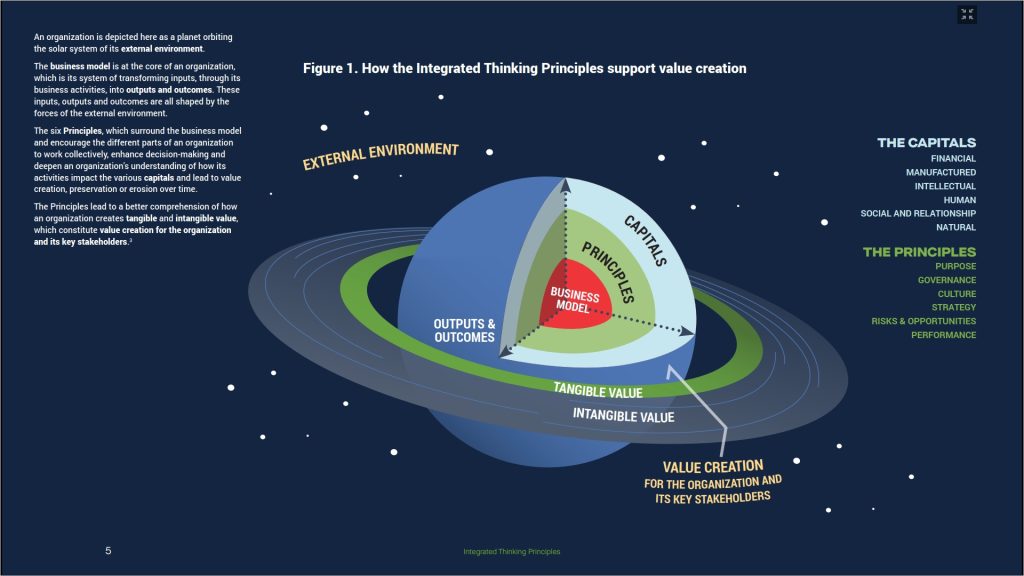
The resources and relationships that a company uses or affects are categorized into six capitals:
- Financial capital: Financial resources available for business operations and investment.
- Manufactured capital: Factories, machinery, equipment, and infrastructure.
- Intellectual capital: Software, patents, rights and licenses, processes, procedures, and other knowledge-based assets.
- Human capital: Employees’ capabilities, skills, and experience.
- Social and relationship capital: Reputation, trust, and relationships with stakeholders.
- Natural capital: Natural resources and environmental resources on which the company depends or which it affects.
Throughout its operations, these capitals may increase, decrease, or be transformed. For example, investment in employee training may increase short-term costs while enhancing workforce capabilities and contributing to improved long-term performance. Companies should therefore consider the benefits, costs, and related consequences of their decisions rather than focusing solely on a single financial indicator.
The Integrated Reporting Framework does not require companies to express all six capitals in monetary terms or calculate a single “net value” figure. Companies should use an appropriate combination of qualitative and quantitative information to explain how their activities affect resources, relationships, and their ability to create value. Furthermore, the relative importance of each capital varies depending on a company’s business model and operating characteristics.
What is the difference between integrated thinking and integrated reporting?
Integrated thinking and integrated reporting are closely related, but they are not the same.
- Integrated thinking refers to how a company considers the connections between strategy, operations, resources, and performance when making decisions.
- Integrated reporting is a process founded on integrated thinking that results in periodic reports and related communications about how a company creates, preserves, or erodes value over time.
An integrated report, meanwhile, is a concise report that explains the connections between a company’s strategy, governance, performance, prospects, and its ability to create value.
In this sense, integrated thinking provides the foundation for connecting information in corporate reports. Conversely, the reporting process can help companies identify gaps in data, information, and coordination mechanisms that need improvement.
For corporate disclosure, this approach helps companies explain more clearly the relationships between strategy, financial performance, sustainability matters, and business prospects.
However, publishing a report labeled an “integrated report” does not necessarily mean that a company has effectively embedded integrated thinking into its governance practices. If information is only consolidated at the end of the reporting period for disclosure purposes, while strategy, budgeting, risk management, and performance evaluation continue to operate in isolation, the extent of integrated thinking in practice remains limited.
How to embed integrated thinking into strategy and governance
Companies can begin by reviewing their business models: how they create value, which resources and relationships they depend on, and how changes in the external environment may affect their operations.
According to the Integrated Thinking Principles, the application of integrated thinking can be assessed at three levels:
- Governance level (Board of Directors/Members’ Council): Reviews the integrated thinking principles to guide strategy, oversee operations, and assess whether governance mechanisms support long-term value creation.
- Executive management level: Assesses the extent to which the principles are embedded in practice, while strengthening connections between strategy, risk management, resource allocation, and performance.
- Senior and middle management level: Implements tools, processes, and cross-functional coordination mechanisms to embed integrated thinking into day-to-day operations.
Companies should also link financial and non-financial indicators to strategic objectives while ensuring the quality of data used for governance, performance evaluation, and corporate disclosure.
Roadmap for adopting integrated thinking
The Transition to integrated thinking: A guide to getting started (2022) proposes a five-step roadmap to help companies progressively embed integrated thinking into their operations.
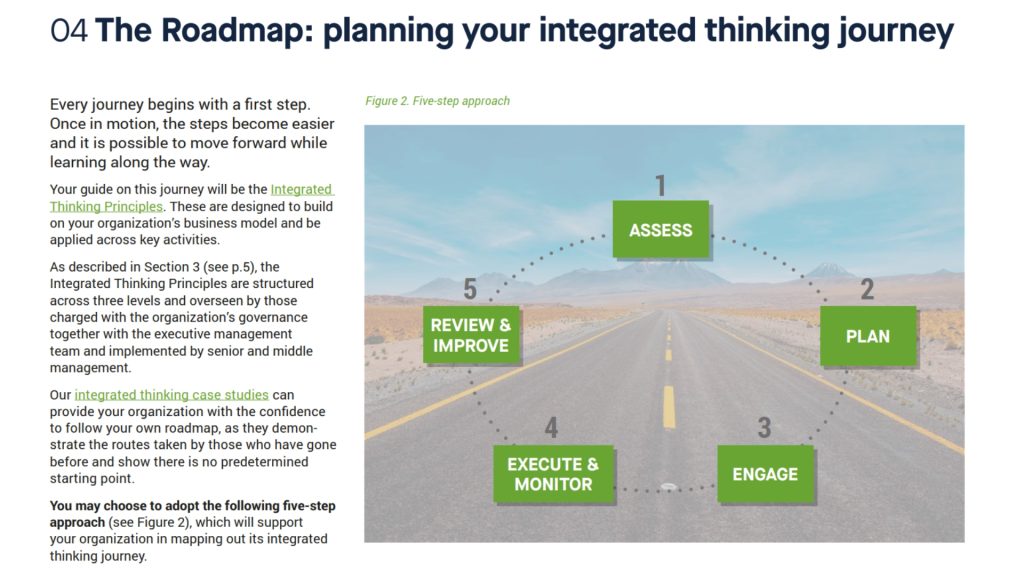
Step 1. Assess
Determine the company’s current level of integrated thinking and the desired outcomes, such as stronger cross-functional collaboration, improved decision-making, or better reporting quality.
Step 2. Plan
Select an approach suited to the company’s characteristics. Implementation may follow a top-down approach, a bottom-up approach, or a combination of both. The roles and responsibilities of different management levels should also be defined.
Step 3. Engage
Engage with the Board of Directors/Members’ Council, executive management, and relevant departments to build a shared understanding, assess the extent to which the principles are applied, and identify priority areas for improvement.
Step 4. Execute & monitor
Embed the principles into relevant processes, such as business planning, risk management, resource allocation, and performance evaluation. Monitor progress and maintain collaboration across departments.
Step 5. Review & improve
Periodically evaluate results against the initial objectives, report progress to the governing body, and identify adjustments needed for continuous improvement.
Companies do not necessarily need to implement all the principles simultaneously or follow an identical roadmap. They can begin with matters most relevant to their business models and gradually expand implementation across other activities and business units.
Integrated thinking is not merely an approach to reporting; it is a way for companies to connect strategy, resources, and operations to make better-informed decisions. When effectively embedded in practice, integrated thinking can strengthen corporate governance, improve the quality of corporate disclosure, and support long-term value creation.
——————————
References:
- Value Reporting Foundation (2022). Integrated Thinking Principles: Value creation through organizational resilience, version 1.0, August 2022. View PDF.
- Value Reporting Foundation (2022). Transition to integrated thinking: A guide to getting started, August 2022. View PDF.
- IFRS Foundation. Integrated Reporting Framework (revised January 2021). Official webpage and downloadable resources.
- IFRS Foundation. Integrated Reporting Framework FAQs. Frequently asked questions.
About CGS Vietnam
CGS Vietnam Consulting Joint Stock Company provides specialized advisory services in Corporate Governance, Sustainability (ESG), Risk Management, and Internal Audit. Backed by a team of experienced professionals with deep expertise in international best practices, CGS Vietnam partners with businesses to strengthen corporate governance, enhance management capabilities, meet investor expectations, and achieve long-term sustainable growth.
Contact CGS Vietnam:
Hotline: (+84) 363 581 520 | Email: [email protected] | Website: https://cgsvietnam.com/
LinkedIn: https://www.linkedin.com/company/cgs-vietnam | Facebook: https://www.facebook.com/CGSVietnamCompany/