

Financial statements provide insights into a company’s revenue, profitability, and financial position, but they do not fully reflect the quality of corporate governance, risk management capabilities, or long-term growth prospects.
Factors such as resource efficiency, occupational safety, workforce quality, corporate governance, and supply chain risks can directly affect business performance, even when their impacts are not yet clearly reflected in financial statements.
Therefore, non-financial information is becoming increasingly important, not only for corporate disclosure but also for risk management, strategic planning, and business decision-making.
What is non-financial information?
Non-financial information refers to information about a company’s operations, governance, environmental and social performance, and other aspects that are not fully captured by traditional financial indicators.
This information can be quantitative, such as greenhouse gas (GHG) emissions, workplace accident rates, and energy consumption, or qualitative, such as business strategies, risk management policies, and governance structures.
While financial information focuses on a company’s financial position, operating results, and cash flows, non-financial information helps explain how a company operates, which resources it depends on, and what risks and opportunities it faces.
For example, financial statements may indicate rising production costs, while data on energy consumption, equipment efficiency, and material losses can help identify the underlying causes.
Importantly, non-financial information covers a broader scope than ESG information. Beyond environmental, social, and governance factors, it also includes product quality, innovation capabilities, operational efficiency, and other aspects of the business model.
Why is non-financial information becoming increasingly important?

Early identification of business risks
Not all business risks immediately translate into financial costs or liabilities.
For example, consistently rising energy consumption may indicate declining production efficiency. High employee turnover may signal workforce shortages, while recurring safety incidents may reveal weaknesses in operational controls.
Monitoring non-financial information enables companies to identify early warning signs and take preventive action rather than responding only after losses have occurred.
Connecting strategy with operational performance
A strategy delivers meaningful value only when its implementation can be monitored, measured, and evaluated.
For example, improving resource efficiency requires measurable indicators for energy, water, and material consumption. Similarly, a workforce development strategy should be supported by data on training, employee capabilities, and talent retention.
This information enables the Board of Directors (BoD) and executive management to assess strategic progress, identify areas for improvement, and allocate resources effectively.
Enhancing transparency and access to capital
Investors are interested not only in current financial performance but also in a company’s ability to sustain growth, governance quality, and risk exposure.
Under IFRS S1, sustainability-related risks and opportunities may affect a company’s cash flows, access to finance, and cost of capital over the short, medium, and long term.
Complete, consistent, and reliable non-financial disclosures provide investors with a stronger basis for evaluating companies. They also support communication with banks, business partners, customers, and other stakeholders.
The value of non-financial information therefore extends beyond regulatory compliance. It also helps companies manage risks, improve operational performance, and create long-term value.
Key types of non-financial information
Depending on their industry and business model, companies may monitor different categories of non-financial information. Common examples include:
| Information category | Key examples |
|---|---|
| Environmental | Greenhouse gas emissions, energy consumption, water use, materials, and waste management. |
| Labour and occupational safety | Workforce composition, training, employee turnover, labour rights, occupational health and safety. |
| Customers and products | Product quality, customer satisfaction, complaints, product safety, and customer data protection. |
| Corporate governance | Board structure, board independence, business ethics, internal controls, and accountability. |
| Risk and compliance | Operational risks, regulatory compliance, incidents, and corrective actions. |
| Supply chain | Supplier activities, raw material traceability, business relationships, and environmental and social risks across the value chain. |
| Strategy and operational performance | Business models, strategic objectives, innovation capabilities, productivity, and resource efficiency. |
International reporting frameworks also establish disclosure requirements covering various aspects of non-financial information.
For example, GRI 2: General Disclosures 2021 sets out 30 general disclosures across five categories:
- The organization and its reporting practices;
- Activities and workers;
- Governance;
- Strategy, policies, and practices;
- Stakeholder engagement.
For topic-specific information, companies should determine their reporting priorities based on material topics, industry characteristics, strategic objectives, and disclosure requirements.
Under GRI 3: Material Topics 2021, material topics are identified based on the significance of an organization’s impacts on the economy, environment, and people.
For example, water use may be particularly material for companies operating in water-scarce regions, while customer data protection and service quality may take priority in the technology and financial services sectors.
Standards, frameworks, and regulations for non-financial disclosure
GRI Standards – Reporting corporate impacts
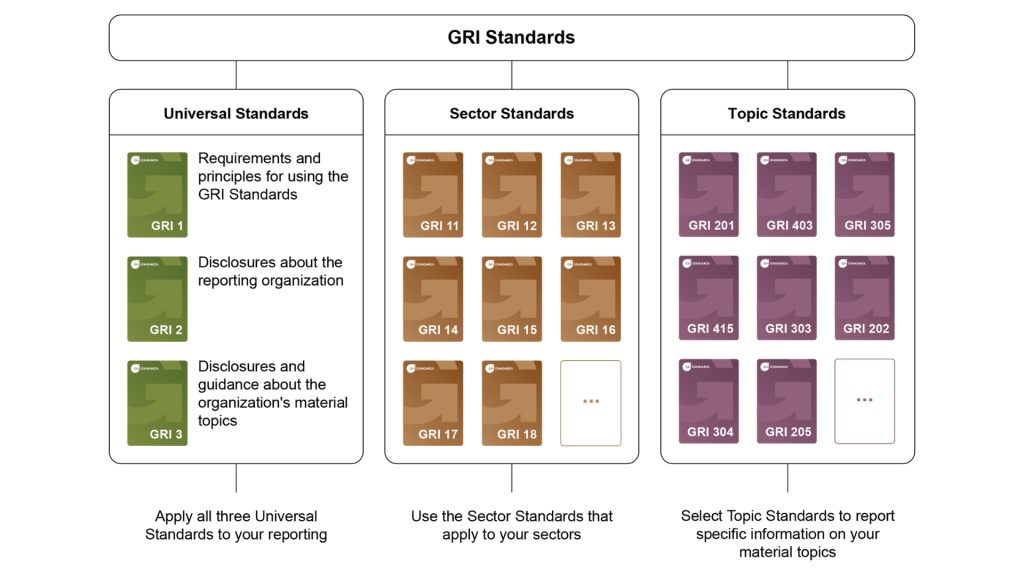
The Global Reporting Initiative (GRI) Standards help companies report their most significant impacts on the economy, environment, and people, including impacts on human rights.
The GRI Standards comprise three categories:
- Universal Standards: Establish the foundational requirements, general organizational disclosures, and processes for identifying material topics.
- Sector Standards: Support the identification of material topics relevant to specific industries.
- Topic Standards: Provide disclosure requirements for specific impacts.
GRI focuses on impact materiality, which concerns the significant impacts that an organization has or may have on the economy, environment, and people.
IFRS S1 and IFRS S2 – Sustainability information linked to financial prospects
The IFRS Sustainability Disclosure Standards, issued by the International Sustainability Standards Board (ISSB), are designed to meet the information needs of investors, lenders, and other creditors.
Specifically:
- IFRS S1 establishes general requirements for disclosing sustainability-related risks and opportunities that could affect a company’s financial prospects.
- IFRS S2 focuses on climate-related risks and opportunities, including physical and transition risks.
Both standards are structured around four core pillars: governance, strategy, risk management, and metrics and targets.
A fundamental distinction lies in their approaches to materiality. GRI Standards focus on impact materiality, reflecting a company’s significant impacts on the economy, environment, and people.
In contrast, IFRS S1 and IFRS S2 focus on financial materiality, requiring disclosures about sustainability-related risks and opportunities that could affect a company’s cash flows, access to finance, and cost of capital over the short, medium, and long term.
These approaches are not mutually exclusive, as significant environmental and social impacts may also give rise to financial risks or opportunities.
Therefore, GRI Standards and IFRS S1/S2 can be used in a complementary manner to meet the information needs of investors and other stakeholders.
Regulations on non-financial disclosure in Vietnam
In Vietnam, Circular No. 96/2020/TT-BTC, issued by the Ministry of Finance, is an important legal framework governing information disclosure in the securities market.
Under Appendix IV on annual reporting, companies within its scope are required to disclose information on business operations, corporate governance, and environmental and social impacts, including:
- Management of materials, energy, water, and emissions.
- Compliance with environmental laws and regulations.
- Employee-related policies and community responsibilities.
- Corporate governance structures and activities.
Circular 96 has been amended and supplemented by subsequent regulations, including Circular No. 68/2024/TT-BTC, Circular No. 18/2025/TT-BTC, and Circular No. 08/2026/TT-BTC.
Notably, in October 2026, the Ministry of Finance published a draft circular intended to replace Circular 96. The draft proposed a dedicated appendix on sustainability-related disclosures covering environmental, social, and governance (ESG) factors.
According to information published on the Government Electronic Portal on October 5, 2026, the draft proposed a mechanism requiring companies to explain the reasons for any undisclosed indicators and provide an implementation roadmap, except where sector-specific reporting regulations apply.
These proposed changes indicate that sustainability disclosure requirements in Vietnam are being considered for greater specificity and stronger accountability. Companies should therefore proactively develop their data management systems rather than focusing solely on preparing reports at the end of each reporting period.
How should companies manage non-financial data?

Unlike financial data, which is typically managed through accounting systems, non-financial data is often dispersed across departments responsible for production, environmental management, human resources, legal affairs, risk management, and internal controls.
Without standardized processes, companies may encounter inconsistent figures, differing calculation methodologies, and difficulties tracing data sources during report preparation.
To improve data quality, companies should focus on five key areas:
- Establishing a KPI framework: Select indicators aligned with corporate strategy, material risks, and disclosure requirements. Each indicator should have a clear definition, unit of measurement, reporting boundary, and calculation methodology.
- Assigning data responsibilities: Identify the departments responsible for collecting, reviewing, approving, and using each category of information.
- Standardizing data sources: Establish consistent methods for data collection, calculation, and storage to ensure traceability and comparability across reporting periods.
- Strengthening data quality control and assurance: Verify the completeness, accuracy, and consistency of information, while progressively considering independent assurance for material indicators where appropriate.
- Integrating and digitalizing data: Gradually establish centralized data management systems to reduce manual consolidation, monitor KPIs, and maintain a consistent data source for management and reporting purposes.
In this context, GRI Disclosure 2-5 addresses the disclosure of policies, practices, and scope relating to external assurance.
IFRS S1 also emphasizes information quality, verifiability, and consistency between sustainability-related information and relevant financial information.
Over the long term, non-financial data should be managed through appropriate accountability and control mechanisms rather than collected only during reporting periods.
From non-financial information to management decisions
The value of non-financial information lies not in the number of indicators disclosed, but in its ability to support better business decisions.
For example, when energy consumption intensity continues to increase, a company should do more than explain the trend in its annual report. Executive management should analyze the underlying causes, identify inefficient production lines, and evaluate improvement measures or equipment investments.
Similarly, occupational safety data can help identify high-risk areas, workforce data can support training and succession planning, and supply chain information can facilitate supplier assessments and reduce the risk of production disruptions.
For the Board of Directors, non-financial information can support:
- Strategic oversight: Monitoring progress against strategic objectives and commitments.
- Risk management: Identifying adverse trends and assessing the effectiveness of internal controls.
- Resource allocation: Prioritizing investments, budgets, and improvement initiatives.
- Performance evaluation: Linking non-financial outcomes with operational and business performance.
This approach is also reflected in IFRS S1, which emphasizes the interconnected nature of information relating to governance, strategy, risk management, metrics, and targets, as well as its relationship with relevant financial information.
Companies should therefore progressively integrate material non-financial indicators into management reporting systems rather than maintaining separate datasets solely for external disclosure purposes.
Conclusion
Non-financial information provides companies with a more comprehensive understanding of their operations, risks, and long-term prospects. When effectively managed and utilized, it not only supports transparency requirements but also contributes to stronger corporate governance and better business decisions.
As sustainability disclosure requirements continue to evolve, Vietnamese companies should proactively identify material indicators, standardize data, and establish appropriate management mechanisms.
Ultimately, what matters is not how much non-financial information a company discloses, but how effectively it uses that information to manage risks, improve operational performance, and create long-term value.
References:
- Ministry of Finance (2020). Circular No. 96/2020/TT-BTC – Guidelines on Information Disclosure in the Securities Market.
- Ministry of Finance (2026). Consolidated Document No. 10/VBHN-BTC on Information Disclosure in the Securities Market.
- State Securities Commission of Vietnam and IFC (2025). Corporate Governance Manual 2025.
- Global Reporting Initiative (2021). GRI 2: General Disclosures 2021.
- IFRS Foundation (2023, 2026 edition). IFRS S1 – General Requirements for Disclosure of Sustainability-related Financial Information.
- IFRS Foundation (2023). IFRS S2 – Climate-related Disclosures.
- Vietnam Government Portal (2026). Key Provisions of the Draft Circular on Information Disclosure in the Securities Market.
About CGS Vietnam
CGS Vietnam Consulting Joint Stock Company provides specialized advisory services in Corporate Governance, Sustainability (ESG), Risk Management, and Internal Audit. Backed by a team of experienced professionals with deep expertise in international best practices, CGS Vietnam partners with businesses to strengthen corporate governance, enhance management capabilities, meet investor expectations, and achieve long-term sustainable growth.
Contact CGS Vietnam:
Hotline: (+84) 363 581 520 | Email: [email protected] | Website: https://cgsvietnam.com/
LinkedIn: https://www.linkedin.com/company/cgs-vietnam | Facebook: https://www.facebook.com/CGSVietnamCompany/