

When preparing a sustainability report or developing an ESG strategy, many companies begin with a predefined list of topics and then send surveys asking stakeholders to rate them. This approach is convenient, but it can easily turn materiality assessment into a procedural exercise for collecting opinions, without fully reflecting the company’s actual impacts on the environment and society.
The quality of an ESG materiality assessment depends on how well a company understands the impacts that are occurring or may arise from its operations and value chain, who is or may be affected, and how significant those impacts are. If a double materiality approach is applied, the company also needs to analyze the financial risks and opportunities associated with sustainability matters.
Therefore, stakeholder engagement is not only intended to improve reporting, but also provides information that helps companies identify, assess, and appropriately prioritize ESG matters.
What is stakeholder engagement?
According to GRI, stakeholders are individuals or groups whose interests are affected or could be affected by an organization’s activities.
ESRS uses a broader concept, covering parties that can affect or be affected by the undertaking. In materiality assessment, ESRS distinguishes between two main groups:
- Affected stakeholders: individuals or groups whose interests are affected or could be affected, positively or negatively, by the company’s activities and business relationships across the value chain;
- Users of sustainability statements: such as investors, lenders, creditors, business partners, civil society organizations, and regulators.
Depending on the industry, location, and business model, stakeholders may include:
- Shareholders and investors;
- Employees and employee representative bodies;
- Customers and consumers;
- Suppliers and business partners;
- Banks, lenders, and creditors;
- Government and regulatory authorities;
- Local communities and civil society organizations;
- Vulnerable groups or groups at risk of significant impacts.
Stakeholder engagement is the process through which a company identifies the parties it needs to engage with; collects, analyzes, and responds to their views; and then uses the results in governance and decision-making. Engagement can take place through surveys, interviews, focus-group discussions, labor dialogue, community consultations, investor meetings, or analysis of data from grievance mechanisms.
The key issue is not the number of participants, but whether the company engages the right stakeholders, asks the right questions, and uses the information obtained in a meaningful way.
Materiality approaches that need to be distinguished
The role of stakeholders depends on the framework applied by the company:
- GRI focuses on the organization’s most significant impacts on the economy, environment, and people, including human rights;
- ESRS applies double materiality, comprising impact materiality and financial materiality;
- The Integrated Reporting Framework (<IR>) focuses on matters that substantially affect the organization’s ability to create value over the short, medium, and long term.
These approaches are related but not identical. Companies therefore need to clearly determine their objectives and the applicable framework before designing the materiality assessment and stakeholder engagement process.
Why does stakeholder engagement play an important role in ESG materiality assessment?
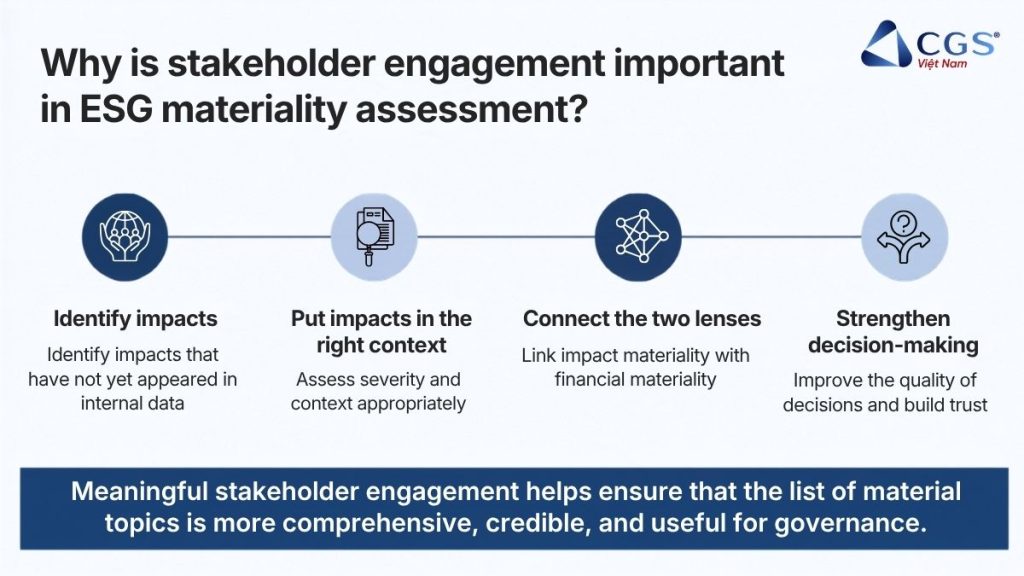
Identifying impacts that are not visible in internal data
Internal systems often capture issues that are already being measured, but many ESG impacts occur outside direct operations, such as working conditions at suppliers or the effects of water extraction on local communities. Dialogue with affected stakeholders and experts can help companies identify these “blind spots.”
Assessing severity and context appropriately
The same metric can have different implications depending on the context. A relatively small volume of water withdrawal can still be material in a water-scarce area; an incident that occurs rarely may still need to be prioritized if its consequences are particularly severe.
The perspectives of affected stakeholders help companies better understand the scale and scope of impacts. For negative impacts, companies should also consider how difficult they are to remediate; for potential impacts, likelihood must also be assessed.
Connecting impact materiality and financial materiality
Under the ESRS double materiality approach, companies consider two dimensions:
- Impact materiality: what significant impacts the company has or may have on people and the environment through its operations and business relationships across the value chain;
- Financial materiality: whether a sustainability matter generates or could generate risks and opportunities that materially affect the company’s performance, financial position, cash flows, access to finance, or cost of capital.
Financial risks and opportunities may arise from the company’s impacts, its dependencies on people, natural resources, and business relationships, or changes in the operating environment.
The two materiality dimensions can be connected but do not necessarily arise at the same time. For example, poor working conditions at a supplier may first create a negative impact on workers; over time, the issue may also lead to production disruption, disputes, remediation costs, or reputational damage for the company.
Strengthening decision quality and trust
A transparent process allows a company to explain why a matter has been prioritized, what information sources were used, and how conflicting views were handled. This supports more effective resource allocation while reducing the risk of selecting topics primarily because they are favorable for communication purposes.
Trust is not created simply because a company “conducted consultation,” but because it can demonstrate that feedback was considered and translated into decisions, actions, or appropriate explanations.
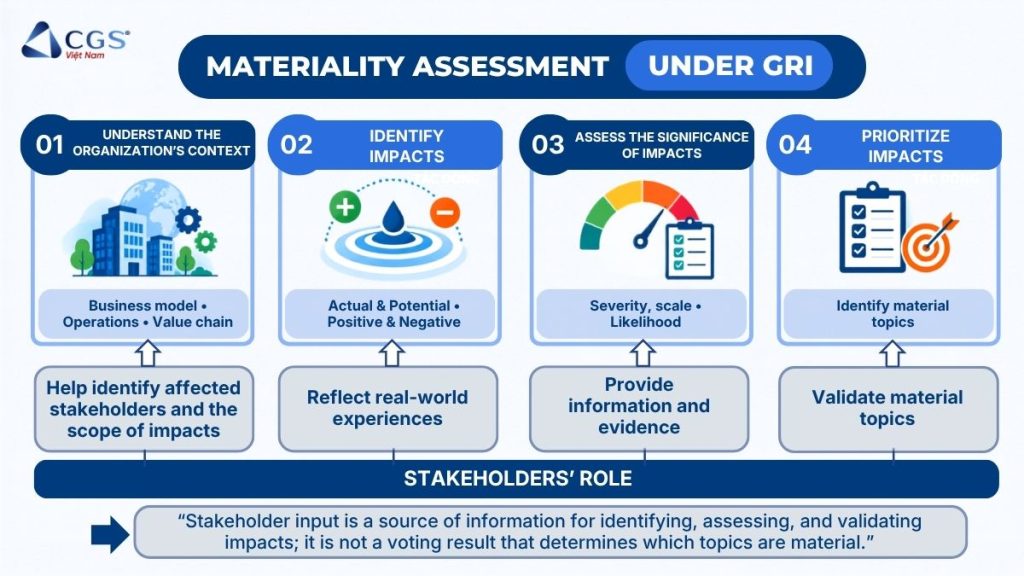
The role of stakeholders in ESG materiality assessment under GRI
The following section focuses on GRI’s impact materiality approach. Under GRI 3: Material Topics 2021, identifying material topics is not simply a matter of preparing a list of ESG issues and asking stakeholders to score them. The focus is on identifying, assessing, and prioritizing the organization’s most significant impacts on the economy, environment, and people, including human rights.
GRI sets out four steps for determining material topics. These steps support an impact materiality approach and do not constitute the full double materiality assessment process under ESRS.
Step 1: Understand the organization’s context
The company needs to consider its business model, activities, products, services, locations of operation, value chain, and business relationships. This process also includes identifying individuals or groups who are or may be affected and considering impacts referenced in the GRI Sector Standards applicable to the industry.
Step 2: Identify actual and potential impacts
The company identifies positive and negative, actual and potential impacts over the short and long term. Impacts may arise from the company’s own activities or be linked to the company through its products, services, suppliers, and business relationships.
Sources of information may include operational data, risk assessments, incident records, grievance mechanisms, expert research, and stakeholder engagement activities.
Step 3: Assess the significance of impacts
The company assesses each impact using qualitative and quantitative criteria appropriate to the nature of the impact:
| Type of impact | Main basis for assessment |
|---|---|
| Actual negative | Severity |
| Potential negative | Severity and likelihood |
| Actual positive | Scale and scope |
| Potential positive | Scale, scope, and likelihood |
For negative impacts, severity is determined based on:
- Scale: how grave the impact is;
- Scope: how widespread the impact is, such as the number of people affected or the extent of environmental damage;
- Irremediable character: how difficult it is to restore or compensate for the harm caused.
For potential negative human rights impacts, severity should take precedence over likelihood.
Negative and positive impacts should be assessed and prioritized separately before related impacts are grouped into topics. A positive impact must not be used to offset or reduce the severity of a negative impact.
Step 4: Prioritize the most significant impacts for reporting
Based on the assessment results, the company ranks impacts according to their significance, determines a prioritization threshold, and groups related impacts into topics. The proposed list should be checked against the applicable GRI Sector Standards and may be validated with experts, information users, and relevant stakeholders.
GRI recommends that the highest governance body oversee the process and review and approve the material topics. Where the organization does not have a highest governance body, this role may be performed by senior executives or a senior management group.
The final outcome is the list of material topics that the company needs to manage and disclose. Under GRI 3, the company discloses:
- The process for determining material topics under Disclosure 3-1;
- The list of material topics under Disclosure 3-2;
- How each material topic is managed under Disclosure 3-3.
Role of stakeholders
Stakeholders do not participate merely as people who “score the importance” of issues. Their core role is to provide experience, evidence, and perspectives that help the company identify and assess the true nature of impacts.
| Stage | Role of stakeholders |
|---|---|
| Understand the context | Help identify groups that are or may be affected and where impacts arise within operations or the value chain |
| Identify impacts | Reflect real-world experience; identify impacts not fully captured in internal data |
| Assess impacts | Provide information on scale, scope, severity, and irremediable character |
| Prioritize topics | Validate whether the proposed list appropriately reflects the most significant impacts |
| Periodic review | Update emerging impacts and changes in the nature or severity of impacts |
Companies should pay particular attention to affected stakeholders, especially vulnerable groups or those with limited ability to protect their own interests. Where direct engagement is not possible, companies may engage legitimate representatives, civil society organizations, experts, or other credible sources of information.
It is important to note that:
| “Stakeholder input is a source of information for identifying, assessing, and validating impacts; it is not a voting result that determines which topics are material.” |
The determination of material topics should be based on assessment criteria, data, professional evidence, and well-grounded judgment. The level and form of engagement should be appropriate to the nature of the impact and the degree to which each stakeholder group is affected.
Where direct consultation is not possible, companies may use appropriate alternatives such as consulting credible representatives, civil society organizations, employee representative bodies, independent experts, or using information from grievance mechanisms, scientific research, and other evidence-based data sources.
Companies should maintain records of the methodology, information sources, assumptions, judgments, and basis for topic selection to ensure verifiability and facilitate review in subsequent reporting periods.
Stakeholder engagement in the Integrated Reporting Framework (<IR>)
Stakeholder engagement is relevant not only to ESG reporting. It is also directly related to the Integrated Reporting Framework (<IR>), under which an integrated report should explain how strategy, governance, performance, and prospects lead to the creation, preservation, or erosion of value over the short, medium, and long term.
Stakeholder relationships as a Guiding Principle
Stakeholder relationships are one of the seven Guiding Principles of the <IR> Framework. The report should provide insight into the nature and quality of the organization’s relationships with its key stakeholders, including how and to what extent it understands and responds to their legitimate needs and interests.
This reflects the fact that an organization’s ability to create value depends on employees, suppliers, customers, natural resources, and community acceptance. Therefore, the report should not simply list stakeholder groups and engagement channels, but should connect stakeholder feedback with strategy, risks, and resource allocation.
Connection with the six capitals
The <IR> Framework considers value creation through six capitals:
- Financial capital;
- Manufactured capital;
- Intellectual capital;
- Human capital;
- Social and relationship capital;
- Natural capital.
Stakeholder input helps companies identify dependencies and trade-offs between these capitals. For example, an expansion project may increase manufactured capital while simultaneously placing pressure on water resources and community relationships.
It is important to note that ESG material topics and an organization’s material matters under the <IR> Framework are related but not identical. GRI focuses on the organization’s most significant impacts on the economy, environment, and people. The <IR> Framework focuses on matters that substantially affect the organization’s ability to create value. Therefore, ESG materiality assessment results are an important input, but companies need to further analyze their connection with the business model, strategy, capitals, and prospects.
Practical examples from PVCFC and Nedbank
Petrovietnam Camau Fertilizer Joint Stock Company (PVCFC)
In its 2025 Sustainability Report, PVCFC stated that this was the first year in which the company conducted a double materiality assessment, considering topics from both the perspective of impacts on the environment and society and their financial effects on the company.
PVCFC also disclosed multiple engagement channels with employees, farmers, investors, and other stakeholder groups, including employee dialogues, farmer workshops, investor meetings, and the 2Nông application. These channels provide potential sources of information for the company to monitor stakeholder concerns and identify impacts across its operations and value chain.
The report also presents the company’s activities through the capitals, thereby gradually connecting sustainability information with the business model and the value creation process.
Nedbank
In its 2024 Integrated Report, Nedbank identified five key stakeholder groups and, for each group, presented their needs and expectations, engagement methods, and corresponding monitoring indicators. Stakeholder feedback, together with the assessment of impacts, risks, and opportunities under a double materiality approach, formed the basis for Nedbank to identify six material matters. These matters in turn informed the bank’s strategic responses, the evolution of its business model, and its short-, medium-, and long-term objectives.
This example reflects the connectivity encouraged by the Integrated Reporting Framework <IR>: stakeholder information is not presented only as a standalone section, but is linked to material matters, the capitals affected, related risks, strategic direction, monitoring indicators, and value-creation outcomes. The process for identifying and reviewing material matters also involves discussion, participation, and approval by senior management and the Board.
Common mistakes
Some common mistakes include:
- Treating stakeholder engagement as a single annual survey;
- Predefining all topics internally;
- Consulting only powerful or easily accessible stakeholder groups;
- Treating scoring results as the conclusion on materiality;
- Publishing a materiality matrix without explaining the methodology and criteria;
- Consulting stakeholders but failing to respond to or use the results.
Responsible stakeholder engagement does not mean that a company must accept every proposal. What matters is listening, objectively assessing input, responding clearly, and explaining the basis for decisions.
Role of the Board and Executive Management
The Board should oversee the scope, methodology, and results of the material topic determination process; Executive Management should organize implementation, ensure data quality, and integrate the results into business activities. Records of information sources, criteria, assumptions, dissenting views, and adjustment decisions should be retained for control and assurance purposes.
Stakeholder engagement for decision-making, not just reporting
A credible materiality assessment needs to combine the views of affected stakeholders with data, professional evidence, and management judgment. When conducted appropriately, the process helps companies identify impacts, risks, and opportunities early; select the right ESG priorities; and connect material matters with strategy, risk management, and resource allocation.
For companies applying the <IR> Framework, engagement results also help clarify the relationship between stakeholders, the capitals, the business model, and the organization’s ability to create value over time.
CGS Vietnam provides consulting services for the development of Sustainability Reports and Integrated Reports, including current-state assessment, material topic determination, stakeholder engagement, and report development aligned with the company’s governance practices.
References:
- Global Reporting Initiative (GRI), GRI 3: Material Topics 2021.
- EFRAG, European Sustainability Reporting Standards – ESRS Set 1.
- EFRAG, ESRS Implementation Guidance – Materiality Assessment.
- IFRS Foundation, IFRS S1 – General Requirements.
- AccountAbility, AA1000 Stakeholder Engagement Standard.
- IFRS Foundation, Integrated Reporting Framework.
- IFRS Foundation, Integrated Reporting FAQs.
- PVCFC, Material Topics – Sustainability Report 2025.
- Nedbank Group, Integrated reporting 2024.
About CGS Vietnam
CGS Vietnam Consulting Joint Stock Company provides specialized advisory services in Corporate Governance, Sustainability (ESG), Risk Management, and Internal Audit. Backed by a team of experienced professionals with deep expertise in international best practices, CGS Vietnam partners with businesses to strengthen corporate governance, enhance management capabilities, meet investor expectations, and achieve long-term sustainable growth.
Contact CGS Vietnam:
Hotline: (+84) 363 581 520 | Email: [email protected] | Website: https://cgsvietnam.com/
LinkedIn: https://www.linkedin.com/company/cgs-vietnam | Facebook: https://www.facebook.com/CGSVietnamCompany/