

A company may achieve strong profits this year, but can it sustain growth over the next 5 – 10 years? How does it use its resources, what risks does it face, and how does it create long-term value?
These are the questions that an Integrated Report seeks to answer.
Rather than simply combining financial reports and ESG information, an integrated report demonstrates how a company’s strategy, business activities, governance, performance, and prospects are interconnected in creating, preserving, or eroding value over time.
According to the International Integrated Reporting Framework (2021), there are 7 guiding principles that help companies select and present information effectively.
Principle 1: Strategic focus and future orientation
A report should not only describe what a company has achieved but also explain how it intends to develop in the future. For example, when setting growth objectives, a company should clarify its strategy, required resources, risks and opportunities, and expected outcomes over the short, medium, and long term.
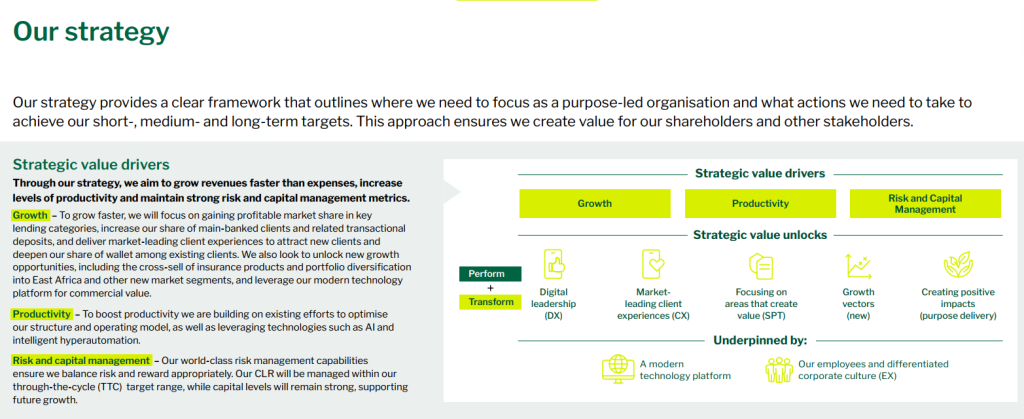
Example from Nedbank: In its 2024 Integrated Report, Nedbank (South Africa) presents three strategic value drivers: growth, productivity, and risk and capital management. The report also identifies priorities such as digital transformation, improving customer experience, and creating positive societal impact. This enables readers to understand the strategic directions Nedbank has chosen to create long-term value.
Principle 2: Connectivity of information
Financial information, ESG, strategy, governance, and risks should not be presented as isolated elements without clear connections. The report should help readers understand what resources a company uses, what activities it undertakes, and what outcomes and impacts it generates.
Example from Eskom: Eskom, South Africa’s electricity utility, uses the six capitals model to illustrate its resource inputs, including financial capital, infrastructure, natural resources, and other forms of capital. The report connects these resources to operational performance and material matters such as financial sustainability, operational stability, or recovering environmental performance and compliance.
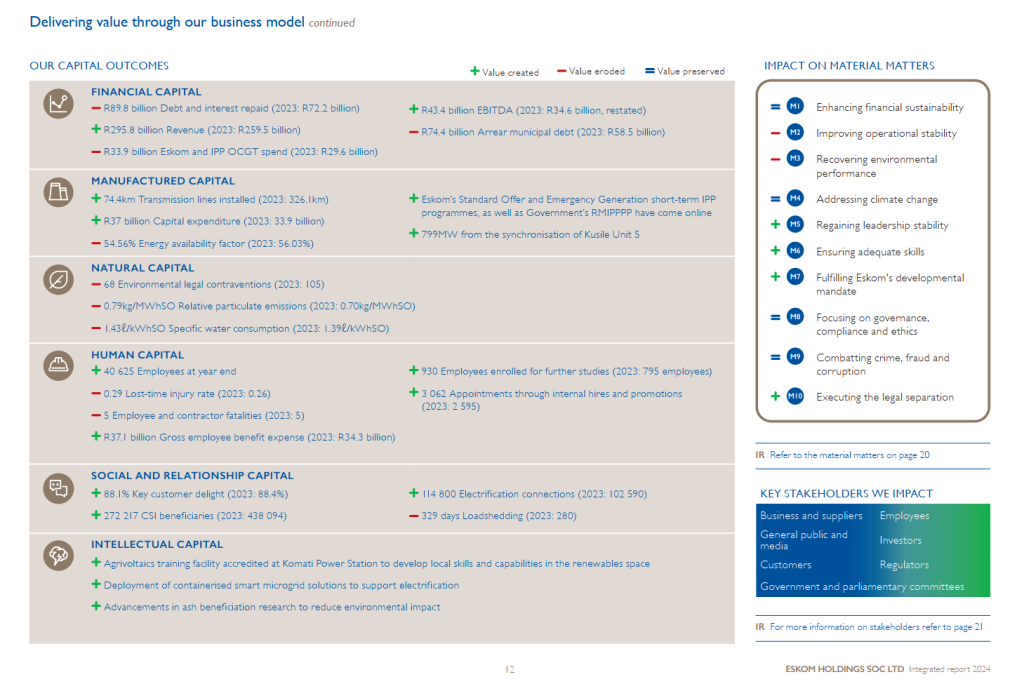
This approach helps readers understand the relationships between business activities, capital utilization, and the company’s ability to create value. An integrated report should also reflect trade-offs. For example, investment in employee training may increase costs in the short term but enhance workforce capabilities and the potential for future value creation.
Principle 3: Stakeholder relationships
A company’s activities are closely connected to its employees, customers, shareholders, suppliers, communities, and other stakeholders. Therefore, the report should explain what matters to key stakeholders and how the company listens to, considers, and responds to their legitimate needs and interests.
Example from Nedbank: Its 2024 Integrated Report separately addresses five stakeholder groups: employees, clients, shareholders, regulators, and society.
For employees, Nedbank discloses key concerns such as the working environment, remuneration, and career development opportunities. The bank also presents survey results, employee support initiatives, and assessments of the quality of its employee relationships.
Notably, Nedbank goes beyond listing engagement activities by demonstrating how it monitors and evaluates stakeholder relationships.
Further reading: Stakeholder engagement: A key element in ESG materiality assessment
Principle 4: Materiality
Not every piece of information about a company needs to be included in an integrated report. Companies should focus on matters that substantively affect their ability to create, preserve, or erode value over the short, medium, and long term.
For example, for a manufacturing company, fluctuations in raw material prices, occupational safety, compliance with environmental requirements, and changes in market demand may constitute material matters.
The report should explain how the company identifies, assesses, and prioritizes these matters, rather than including all information simply because data is available.
Principle 5: Conciseness
A good report does not necessarily need to be lengthy or contain extensive amounts of data.
Instead of describing every activity, companies should focus on material information, using clear language, appropriate charts, and relevant performance indicators. More detailed information can be cross-referenced to financial statements, sustainability reports, or other documents.
However, being concise does not mean omitting important information. The report must still provide sufficient context for readers to understand the company’s strategy, performance, and prospects without having to piece together information from multiple documents.
Principle 6: Reliability and completeness
An integrated report is not merely a document for showcasing achievements.
Companies should disclose all material matters, including positive and negative outcomes, limitations, and ongoing challenges. Information should be presented in a balanced manner, free from material errors, and supported by verifiable evidence.
Example from Eskom: Its 2024 Integrated Report discloses that the energy availability factor of its power plants declined from 56.03% in 2023 to 54.56% in 2024, falling short of the 65% target.
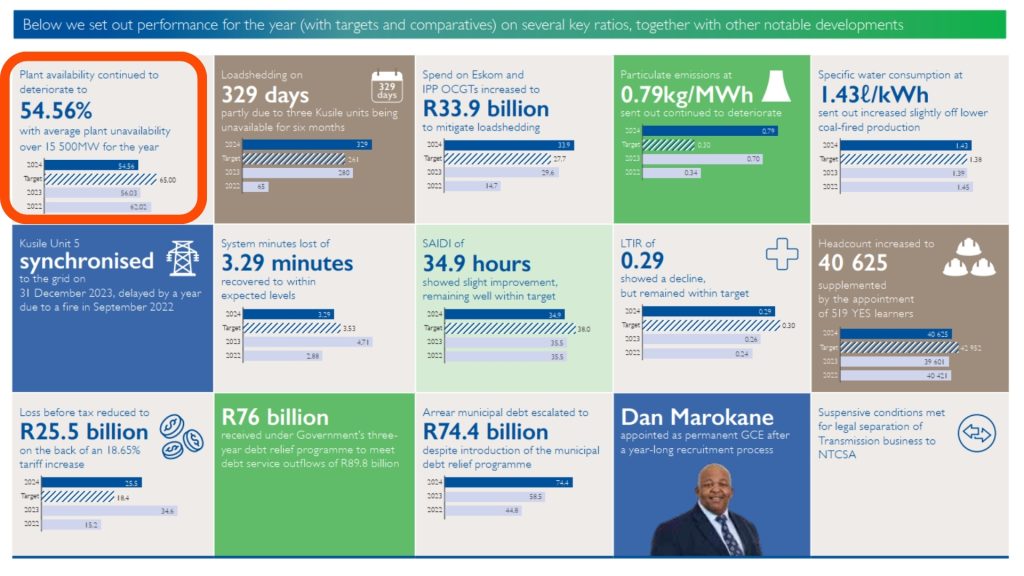
Disclosing underperformance alongside achievements provides investors with a more realistic and balanced view of a company’s operations. In addition, accountability at the governance level, internal control systems, and assurance activities contribute to enhancing the reliability of the report.
Principle 7: Consistency and comparability
Information should be presented consistently across reporting periods, enabling readers to assess whether a company’s performance is improving or deteriorating. For example, when disclosing greenhouse gas emissions, companies should maintain consistent calculation methodologies and reporting boundaries, while explaining any significant changes.
Example from Eskom: Its 2024 Integrated Report compares several operational and environmental indicators against 2022 and 2023 results and 2024 targets, allowing readers to track trends rather than focusing on isolated figures.
As a result, readers can assess not only a single year’s performance but also trends and the extent to which targets have been achieved. Where appropriate, information should also be presented in a way that enables comparisons with other companies.
Where should companies start to effectively apply the 7 guiding principles?
To effectively apply the 7 guiding principles, companies can begin with three steps:
- Define the value creation story: Clarify how the company creates value through its business model and the resources and relationships on which it depends.
- Connect material information: Establish clear links between the business context, strategy, risks, opportunities, resource allocation, performance indicators, and results.
- Ensure information quality: Prioritize material matters, provide balanced disclosures of both positive and negative outcomes, and use consistent, verifiable data.
An effective integrated report is not simply a combination of financial statements and a sustainability report. Its purpose is to provide readers with a holistic view of how a company operates, uses its resources, manages factors affecting value, and prepares for the future.
By effectively applying the 7 guiding principles, companies can not only improve disclosure quality but also foster integrated thinking, strengthening the connections between strategy, risk management, resource allocation, and business performance.
References:
- IFRS Foundation, International Integrated Reporting Framework (2021).
- Eskom Holdings SOC Ltd, Integrated Report 2024.
- Nedbank Group, Integrated Report 2024.
About CGS Vietnam
CGS Vietnam Consulting Joint Stock Company provides specialized advisory services in Corporate Governance, Sustainability (ESG), Risk Management, and Internal Audit. Backed by a team of experienced professionals with deep expertise in international best practices, CGS Vietnam partners with businesses to strengthen corporate governance, enhance management capabilities, meet investor expectations, and achieve long-term sustainable growth.
Contact CGS Vietnam:
Hotline: (+84) 363 581 520 | Email: [email protected] | Website: https://cgsvietnam.com/
LinkedIn: https://www.linkedin.com/company/cgs-vietnam | Facebook: https://www.facebook.com/CGSVietnamCompany/